[Arctic Maritime Strategy] Adak's Return: How Alaskan Command Coordinates North Pacific Defense

Working across research, policy, and data-driven analysis, the Editorial Board ensures that published pieces reflect a consistent institutional perspective grounded in quantitative reasoning and long-term structural assessment.
Authored On
Modified
Adak is being assessed for intermittent military use, not a confirmed Navy reopening
ALCOM consolidates operating-location needs across commands and local stakeholders
Komatsu says better surveillance depends on relationships as much as infrastructure

This article is based on an interview conducted by The Economy with Brigadier General Matthew S. Komatsu, Deputy Commander of Alaskan Command (ALCOM), on November 9, 2026, supplemented by publicly available military, government and research sources.
Alaskan Command's Public Affairs office reviewed this article before publication for factual accuracy and attribution, provided factual clarifications, and confirmed that BG Komatsu's comments were quoted accurately and in context. This review does not imply endorsement of the article or its editorial conclusions.
The analysis and editorial judgments in this article are independently developed by The Economy and do not necessarily represent the views of any interview participant or government organization.
By October 2026, $115 million in federal defense funds had been designated for assessing and improving infrastructure at Adak Island to support possible episodic military use. That does not amount to a decision to reopen a permanent Navy base. Farther west in the Aleutian chain than Alaska's principal military installations, Adak could reduce transit times for aircraft operating over parts of the North Pacific. In 2025, Admiral Samuel Paparo, commander of what is now U.S. Pacific Command (USPACOM), endorsed restoring access. Yet a forward operating location is only part of the defense equation: the value of any additional observation would also depend on communications, sustainment and how information travels between commands. Brigadier General Matthew Komatsu described ALCOM's contribution to that process in an interview with The Economy.
Adak and the Limits of North Pacific Surveillance
During the Cold War, Navy maritime patrol aircraft operated from Adak to monitor the North Pacific and Soviet submarine activity. The Navy closed its permanent installation on the island in 1997 as its post-Cold War basing requirements changed. The surrounding geography has not changed; the strategic debate has. Re-establishing episodic access, however, is different from reconstructing the scale of the Cold War installation.
Over the last 30 years, nothing has changed about the location of Adak. What has changed is what is happening around Alaska. More attention has been drawn to the North Pacific and Alaskan approaches. Russia and China have continued to fly and send ships into these areas. This doesn't mean that the United States is blind to what is going on around Alaska. That would be a bigger statement than the available evidence supports, but it does show why having more access to the North Pacific could be beneficial.
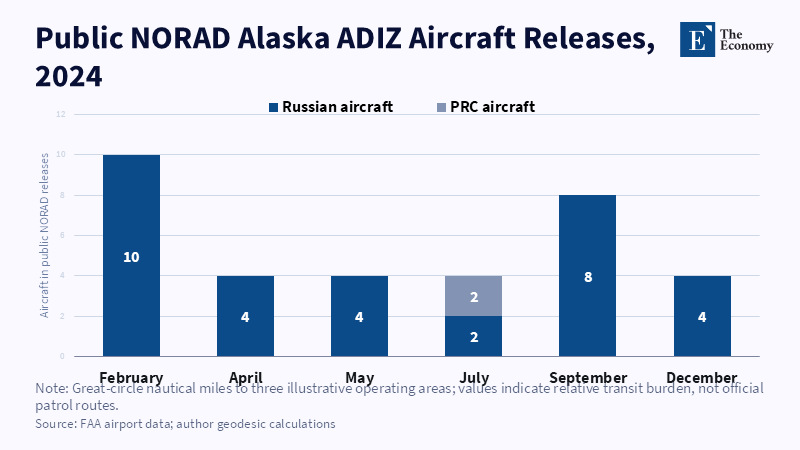
Admiral Paparo made the case in 2025 that reopening Adak could provide up to ten times the maritime patrol and reconnaissance aircraft coverage over a contested area of the ocean. These numbers can be helpful, but several questions remain. How often would aircraft fly from Adak? How many aircraft would be available? Would they have the proper maintenance? Could the island be supplied with fuel and other necessities? Simply having a runway does not provide more eyes in the sky over the North Pacific. If range from Adak increases, how will that information be used to better defend the North Pacific?
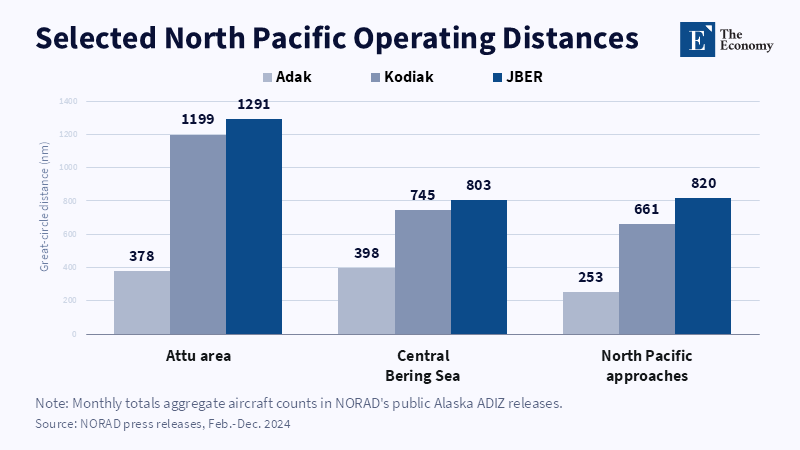
Adak Could Be Used for Episodic Deployments
The $115 million funding supports assessments and potential work involving Adak's electrical grid, airport and surveys of nearby bays for residual munitions. According to KUCB's October 2026 reporting, the Denali Commission is administering the funding in stages, with approximately $12.5 million awarded as of that report. Preparations are intended to make episodic military operations possible while also supporting the island's civilian infrastructure. Neither a permanent military garrison nor a full Navy restoration had been authorized.
Komatsu emphasized that possible operating locations outside Alaska's established federal military installations have varied ownership and community interests, including Alaska Native and state stakeholders. ALCOM considers how potential defense investments might also serve the people who use these facilities year-round. In this framework, dual-use infrastructure is not an afterthought: a military requirement is weighed alongside the day-to-day needs of the local community.
Coordinating Across Existing Command Authorities
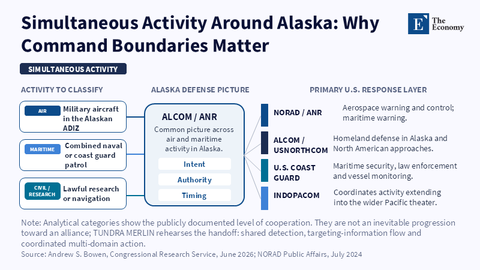
The problem becomes more complex when the separate authorities of the Navy, ALCOM, NORAD, Eleventh Air Force and Coast Guard are considered. ALCOM is a sub-unified command within NORTHCOM, while Pacific Fleet and Eleventh Air Force activities involve USPACOM-related chains of command; NORAD has a binational aerospace-defense and maritime-warning mission. These overlapping interests do not imply a failure of coordination, but they make it necessary to identify which authority applies to each activity and who needs the resulting information.
Consider a hypothetical Navy aircraft operating from Adak that identifies an unfamiliar vessel. The Pacific Fleet may need the track for maritime planning; the Coast Guard may have an interest in the vessel's activities; ALCOM may need the information to synchronize homeland defense; and NORAD's maritime-warning mission may also require awareness. These organizations do not necessarily exercise authority over the same forces. What matters is whether the relevant information reaches the right decision-makers under the appropriate authorities.
Table 1: Illustrative Command Interests in Potential Adak-Generated Information (editorial analysis; not an ALCOM operating plan)
| Organization | Parent Command | Role in the North Pacific | What It Would Need from Adak Data |
|---|---|---|---|
| U.S. Pacific Fleet | USPACOM | Naval forces and maritime patrol aircraft | Ship and submarine tracks relevant to Pacific operations |
| Alaskan Command | NORTHCOM, as a sub-unified command | Synchronizes homeland defense in the Alaska theater without assigned forces | A shared picture to coordinate responses across services |
| Alaskan NORAD Region | NORAD, binational U.S.-Canada command | Aerospace warning and control, maritime warning | Early warning of approaching aircraft and vessels |
| 11th Air Force | Pacific Air Forces, under USPACOM | Fighters, tankers and air support in Alaska | Target and weather data for missions from remote fields |
| Coast Guard Arctic District | Coast Guard chain of command | Law enforcement, search and rescue, most persistent maritime presence | Vessel identification and activity inside the EEZ |
Additional sensing and patrol opportunities would be most useful when they feed existing information-sharing and planning arrangements. Komatsu described ALCOM as a homeland-defense synchronizer positioned near the NORTHCOM-USPACOM boundary, not as a new owner of the Navy's assets. The interview provides a reason to examine this coordination more closely, but not evidence that Adak-generated information is currently being lost or mishandled.
ALCOM Sets Out the Options; Other Authorities Decide
During the November 9 interview, Komatsu compared ALCOM's work on prospective operating locations to "building a menu and kind of bringing the menu forward for other people to spend their money on." He explained that ALCOM gathers perspectives from NORTHCOM, USPACOM, the military services, state agencies and local stakeholders to determine how sites might be used. Adak, he said, is "probably the flashiest one," but it is only one of multiple possible locations. His remarks did not announce a basing decision or a new Navy deployment schedule.
Komatsu stressed that investment should support local communities, whose members are likely to remain the principal day-to-day users of these locations. ALCOM would generally not take responsibility for operating the facilities. Decisions on higher-level funding and development sit above ALCOM; its job is to provide current defense-planning information. Questions about whether, when and how naval aircraft might use Adak therefore remain primarily for the Navy, USPACOM and the relevant defense authorities.
Asked whether better surveillance or better coordination was the greater need, Komatsu answered, "the answer is yes. We need it all." He described a vast theater where extreme weather, sparse roads and difficult communications make routine operations unusually demanding. He also explained that relationships with the Coast Guard and Royal Canadian Navy have expanded ALCOM's maritime domain awareness: their regular presence provides the command with its most persistent maritime picture. In other words, more cooperation has already meant more usable surveillance without first requiring a new base.
ALCOM has no assigned or allocated forces, Komatsu explained, so its coordinating mission relies on units and partner organizations already operating in the Alaska Theater of Operations. He offered practical evidence that this approach is becoming more institutionalized. The U.S. Coast Guard Arctic District has committed to maintaining a permanent liaison at ALCOM headquarters, while Canadian Armed Forces placed a senior O-6 officer there in 2026 to coordinate their contribution. ALCOM does not thereby acquire operational command over Coast Guard or Canadian forces; rather, permanent channels make collaboration easier.
Captain Kitsana R. Dounglomchan, ALCOM's public affairs director, subsequently confirmed that the entire combined headquarters (CHQ) has 466 personnel across the Alaskan NORAD Region (ANR), ALCOM, Eleventh Air Force, PRSC and the 611th Air Operations Center (611th AOC). Within that wider headquarters, one three-star commander holds the distinct ANR, ALCOM and Eleventh Air Force command responsibilities. Staff working across those three missions have been encouraged to break down organizational barriers, leading Komatsu to describe an approach where "kind of everybody does everything." That phrase concerns collaboration, not interchangeable legal powers: senior officers still determine which of the three mission authorities authorizes a given action, an exercise Komatsu said is examined "at sort of a forensic level." The distinction matters when considering how any future Adak activities could contribute to homeland defense.
An Adak Outpost Would Add Reach, Not Replace Coordination
A stronger case for access to Adak still needs to be tested against costs, operational reliability and alternatives. Satellites and existing aircraft already collect information over the North Pacific, while the island's remote location and weather complicate maintenance and resupply. Earlier analysis in this series highlighted an American icebreaker shortfall, which an airfield cannot resolve. These considerations do not refute a case for Adak; they show why basing and surveillance should be evaluated as parts of a wider defense network.
Extra patrol coverage would be valuable only to the extent that it can be sustained and incorporated into a wider operational picture. The November interview suggests ALCOM is approaching the issue through a network of partnerships and command authorities rather than a single installation-centered solution. No public evidence in the interview establishes that today's surveillance data cannot be shared, so the relevant future question is how Adak, if used, would improve the network already in place.
The interview does not answer whether restoring access to Adak would justify its full cost. It does show that ALCOM has strengthened maritime awareness through relationships with forces already present in the theater, and that training exercises have prompted practical changes in liaison and headquarters coordination. A future operating location could add useful reach to that network, but the value would depend on actual operating patterns, infrastructure readiness and how the resulting information is shared.
The remaining basing questions belong principally to the Navy and the authorities making investment decisions: how many aircraft would operate from Adak, how frequently, with what support and under whose tasking arrangements? Komatsu offered neither a schedule nor a commitment on those points. His account instead makes clear what ALCOM can contribute before any such decision: a consolidated account of defense needs, interagency requirements and potential benefits to the communities that would continue to use the site.
This article was independently prepared by The Economy Review following an interview with Brigadier General Matthew S. Komatsu of Alaskan Command.
Statements attributed to Brigadier General Komatsu reflect his interview remarks, reviewed by Alaskan Command's Public Affairs office for accuracy and context. Other analysis, interpretations and conclusions are The Economy's own and should not be construed as official positions of ALCOM, U.S. Northern Command, the Department of Defense, the Canadian Armed Forces or any other institution.
Alaskan Command's Public Affairs office completed a pre-publication review for factual accuracy and attribution. Such review does not constitute institutional endorsement of the article, its conclusions or any subsequent use by third parties.
Identification of military organizations, individuals and institutions does not imply sponsorship, partnership or endorsement.
References
Alaska News (2026) ‘Navy eyes return to Adak amid Arctic security concerns’, 10 May. Alaska News
Alaska News (2026) ‘JASC-260508-0800’, Joint Armed Services Committee transcript, 8 May. Alaska News
Stuart-Rasi, S. (2026) ‘Adak’s $115 million upgrade begins, but military return not guaranteed’, KUCB, 19 October. KUCB
Sullivan, D. (2025) ‘INDOPACOM Commander recommends reopening Adak Naval Base in Alaska’, Office of U.S. Senator Dan Sullivan, 11 April. Senator Dan Sullivan
Sullivan, D. (2025) ‘NORTHCOM Commander recommends reopening Adak Base, bolstering homeland missile defense’, Office of U.S. Senator Dan Sullivan, 14 February.
Working across research, policy, and data-driven analysis, the Editorial Board ensures that published pieces reflect a consistent institutional perspective grounded in quantitative reasoning and long-term structural assessment.