The Shrinking Safe Haven: What Repo's Rise Reveals About Confidence in Long-Term U.S. Debt

Working across research, policy, and data-driven analysis, the Editorial Board ensures that published pieces reflect a consistent institutional perspective grounded in quantitative reasoning and long-term structural assessment.
Authored On
Modified
Repo's convenience premium holds while Treasuries lose theirs
Fiscal supply, dealer constraints and volatility complicate attribution
Dollar demand persists, increasingly through shorter-term instruments

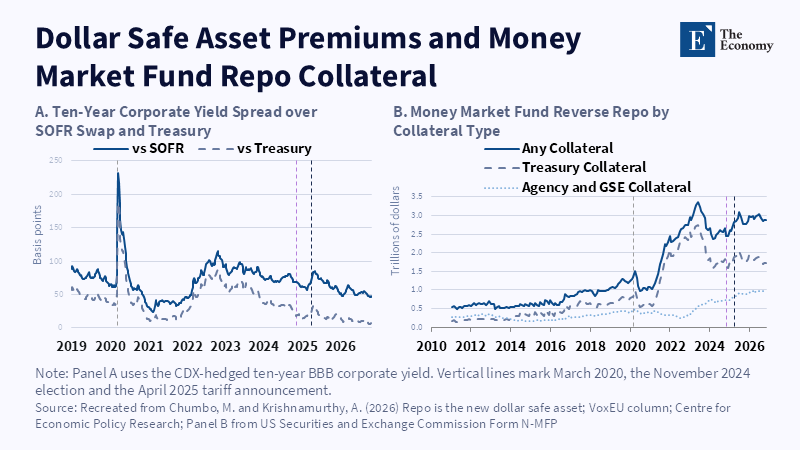
The convenience yield investors accept for holding the ten-year U.S. Treasury has fallen from approximately 60 basis points to around 10 basis points from 2023 to October 2026. The premium on repo has remained near 90 basis points over the same period. As measured by academics at Stanford University, the difference between these two is now about 40 basis points. Repurchase agreements are predominantly backed by U.S. Treasuries, so it's not unreasonable to expect these two numbers to be closer together. The bond market has weighed in on this too. The 30-year Treasury has traded above 5.6% on 29 September, its highest level since June 2002. A model from the Federal Reserve Board estimated the 10-year term premium to be around 1.07% as of 9th October. These are not questions of repayment, but rather of what terms investors are willing to accept to hold long-dated U.S. debt. Investors still want to hold dollar liquidity but are asking to be compensated for extending it out past the next few years.
Repo vs Long-Dated U.S. Treasuries
The convenience yield is the return investors give up in exchange for an asset’s safety and liquidity. The paper published on the National Bureau of Economic Research website as a working paper tries to measure this yield by looking at the spread on a 10-year BBB corporate bond (hedged for credit risk) against two benchmarks: the 10-year U.S. Treasury and the 10-year swap, which is a proxy for the SOFR or overnight repo rate. The 10-year BBB corporate bond hedged for credit is relatively safe but illiquid; therefore, the additional yield it carries represents the liquidity and collateral premium that investors receive for holding these other assets. This value has remained near 90 basis points when compared to swaps, broadly unchanged since 2019. When compared to the 10-year U.S. Treasury, it has almost disappeared. So while the desire to hold dollar safe assets hasn't disappeared, it appears that they are no longer at the top of the list.
Money market fund filings show a similar pattern. Funds have reduced the amount of U.S. Treasuries held in their repo agreements since 2023 in favour of agency and GSE collateral. Within the U.S. Treasury collateral held by these funds, there has been an increase in paper with maturities of 1-5 years and a decline in longer-dated securities. Overnight lenders can reclaim their cash the next day with minimal exposure to changes in ten-year Treasury yields. Treasury holders, by contrast, face those price changes. For investors seeking dollar liquidity, repo therefore avoids much of the exposure to long-dated U.S. Treasuries. Once again, this isn't a question of solvency. Long-dated U.S. Treasuries are still a good credit, just not as good as they have been in the past when investors viewed them as being close to cash.
Higher Debt Issuance Reduces the Appeal of U.S. Treasuries
According to the Committee for a Responsible Federal Budget, the U.S. ran a deficit of $2.0 trillion in 2026, or 6.2% of GDP. U.S. Debt held by the public is currently $32.3 trillion, with interest payments at $1.1 trillion or 3.4% of GDP. This is higher than both defence spending and Medicare. The Congressional Budget Office forecasts U.S. Debt to reach 120% of GDP by 2036. This is up from 101% of GDP this year. Any buyer of a 30-year U.S. Treasury takes on these risks, along with three decades of inflation and policy uncertainty that overnight lenders can largely avoid.
The authors of the paper believe that this has caused the supply of safe dollar assets to decline. U.S. Treasuries held by the public have increased by over $10 trillion since 2019. But if longer-dated Treasuries are no longer treated as safe assets, the focus shifts to bills and overnight reverse repo, which, according to the authors, amounted to around 20% of GDP in mid-2025, compared with 70% of GDP in Treasuries in 2019. The authors state that this number likely overstates the decline and that they cannot prove this hypothesis with the data at hand. However, the St. Louis Federal Reserve also noticed a decrease in Treasury yields in February of this year and attributed it to QT, higher bond issuance and concerns around U.S. fiscal policy. They believed this to be consistent with the bond vigilante hypothesis.
The type of investor holding these assets is also becoming a factor. Federal Reserve Board staff have stated that the U.S. Treasury market has become more price-sensitive as foreign official investors have decreased and private sector investors have increased. An additional $100bn in U.S. Treasury issuance has been found to increase the 5-year yield by around 3bps. State Street believes that the official sector has decreased to 43% of foreign holdings of U.S. Treasuries in 2025 from 59% in 2020. These foreign officials will continue to buy these assets as they are looking to hold dollar liquidity. Private sector investors will view U.S. Treasuries like any other asset they can purchase and will only hold them if they can receive an appropriate return, which means that as more of these investors enter the market, the U.S. will have to provide higher interest rates to attract them. This suggests growing concern about the compensation for holding long-term U.S. debt, rather than about access to short-term dollar liquidity.
Balance Sheets and Volatility May Play a Role
There are other factors that could contribute to this decline. As noted above, swaps require less dealer balance-sheet capacity than Treasuries funded through repo. So some of this spread could be attributed to dealers needing to hold these bonds on their balance sheet. The authors of the paper create a trade that would be long the 10-year U.S. Treasury, fund it with repo and short a 10-year swap. The carry on this trade is around 40bps on average, which they believe to be an upper bound on this cost. With the current spread being around 44bps on average, it could very well be that this is the majority of the spread, although the comparison mixes an average with a current reading. Also, as mentioned in the paper, swap spreads have been increasing, which means that this trade may not have a constant cost.
The numbers from the St. Louis Federal Reserve provide another point to consider. Their convenience-yield calculations were negative for the US, Germany, Japan and the UK at the end of 2025 between 20-60bps below zero. It would be difficult to blame the decline in U.S. convenience yields solely on one country's ministry of finance if this is a global trend.
Volatility in interest rates can also have an effect on this number. Over the past decade, the U.S. Treasury market has not seen much volatility in long-dated rates, with the Federal Reserve keeping rates at the zero lower bound and providing guidance that it would keep them there for a period of time. This changed during the 2022 inflation surge and volatility has returned this year. The Federal Open Market Committee voted unanimously to increase interest rates by 25bps in September. The ICE BofA MOVE index increased by nearly 30% during the month. Such volatility reduces the asset's appeal as collateral.
These factors may explain part of the premium's decline, but not necessarily all of it. If the issue is just that banks cannot warehouse these bonds, then it doesn't explain why money market funds are using fewer of them as collateral. It also doesn't explain why the same trend appears in other countries. If a bank faces the same cost to hold U.S. Treasuries and German Bunds, that balance-sheet cost cancels out when currency-swapped. The U.S. ten-year yield remains higher than the currency-swapped German Bund yield, although collateral scarcity in the euro area may contribute to the gap.
The Dollar Still Holds Up
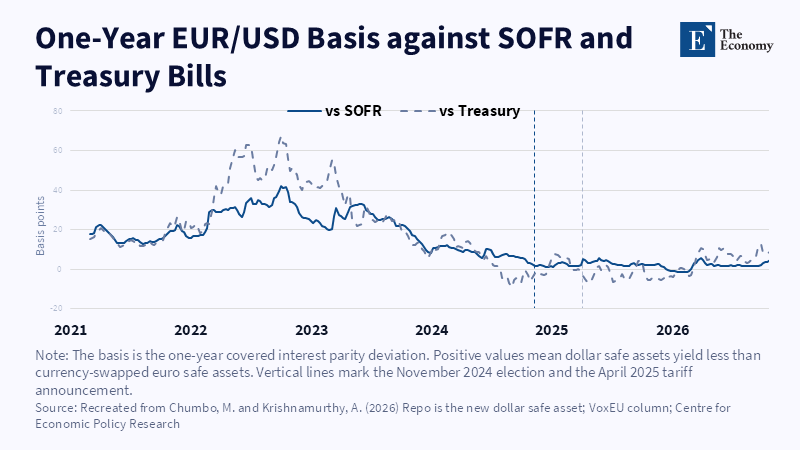
A similar pattern appears in the Treasury premium over other countries' currencies. From 1988 to 2025, the 1-year U.S. Treasury has had a premium of 22bps on average when compared to other G10 countries' currency-swapped bonds. When compared to the Euro, this was anywhere from 20-60bps until mid 2023. It then dropped below zero in mid 2024 and has continued to decrease since the tariff announcement in April 2025. As of October 2026, it has recovered to around 8bps. The equivalent repo measure has held up slightly better but is also in single digits. The paper concludes that the global safe-asset role of U.S. assets is at its weakest in 30 years. Investors still want dollar liquidity, as shown by money market funds' repo holdings, but may be less willing to hold long-dated U.S. debt to obtain it.
According to the IMF, the U.S. dollar accounted for 56.70% of global reserves in Q2 2026, down from 57.18% in Q1. While the U.S. did not see a large change in its claims, the Euro increased by close to $100bn. This increase was mostly driven by active purchases and the exchange rate did not move enough to drive this change. It may be too early to say that this is a trend, but the U.S. Dollar has only been below 56.3% in the first half of 2025. So it could be the beginning of something. Nevertheless, repo remains a dollar-safe asset and a large share of this market is cross-border. The Office of Financial Research states that cross-border transactions make up about a third of the $13trillion U.S. Repo market. Investors therefore appear to favour this market without holding as much long-dated U.S. debt.
As U.S. Treasuries become less of a safe asset, the government will have to provide higher interest rates to attract buyers. The U.S. Treasury has also increased its long-end buybacks to support market liquidity. They have announced that they will continue to have regular auction sizes for the next few quarters. This will allow bills and cash management bills to fluctuate as needed. They also doubled the amount of buybacks they are doing on the long end to $4bn in August, with some buybacks going up to $6bn. These measures may ease long-end pressure while leaving more borrowing exposed to short-term rates, which the Federal Open Market Committee has been raising. The Congressional Budget Office projects ten-year yields of 4.1% in 2026 and 4.4% from 2031, compared with market yields above 5% this autumn.
If investors continue to move away from long-dated U.S. debt, then the U.S. will have a hard time financing its deficit. A continued shift in foreign demand could force the U.S. to offer higher rates to attract buyers. This could lead to higher inflation and less growth, which will only compound the problem. The share of this decline attributable to U.S. fiscal policy, dealer balance sheets and volatility remains uncertain. But one thing is certain. The U.S. will have to pay more to finance its debt. And that bill is already coming due at $1.1 trillion in interest payments this year.
The views expressed in this article are those of the author and do not necessarily reflect the views of The Economy, its Editorial Board, or any affiliated institution.
References
Beltran, D. and Li, C. (2026) Estimating Yield Impacts of Treasury Demand and Supply Changes. International Finance Discussion Papers 1447. Washington, DC: Board of Governors of the Federal Reserve System.
Chien, Y. and Bloodworth II, K. (2026) 'The Declining Convenience Yield and Quantitative Tightening', St. Louis Fed On the Economy, 27 February.
Chumbo, M. and Krishnamurthy, A. (2026) 'Repo is the new dollar safe asset', VoxEU. London: Centre for Economic Policy Research.
Committee for a Responsible Federal Budget (2026) 'U.S. Ran a $2 Trillion Deficit Last Year, We Estimate', 1 October.
Congressional Budget Office (2026) The Budget and Economic Outlook: 2026 to 2036. Washington, DC: Congressional Budget Office.
Friedrichs, M., Garriott, C. and Mann, R. (2026) 'Sizing the U.S. Cross-Border Repo Market', The OFR Blog 26-07. Washington, DC: Office of Financial Research.
Krishnamurthy, A. and Chumbo, M. (2026) Disappearing Dollar Convenience? NBER Working Paper 35742. Cambridge, MA: National Bureau of Economic Research.
Mola, S. (2026) 'De-dollarization gets the headlines. Treasury demand tells the story', Mind on the Market, 1 October. Boston: State Street Investment Management.
Nephew, E., Wei, H. and Gweder, A. (2026) 'World Official Foreign Currency Reserves Increased Slightly in the Second Quarter of 2026', IMF Data Brief, 30 September.
Smith, B. (2026) Quarterly Refunding Statement of Deputy Assistant Secretary for Federal Finance Brian Smith, 5 August. Washington, DC: US Department of the Treasury.
Working across research, policy, and data-driven analysis, the Editorial Board ensures that published pieces reflect a consistent institutional perspective grounded in quantitative reasoning and long-term structural assessment.