Stablecoin Adoption at the Periphery: Why Local Appeal Has Yet to Reshape Global Finance

Working across research, policy, and data-driven analysis, the Editorial Board ensures that published pieces reflect a consistent institutional perspective grounded in quantitative reasoning and long-term structural assessment.
Authored On
Modified
Stablecoins address local financial weaknesses, particularly in emerging economies
Most activity redistributes existing dollars rather than creating output
Their global macroeconomic impact remains limited despite growing adoption

Blockchain data shows annual transactions of up to $35 trillion flowing through stablecoins. That number could make the argument for the death of correspondent banking. After McKinsey and Artemis Analytics stripped out trading, wallet transfers and automated smart-contract activity, there was about $390 billion that could be classified as payments, annualized from December 2025. That is 1.1% of the initial figure and around 0.02% of global payments. There is no doubt that people are using stablecoins to their advantage. Whether that translates into global adoption is another question. People in Buenos Aires have different needs than people in Ohio. What they need locally hasn't yet changed global financial infrastructure. Most stablecoins just convert from one financial intermediary to the next. Changing how money flows through the banking system doesn't mean output is growing.
How Stablecoin Adoption Impacts the U.S. Economy
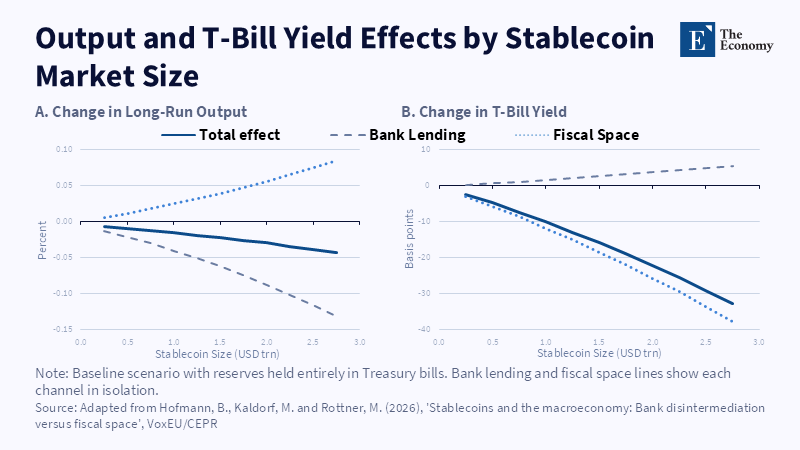
Researchers from the BIS and Bundesbank have attempted to measure both sides of this argument quantitatively and apply it to the U.S., which isn't done often in stablecoin research. One is how stablecoins affect banks and the other is how they affect governments. If a household decides to move from bank deposits to stablecoins, it puts pressure on banks to increase interest rates on loans, meaning less credit can be issued. The other side is that stablecoin issuers are buying Treasury bills. This allows the government to decrease tax rates or spend more. One can increase output and the other can decrease it, depending on what percentage of people use stablecoins and who is using them.
The model uses $2 trillion in stablecoin adoption (about six times the roughly $306 billion market recorded by DeFiLlama in October 2026). Treasury bill yields decrease by almost 25 basis points. Bank deposit rates increase by around 4 basis points and long-run GDP declines by 0.03%. At first glance, this seems odd, but it all comes down to offsetting factors. People will move some of their funds from cash to stablecoins. Banks will sell Treasury bills to issuers, helping offset deposit losses. Companies will use more equity and the government will have less long-term debt. In the model, stablecoins will only make up about 5% of household liquid assets at $3 trillion. This shows how stablecoins can have a huge impact on the balance sheet and not really change the economy.
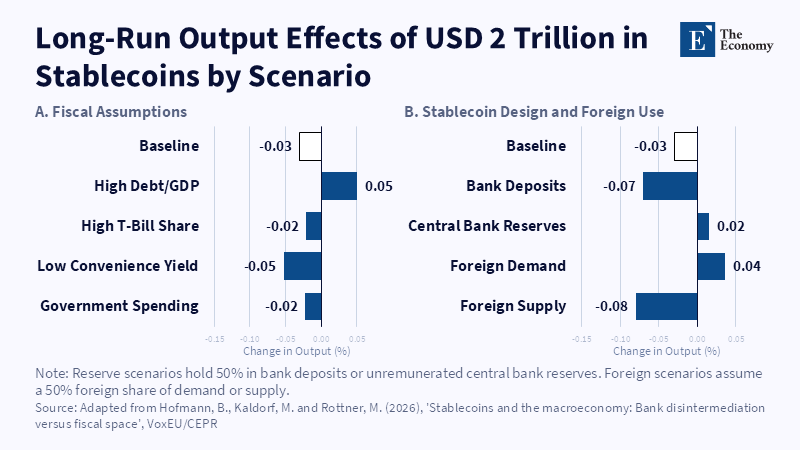
A 0.03% decline shouldn't be taken to mean no change in the economy. In their model, GDP increases by about .3% over the first three years due to cheaper government debt. They also find that if they include people preferring to hold liquid assets, welfare improves. If rules require stablecoin issuers to keep 50% of their reserves in bank deposits, GDP decreases by almost 0.07%. And if rules allow them to hold 50% of their reserves in non-interest-bearing central bank reserves, GDP increases by about 0.02%. Again, all these numbers are below 0.1% in the long run, which is odd given how much these can be touted as changing the financial system but the model's numbers are based on assumptions.
Why Stablecoins Won't Change How the Average American Saves
One of these assumptions is that Americans will want to use stablecoins. Currently, there aren't many reasons for an American to move their money to a stablecoin. If someone takes $1,000 out of a bank account and converts it to USDC, they still have the same currency. There is no increase in diversification and if something happens, the holder has less protection than if the money stayed in the bank. The GENIUS Act that was signed in July 2025 does not allow issuers to pay interest on stablecoins. This removes another reason to move to stablecoins. Americans have plenty of ways to send money domestically already: Zelle, FedNow and debit cards. The estimated $4.5 billion in stablecoin-linked card payments in 2025, according to McKinsey, involved converting stablecoins into normal money at the point of sale. So right now, stablecoin payments are just going through the same card networks used today.
Some may argue that interest is something that can change the dynamic. The Congressional Research Service stated that the law does not explicitly ban exchanges from paying rewards on stablecoins in March 2026. Many exchanges do pay interest on their stablecoins. This could drive more people to move away from their bank accounts. This could lead to banks being more willing to pay for their deposits, which is probably why there has been so much back and forth with the Senate bill regarding market structure. But if exchanges start offering a market rate of interest, they are basically becoming money market funds, which already exist. Another thing to consider is that FDIC-insured banks held around $20.55 trillion in total deposits in March 2026. Stablecoins are about 1.5% of that. And USDT, which is about 60% of the stablecoin market, is mostly used in developing countries. Banks will need to find ways to keep their customers, as shown by how much interest rates move. This is one factor that will affect the $6.6 trillion of transactions identified as potentially at risk by a Treasury advisory body.
Stablecoins in Developing Countries
In Buenos Aires, $1,000 means something different. According to INDEC, consumer prices increased by 211.4% and 117.8% in 2023 and 2024, respectively. Citizens were also restricted in how much money they could spend. Chainalysis found that 61.8% of retail-sized crypto volume in Argentina involved stablecoins from July 2023 to June 2024. This compared to 44.7% worldwide. Similar things happened in Nigeria when the Naira dropped to an all-time low in February 2024, with stablecoin transfers under $1 million coming in at nearly $3 billion. Sending money internationally is also expensive; the World Bank found it cost an average of 8.46% to send $200 to Sub-Saharan Africa in Q3 2025, while the world average was 6.36%. People in these countries have a use for stablecoins that may not be available to them locally.
An IMF paper looked at stablecoin adoption around the world. It found that in 2024 North America led all other regions with $633 billion in stablecoin flows. Asia and the Pacific came in second at $519 billion. When these numbers are compared to GDP, Latin America and the Caribbean were the highest at 7.7%, with Africa and the Middle East at 6.7%. Only 12% to 14% of flows originating in those regions stayed within those regions. North America kept 34% of its flow within the region. Stablecoin usage can be low-ticket; the median transfer in Latin America was $51. These figures are modeled by classifying wallets and have about 65% accuracy. But this follows the Chainalysis data that the paper used for comparison.
These two regions that use the most stablecoins as a % of GDP only produce about 10% of world output. Taking the IMF numbers and applying them to GDP for Latin America produces around $376 billion while McKinsey showed that less than $1 billion was sent from Latin America and about the same from Africa. There could be some definition issues with the IMF counting all types of stablecoin movement and McKinsey trying to isolate payments. But the data suggests that some of these stablecoins are being used for savings and moving dollars. How much is used for what is still unknown. Argentina has eased its exchange controls since April 11, 2025 and inflation has slowed to 31.5%. Bitso reported that 71% of its Argentine customers' purchases were made with stablecoins in 2025. With the peso down 41%, it remains to be seen if that usage declines. But the central bank will be watching closely.
Stablecoins in Other Countries
Having other countries hold stablecoins can benefit the U.S. When the BIS and Bundesbank modeled half of the stablecoin market outside the U.S., they found a 0.04% increase in long-run output. This is because the issuers are still buying Treasury bills, but U.S. bank deposits haven't moved. The IMF paper found that net stablecoin outflows from North America were $54 billion in 2024 and increased when the dollar appreciated. Tether holds $132.4 billion in direct and indirect Treasury bills as of the end of September 2026 with about $184 billion in circulation. The BIS found that $3.5 billion in stablecoin inflows lowered three-month bill yields by 2.5-3.5 basis points and by 5- 8 basis points when bills are in short supply.
This assumes that stablecoins create new dollar demand rather than replace dollars already held. If someone in Argentina decides to take dollars held at home and convert them to USDT, that replaces a Federal Reserve liability, backed mostly by government debt, with a Tether liability backed by Treasury bills. So the impact on U.S. debt may not be as large as expected, while the income that comes from that money will go to Tether. If someone moves their dollars out of a local bank account, that bank will have to find more funding or decrease lending. New dollar demand appears when someone who couldn't access dollars before now can. The IMF paper also states that the flows offsetting stablecoins being moved are unknown. So it is not known if these numbers are increasing dollar demand or just converting dollars to stablecoins, leaving the U.S. Treasury with less certainty about the benefit to its borrowing costs. The BIS also found that when stablecoins leave, Treasury bill yields increase two to three times more than they decrease when stablecoins come in. So overseas stablecoin holders may be a less reliable source of Treasury funding.
Stablecoins Will Not Replace the Financial System
Stablecoins are currently replacing one aspect of the financial system. When Silicon Valley Bank, Signature Bank and Silvergate failed, stablecoin flows dropped by almost 10 standard deviations from North America compared to other regions, because stablecoin issuers and exchanges were using these banks to convert fiat money into stablecoins. Stablecoins can change the intermediary and who owns the debt that backs the currency, but that won't necessarily create new output, which is why the model's estimates are so small.
When McKinsey broke down those $390 billion in payments, 60% of that was from businesses, which increased by 733% in a year. About $245 billion was sent from Asia, mostly from Singapore, Hong Kong and Japan. Countries that are heavily banked are sending out the most stablecoin payments. Maybe it will grow. There was less than $30 billion in circulation in 2020 and circulation is now over $300 billion. Payments have also grown over 2x in a year. The U.S. Treasury Secretary thinks circulation will reach $3 trillion by 2030. If payments continue to grow at the same rate, it will take about six years to reach 1% of global payments. And based on the model, minimal output gains are expected at that mark. How much stablecoins are backed by reserves and who gets the income from that will play a bigger role in the economy. This is receiving less attention right now.
There is a big difference between $35 trillion and $390 billion. Most blockchain activity is financial and what stablecoins have done is take those dollars and put them somewhere else. There is a need that they have filled for those in certain regions. When a currency loses 41% in a year, or it takes $17 to send $200 to another country, stablecoins become more appealing. For now, stablecoins will continue to move dollars around.
The views expressed in this article are those of the author and do not necessarily reflect the views of The Economy, its Editorial Board, or any affiliated institution.
References
Ahmed, R. and Aldasoro, I. (2025) Stablecoins and safe asset prices. BIS Working Papers No. 1270, revised February 2026. Basel: Bank for International Settlements.
Bitso (2026) Panorama Cripto en América Latina 2025. Bitso.
Chainalysis (2024) The 2024 Geography of Cryptocurrency Report. New York: Chainalysis.
Congressional Research Service (2026) The Stablecoin Yield Debate. In Focus IF13174, 6 March. Washington, DC: Congressional Research Service.
DefiLlama (2026) Total stablecoins market capitalisation, 12 October.
Federal Deposit Insurance Corporation (2026) Quarterly Banking Profile: First Quarter 2026. Washington, DC: Federal Deposit Insurance Corporation.
Higginson, M., Zorrilla, A., Madden, J. and Kirchner, M. (2026) Stablecoins in payments: What the raw transaction numbers miss. McKinsey & Company, 18 February.
Hofmann, B., Kaldorf, M. and Rottner, M. (2026) The macroeconomics of stablecoins. BIS Working Papers No. 1363. Basel: Bank for International Settlements.
Instituto Nacional de Estadística y Censos (2026) Índice de precios al consumidor: diciembre de 2025. Buenos Aires: INDEC.
Reuter, M. (2025) Decrypting Crypto: How to Estimate International Stablecoin Flows. IMF Working Paper WP/25/141. Washington, DC: International Monetary Fund.
Tether (2026) Financial Figures and Reserves Report as of 30 September 2026, with assurance report by BDO. Tether.
United States Congress (2025) Guiding and Establishing National Innovation for U.S. Stablecoins Act. Public Law 119-27.
World Bank (2025) Remittance Prices Worldwide, September 2025. Washington, DC: World Bank.
Working across research, policy, and data-driven analysis, the Editorial Board ensures that published pieces reflect a consistent institutional perspective grounded in quantitative reasoning and long-term structural assessment.