Japan SME Digitalization Has to Reach the Pay Packet

Working across research, policy, and data-driven analysis, the Editorial Board ensures that published pieces reflect a consistent institutional perspective grounded in quantitative reasoning and long-term structural assessment.
Authored On
Modified
Japanese SMEs lag in productivity despite employing most workers
Digitalization improves efficiency but does not guarantee higher wages
Organisational reform must translate productivity gains into household income

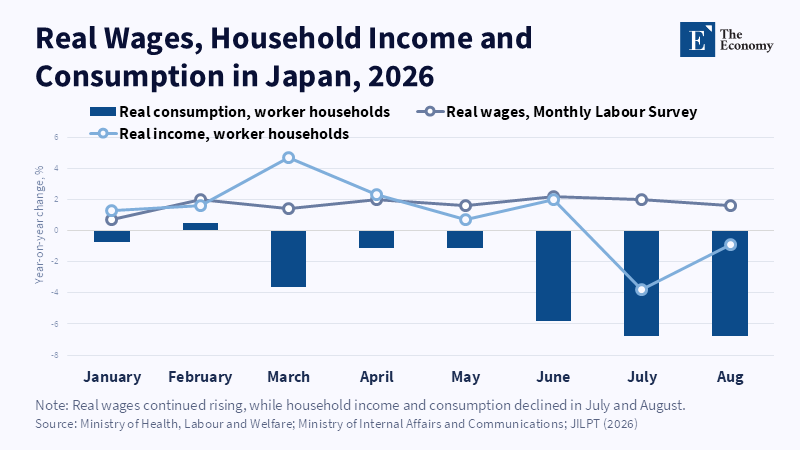
Real wages increased 1.6 percent in August 2026, according to the Ministry of Health, Labour and Welfare, marking the eighth month of growth following twelve months of decline from January 2025. Prices helped push this figure up as the rate used in the calculation of real wages decreased from 3.1 percent to 2.2 percent year on year due to falling prices of rice and subsidies on petrol, power and gas. Spring wage negotiations did not deliver to the same extent. The average increase agreed in 2026 was 5.01 percent according to Rengo and 4.69 percent for unions with under 300 members, which were aiming for at least 6 percent. Small and medium-sized enterprises employ around 70 percent of Japan's workforce, so the shortfall matters. Japan SME digitalization could help narrow the gap, but success must be judged by more than uptake rates.
Why Japan's Small Businesses Lag in Productivity
The OECD Economic Survey of Japan 2026 highlights the disparity between large companies and SMEs. SMEs account for 70 percent of employment but only 56 percent of value added. The 14-point difference points to lower output per worker. Services account for 71 percent of workers in non-agricultural SMEs, which is where the gap between small and large firms is most pronounced. Japan's larger firms have been able to maintain their technological edge and companies as a whole make up 79 percent of research spending in the country. However, SMEs only make up around 5 percent of company research, which is the lowest in the OECD. When it comes to digital adoption, the Information-technology Promotion Agency states that firms with over 1000 employees have an adoption rate of 90 percent, while those with under 100 employees stand at 30 percent. Entrenched seniority and hierarchical management also reinforce the gap, according to the OECD.
Firm creation and dissolution rates are about half those of the U.S. and zombie companies made up 14.3 percent of businesses in 2024. Around 210,000 firms could not cover interest payments from earnings for three consecutive years. This increases to 21 percent for firms with fewer than six employees. Government-backed guarantees help to keep some of these firms afloat, as 44 percent of SMEs have a guaranteed loan as of March 2025 and the guarantee rate is 80 percent. When businesses do leave the market, it's often for the wrong reasons. There were approximately 68,000 businesses that voluntarily dissolved in 2025. Only 51 percent were in the red and the average age of departing business owners was 71.5. Some viable businesses might have survived with a successor, while competitors with government-backed loans may stay afloat but be unable to increase wages.
Japan SME Digitalization Must Go Beyond Adoption
The case for digitalization is evident from demographic trends. Japan's population stood at 122.97 million in the 2025 census, 3.17 million less than in 2020. In April, the government released White Papers on SMEs stating that the current situation poses the greatest risk. They recommend implementing AI and digitalization alongside passing on price increases, increasing investment and restructuring through succession or mergers and acquisitions. Firms that have implemented these steps have seen higher value added and more efficient use of labour than those that have not, according to the Small and Medium Enterprise Agency. Hourly productivity is increasing as hours per worker decrease. With the advent of generative AI, this may become easier to implement. A recent article by the Research Institute of Economy, Trade and Industry found that the difference in adoption rates between small and large firms has not been as wide when it comes to generative AI. These tools can require less capital and preparation than earlier IT.
The OECD has found that most digitalization within SMEs replaces analog processes. Using it to increase efficiency and competitiveness has not been high due to a lack of time, skill and capital from owners. If a company uses cloud invoicing and the invoice still travels down the same chain as it would with paper, they have simply digitised a process. Other factors can also hinder change. The OECD states that one reason the hanko seal continues to be used is because of customer demand. Many SMEs will be unable to change a process that their customers are requesting. Support for small and medium businesses has not reached enough companies. Only 14 percent are aware of government support and only 25 percent of these have benefited.
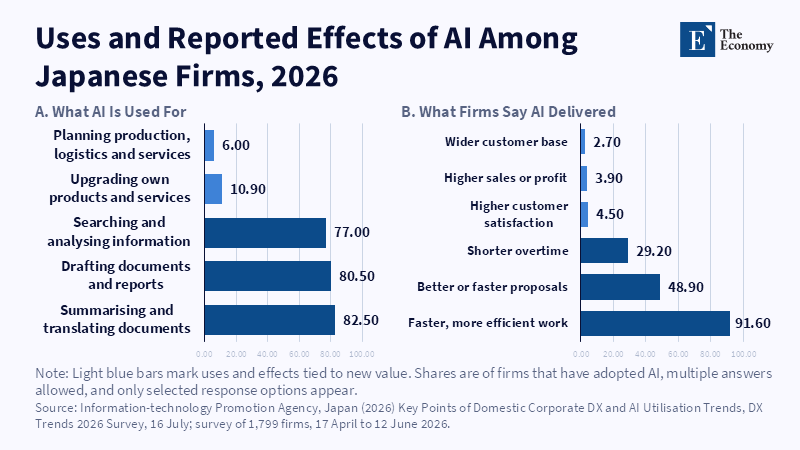
The White Papers state that firms that manage their costs more granularly have seen an increase in price pass-through. This may be where digitalization can have an impact on increasing wages. The gains may be unglamorous: detailed costing can help a firm show customers what a job costs and justify higher prices. Better cost control can create more room for wage increases. There will be many companies that cannot implement this. Japanese companies are about three times more likely than US firms to cite shortages of AI talent. Small businesses may struggle to compete for that talent with larger groups offering higher wages.
Productivity Gains Do Not Guarantee Higher Wages
A Bank of Japan working paper from August 2026 examines why productivity gains have not translated fully into higher wages. It compares the divergence between labour productivity and wages over the past 30 years to that of Western Europe. Using data from 1990 to 2024, it shows wage freezes in both directions during deflation, with stronger rigidity against increases. Around 7 percent of workers experienced upward rigidity and 4 percent experienced downward rigidity. This shows that if companies can't reduce wages, they are less likely to increase them. Companies will increase employment at a faster rate when they are more productive but if wages are fixed, then this won't be as effective.
Whether digitalization raises wages depends on other factors. If a company is able to reduce its hours through new software, it could use this to increase wages, reduce its number of staff, pay off debt or just hold more cash. Japanese companies held 57 percent of GDP in cash in 2024 compared to 16.6 percent in the US. The paper finds that, as rigidity has eased since 2020, higher trend inflation can increase the pass-through of productivity gains to wages and output per worker. Allowing more labour to move between firms will see an increase in wages, but the paper found that this can decrease the wage differential between firms and lead to a lower pass-through to productivity.
A study published in The Japanese Political Economy in 2025 looked at how digitalization may be driving wage decreases. They believe that it has increased competition between firms, led to a shortage of skilled labour and decreased wages. The gap between regular and non-regular workers is growing as well. In 2025 regular workers earned, on average, ¥5.59 million (approximately $35,300) and non-regular workers earned ¥2.10 million (approximately $13,300). If a company can implement new software, it may be able to pay its employees with the skill set to run it more. But they may also see a decrease in other positions that are able to fill full-time roles such as reconciliations and data entry. This will see wages increase for those who have the skills and remain the same for those who don't. Regional panels recommended a national weighted-average minimum wage of ¥1,177 ($7.43) per hour for fiscal 2026, helping low-wage earners but remaining below the government's ¥1,500 ($9.47) per hour goal, now pushed into the first half of the 2030s.
Higher Wages Require More Than Digitalization
One argument is that policy intervention is unnecessary. As wages increase and labour becomes scarcer, these companies will fail and workers will move to more productive firms, increasing the average productivity and wages. Tokyo Shoko Research reported 5,346 failures in the first half of 2026. This is the first time that the number of failures has been over 5000 in 12 years. 37.7 percent more companies cited a lack of labour as a reason for failing and 237 companies failed due to this reason. However, as discussed before, these companies that fail may not be the right ones. The OECD states that firms with less than 10 employees make up 89 percent of bankruptcies, while nearly half of voluntary closures involved businesses that were not loss-making. The Bank of Japan working paper shows that when wages are fixed, reallocating labour to more productive firms will not be as effective. Such turnover alone cannot guarantee higher wages.
There are many steps that can be taken to increase wages for Japanese SMEs. The Small and Medium Enterprise Agency should look at the effect of digitalization on the process and the increase in value added per hour. The OECD recommends that more support be provided to companies in terms of technical and management advice. Germany's 26 Mittelstand Digital Innovation Hubs offer a model where owners can visit demonstration facilities. The Ministry of Finance can also play a role by decreasing the guarantee rate on loans and allowing companies to sell to third parties and be taxed the same as they would if selling to family. Companies that are able to implement new technology should communicate this to their workforce. Unions can also push for an increase in wages for smaller companies, as Rengo's 2027 goals are asking for at least 6 percent from unions with fewer than 300 members. The Bank of Japan will have to tread carefully as Tokyo Shoko Research predicts an increase in failures from rising interest rates this fiscal year.
Digitalization could raise productivity and help overcome Japan's corporate stagnation. Eight consecutive months of rising real wages offer some hope, but household budgets remain under pressure. In July, real wages rose 2.0 percent. Real income in worker households fell 3.8 percent and their consumption fell 6.8 percent, according to the Ministry of Internal Affairs and Communications, although these surveys measure different things. It remains unclear whether firms will share digitalization gains with workers. The 2027 spring bargaining round will test whether unions with fewer than 300 members can secure at least 6 percent, after 4.69 percent in 2026.
The views expressed in this article are those of the author and do not necessarily reflect the views of The Economy, its Editorial Board, or any affiliated institution.
References
Abe, N., Hirano, R. and Kaihatsu, S. (2026) What Prevents Productivity Gains from Translating into Wages: Lessons from Japan's Deflationary Period. Bank of Japan Working Paper Series No. 26-E-12.
Information-technology Promotion Agency (2026) DX Trends 2026. Tokyo: IPA.
Japan Institute for Labour Policy and Training (2026a) Recent Statistical Survey Reports, September 2026. Tokyo: JILPT.
Japan Institute for Labour Policy and Training (2026b) Recent Statistical Survey Reports, October 2026. Tokyo: JILPT.
Konishi, Y. and Kubo, T. (2026) ‘How Has Generative AI Spread among Companies: Synchronized Adoption Demonstrated by SMEs’. Tokyo: Research Institute of Economy, Trade and Industry.
Ministry of Economy, Trade and Industry (2026) Cabinet Decision on the 2026 White Papers on Small and Medium Enterprises and Small Enterprises. Tokyo: METI.
Ministry of Health, Labour and Welfare (2026) Monthly Labour Survey, July–August 2026. Tokyo: MHLW.
Ministry of Internal Affairs and Communications (2026) Family Income and Expenditure Survey, July–August 2026. Tokyo: MIC.
National Tax Agency (2026) Statistical Survey of Actual Status for Salary in the Private Sector for 2025. Tokyo: NTA.
OECD (2026) OECD Economic Surveys: Japan 2026. Paris: OECD Publishing.
Rengo (2026) 2027 Spring Labour Offensive: Basic Concept. Tokyo: Japanese Trade Union Confederation.
Shibata, S. and Lechevalier, S. (2025) ‘Hampered digitalization: Institutional failure and new instability in Japan’, The Japanese Political Economy, 51(1–2), pp. 180–207.
Tokyo Shoko Research (2026) Nationwide Corporate Bankruptcies, First Half of 2026. Tokyo: Tokyo Shoko Research.
Working across research, policy, and data-driven analysis, the Editorial Board ensures that published pieces reflect a consistent institutional perspective grounded in quantitative reasoning and long-term structural assessment.