[Arctic Maritime Strategy] Canada's Arctic Military Expansion: Why U.S.–Canadian Defense Cooperation Is Deepening

Working across research, policy, and data-driven analysis, the Editorial Board ensures that published pieces reflect a consistent institutional perspective grounded in quantitative reasoning and long-term structural assessment.
Authored On
Modified
Canada's future Arctic equipment investments will arrive in stages
Komatsu says U.S.-Canadian operational cooperation is already deepening
TUNDRA MERLIN exposed and helped resolve practical joint-headquarters obstacles
This article is based on an interview conducted by The Economy with Brigadier General Matthew S. Komatsu, Deputy Commander of Alaskan Command (ALCOM), on November 9, 2026, supplemented by publicly available military, government and research sources.
Alaskan Command's Public Affairs office reviewed this article before publication for factual accuracy and attribution, provided factual clarifications, and confirmed that BG Komatsu's comments were quoted accurately and in context. This review does not imply endorsement of the article or its editorial conclusions.
The analysis and editorial judgments in this article are independently developed by The Economy and do not necessarily represent the views of any interview participant or government organization.
Canadian and American forces rehearsed combined maritime operations in the Bering Sea in September 2026, linking Canadian naval and air assets with U.S. Coast Guard and Air Force participants under NORTHCOM/ALCOM command and control. The exercise pointed toward more than the potential of future Canadian aircraft and submarines. In an interview with The Economy, Brigadier General Matthew Komatsu described concrete improvements in how the two countries coordinate today, including liaison arrangements, access to headquarters systems and Canadian transport support for an American deployment to Nome. Those details offer a more immediate measure of continental defense integration than procurement forecasts alone.
Canada's Northern Military Build-Out Is Already Underway
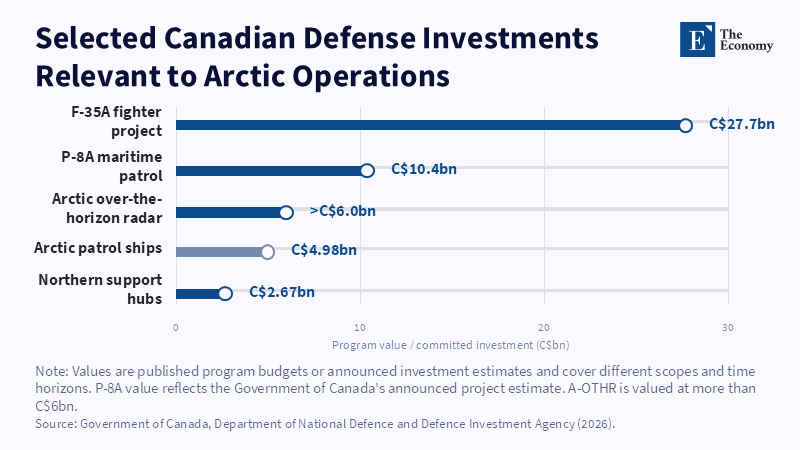
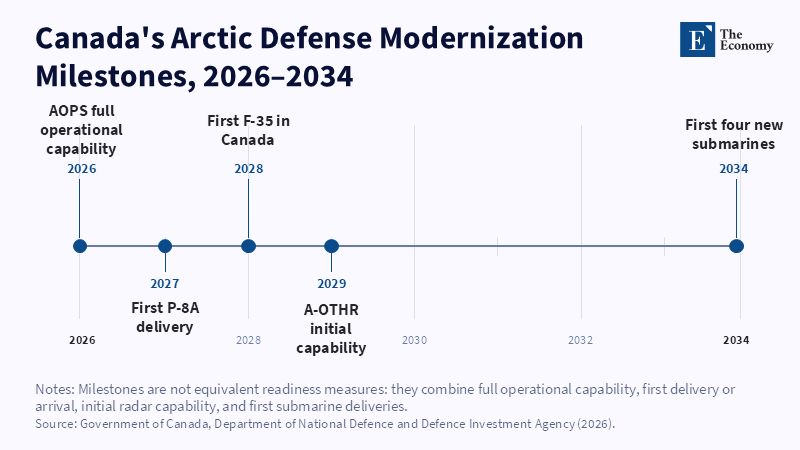
The Royal Canadian Navy now has all six Harry DeWolf Class Arctic and Offshore Patrol Ships and reached full operational capability on October 15, 2026. Since 2021, these ships have been rotating into the Arctic each summer from June to October to help Canada monitor and assert its sovereignty in the Arctic, as well as help with combined activities. These ships are designed to operate through first-year ice without an icebreaker, meaning they allow Canada to have a greater presence in the Arctic than was possible with its last surface ships. It does not mean that Canada can go anywhere it wants in the Arctic or that logistics will be easy but it does provide Canada with more presence in its north than it has had in the past.
Canada will also be upgrading its air power in the coming years. Up to 16 P-8A Poseidons are expected to enter service, replacing Canada's current CP-140 Aurora maritime patrol fleet. The first aircraft is expected to arrive in 2027, with deliveries continuing through 2028. These aircraft can be used for anti-submarine warfare, anti-surface warfare and as an intelligence asset to help monitor maritime operations. Of course, Canada will need to develop its people and support structure before these aircraft are fully operational. Once that happens, Canada could see a larger fleet of maritime patrol aircraft that can operate in more areas and help monitor more of the North and Pacific.
Canada planned a fleet of up to 88 F-35As, although the acquisition beyond the first 16 aircraft has remained under government review. The first two fighters were accepted in October 2026 at Luke Air Force Base in Arizona for training; initial arrival in Canada is expected in 2028, and operational capability will follow later. Future Canadian fighters could strengthen North American aerospace defense, but the first training aircraft should not be confused with an already fielded fleet available for Arctic operations.
Canada will also be upgrading its radar network to better monitor activity in the north. In June 2026, Canada agreed to buy technology from Australia and BAE Systems Australia to help with its Arctic Over-the-Horizon Radar project. This radar is expected to reach initial operational capability in December 2029. It will allow Canada to monitor activity from farther away than its current radar can. This will give commanders more time to figure out what assets to use if there is an incursion into Canadian or North American waters. Canada will be spending over C$6 billion, approximately US$4.25 billion, on this project, with C$2.5 billion, approximately US$1.77 billion, going to Australia. If forces are not deployed to those areas, reacting quickly will remain difficult.
That is why Canada is also building out more support sites in the north. Canada will spend C$2.67 billion, approximately US$1.89 billion, between 2024 and 2044 to create Northern Operational Support Hubs. These hubs will be built in Inuvik, Iqaluit, Resolute, Whitehorse and Yellowknife. This program is easy to overlook when talking about new F-35s and submarines but it can allow Canada to have more forces deployed to the north if needed.
Beyond NORAD: Canadian Forces Already Work with ALCOM
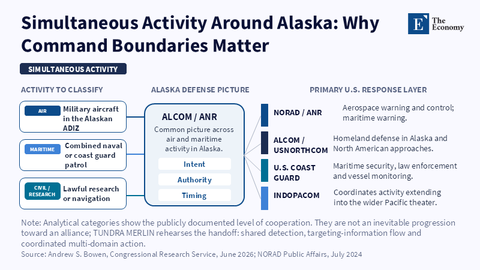
NORAD provides the established binational framework for aerospace warning, aerospace control and maritime warning. Maritime warning involves awareness and information sharing; it does not by itself provide a combined command structure for every Canadian or American vessel at sea. That distinction matters as Canada's naval capabilities expand. Rather than treating the additional assets as an automatic extension of NORAD, ALCOM must work with the organizations that actually operate them, as its recent exercises have demonstrated.
As Canadian aircraft, surface ships and planned submarines become available, they may contribute more information and presence across the northern approaches. Whether this produces a larger operational role will depend on logistics, personnel, command arrangements and joint procedures. Komatsu did not claim that Canada's future procurement projects have already altered the division of responsibilities; his interview was primarily about what existing personnel and equipment have achieved together.
Komatsu explained that ALCOM has no assigned or allocated forces of its own, so it achieves its Alaska-theater mission by coordinating with organizations already active there. Maritime awareness, he said, depends especially on the Coast Guard and, increasingly in recent years, the Royal Canadian Navy. These partnerships provide ALCOM with its most persistent maritime-domain picture and, in Komatsu's words, the "ability to see more and do more than we would normally have." His conclusion was that stronger coordination is itself a way to improve surveillance.
NORAD supplies a longstanding binational foundation. Lieutenant General Robert Davis holds command responsibilities for the Alaskan NORAD Region, Alaskan Command and Eleventh Air Force; the Alaskan NORAD Region also has a Canadian general officer serving as deputy. Komatsu described the NORAD relationship as historically and culturally embedded. A Canadian exchange officer also works in the headquarters' planning organization. Following the interview, ALCOM Public Affairs confirmed that the entire combined headquarters (CHQ) has 466 personnel, including the Alaskan NORAD Region (ANR), ALCOM, Eleventh Air Force, PRSC and the 611th Air Operations Center (611th AOC); the figure covers all five organizations, not just the three command responsibilities held by Davis. These arrangements help explain why cooperation beyond NORAD's aerospace mission has an institutional starting point rather than having to be invented afresh.
The boundaries between those missions remain legally important. Komatsu explained that some decisions can only be made by the three-star commander using a specific command authority. Headquarters personnel may collaborate across organizational lines, but they still need to establish which authority supports each decision. He made equally clear that ALCOM does not command Canadian Armed Forces or Coast Guard units simply because they participate in a combined exercise. What is becoming more flexible is coordination, not the underlying legal chain of command.
TUNDRA MERLIN's Practical Lessons: People, Networks and Command Relationships
In Operation TUNDRA MERLIN, Canadian and American participants practiced sharing information and conducting simulated maritime engagements. Public descriptions of the 2026 event emphasize the integration of sensor, targeting and response processes. Komatsu, however, identified a less visible source of progress: the ability to make several organizations function together inside a headquarters without assuming they share the same equipment, permissions or command systems.
Joint participation does not mean the two nations' forces have become a single military organization. It does show how meaningful combined operations can be rehearsed under existing command arrangements. The integration gains described by Komatsu are specific and observable, rather than a prediction about what a future Canadian fleet might be able to do.
Komatsu said TUNDRA MERLIN "has absolutely helped." In the 2025 exercise, headquarters staff confronted ordinary but consequential questions: how to host 30 or 40 Canadian personnel for 45 days, how to organize the work of officers from different services and how to give personnel from another country the necessary access to information systems. He stressed that these problems need to be encountered during training, not for the first time in a crisis. The high-profile maritime maneuvers were thus accompanied by quieter advances in administrative and operational interoperability.
Some of the most consequential changes have involved personnel. The U.S. Coast Guard Arctic District committed to permanently stationing a liaison officer at ALCOM headquarters, while the Canadian Armed Forces placed an O-6 officer there in 2026 as lead coordinator for Canadian participation in the Alaska theater. A single senior Canadian point of contact has reduced the need for U.S. planners to pursue separate conversations across the Canadian chain. Komatsu regarded both organizations as essential to synchronizing operations, despite ALCOM having no direct command authority over them.
Canada's six Arctic and Offshore Patrol Ships reached full operational capability in October 2026, but major components of its modernization program remain ahead: P-8A deliveries are scheduled to begin in 2027, the first F-35s for operations in Canada are expected in 2028, and the radar and submarine projects extend well into the following decade. This timetable creates room for further joint planning, but Komatsu did not offer specific forecasts about how these acquisitions will be integrated into ALCOM operations.
Canada's Existing Forces Are Already Expanding Joint Operations
A larger Canadian fleet and improved surveillance could eventually expand the country's contribution to continental defense, but the immediate evidence is more concrete. The forces Canada already fields are helping ALCOM undertake activities that require multinational logistics and joint planning. The distinction matters: new equipment promises additional capacity, while existing operational cooperation demonstrates what can already be accomplished.
Procurement programs can slip and promised capabilities are not the same as forces available for deployment. Yet Canada has already put Arctic patrol vessels into service and is contributing aircraft and personnel to combined operations. Its future role should therefore be evaluated through both delivery milestones and sustained participation in exercises, planning and real deployments.
Komatsu acknowledged that geopolitical tensions and reports of some Canadian officers' reluctance to accept U.S. postings have formed part of the wider discussion. He distinguished that political backdrop from his direct operational experience: in cooperation with the Canadian Armed Forces, he said he had "observed no pushback." He cited a particularly tangible example from August 2026, when Canadian C-17 transport aircraft carried 11th Airborne Division and I Corps personnel and equipment to Nome and returned them afterward. Komatsu said the deployment would not have been possible without the Canadian military's flexibility and commitment.
The Nome operation relied on equipment Canada already operates; the future P-8A, radar and submarine programs were not the subject of Komatsu's specific operational examples. Looking ahead to summer 2027, he said the planning was "not more of the same. It is increasing," because both militaries are seeking to do more together. That is an observation about the direction of cooperation, not a guarantee of particular deployments or a future reallocation of continental defense responsibilities.
September's Bering Sea activities and August's Nome deployment show the range of cooperation already taking place, from simulated maritime operations to practical airlift. The next chapter of continental defense will depend on how consistently those relationships can be sustained while Canada's promised capabilities arrive. For now, Komatsu's account points to deeper coordination across existing forces, not a departure from North American military cooperation.
This article was independently prepared by The Economy Review following an interview with Brigadier General Matthew S. Komatsu of Alaskan Command.
Statements attributed to Brigadier General Komatsu reflect his interview remarks, reviewed by Alaskan Command's Public Affairs office for accuracy and context. Other analysis, interpretations and conclusions are The Economy's own and should not be construed as official positions of ALCOM, U.S. Northern Command, the Department of Defense, the Canadian Armed Forces or any other institution.
Alaskan Command's Public Affairs office completed a pre-publication review for factual accuracy and attribution. Such review does not constitute institutional endorsement of the article, its conclusions or any subsequent use by third parties.
Identification of military organizations, individuals and institutions does not imply sponsorship, partnership or endorsement.
References
Alaskan Command Public Affairs (2026) 'U.S., Canadian Forces to Rehearse Joint Maritime Strikes in the Bering Sea'. Defense Visual Information Distribution Service, 18 September.
Defence Investment Agency (2026a) 'Backgrounder: Government of Canada advances Canadian Patrol Submarine Project'. Government of Canada, 6 July.
Defence Investment Agency (2026b) 'Canada-Australia Partnership on Arctic Over-the-Horizon Radar'. Government of Canada, 22 June.
Delaney, S. (2026) '“Divided by Tariffs, United in the Arctic”: U.S. and Canada Conduct Bering Sea Maritime Strike Scenario'. The Economy, 22 September.
Department of National Defence (2026a) 'Arctic and offshore patrol ships'. Government of Canada.
Department of National Defence (2026b) 'Canadian Multi-Mission Aircraft project'. Government of Canada.
Department of National Defence (2026c) 'Future Fighter Capability Project'. Government of Canada.
Department of National Defence (2026d) 'Northern Operational Support Hubs (NOSH)'. Government of Canada.
North American Aerospace Defense Command (n.d.) 'About NORAD'. North American Aerospace Defense Command.
The Economy Editorial Board (2026) '[Arctic Maritime Strategy] Canada’s Northwest Passage: Sovereignty, Surveillance and the Limits of Arctic Defense'. The Economy, 26 October.
Working across research, policy, and data-driven analysis, the Editorial Board ensures that published pieces reflect a consistent institutional perspective grounded in quantitative reasoning and long-term structural assessment.