Europe's Innovation Trap: When Industrial Maturity Makes Risk-Taking More Expensive

Working across research, policy, and data-driven analysis, the Editorial Board ensures that published pieces reflect a consistent institutional perspective grounded in quantitative reasoning and long-term structural assessment.
Authored On
Modified
Costly unemployment makes workers demand premiums to join start-ups
Mature European industries reward caution and absorb few young workers
Faster job-finding could revive experimentation without weakening established industries

There were 5.9% unemployed people in the EU as of 2024. This is the lowest unemployment rate Eurostat has measured since the series started in 2009. That number could suggest that Europeans are willing to take more economic risks. But another statistic from Eurostat paints a different picture. 4.2 million Europeans who are unemployed have been unemployed for more than a year. In Greece, 5.4% of the labor force has been unemployed for over a year. Unemployment measures how many people are unemployed. Unemployment duration measures how much it costs to not have a job. Workers consider the second number when deciding if they should leave a stable company to work for a start-up that may not survive for 3 years. This is one of the many reasons why Europe has fallen into an innovation trap. Its history of industrial growth and the lack of newer industries that have emerged play a large role in why this problem exists.
The Wage Premium That Taxes Experimentation
A recent paper published this fall by Danmarks Nationalbank and the Halle Institute for Economic Research measures how much this costs. Workers share risk with their employer; therefore, if a young firm wants to experiment, it has to compensate its workers for possibly losing that job. Using data from Denmark that matches employers to employees from 2008-2022 and looking at 29 commuting zones, the study finds that as the job-finding rate increases by one standard deviation, young firms pay 0.6%-1.1% less than old firms. The study also runs a survey experiment to support this claim. Participants were asked to choose between a stable company that has a probability of failing of 4% a year or a start-up with a probability of 20% a year. When doubling the amount of time they would be unemployed if the firm fails, the wage premium increases by 2.3 percentage points.
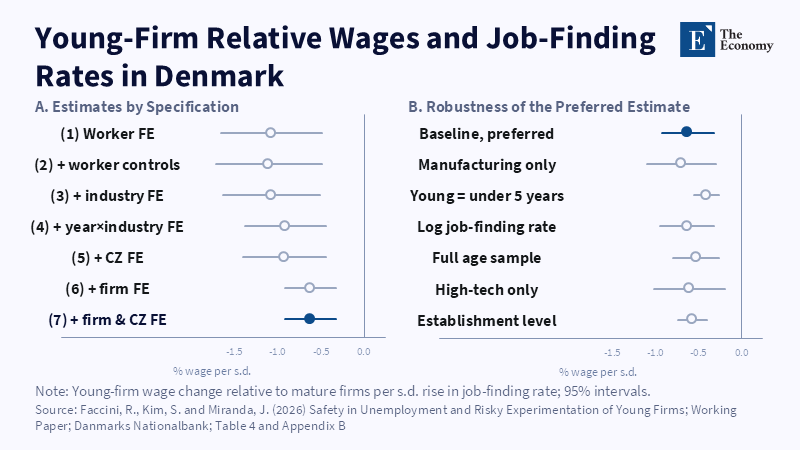
This 2.3 percentage point wage premium can be costly for young companies that are just starting out, since many of these companies have tight budgets and are spending the bulk of their money on employees. If they have to spend money compensating workers for that risk, they will have less money to invest in their product. Founders will choose less innovative methods of business if they know they have to pay their employees more to take risks. Using a calibrated model, the study shows that entrants will take less risk when the cost of unemployment is higher and will take more risk if unemployment is lower. This is caused by the risk of unemployment, not the lack of new technology. If the wage premium acts as a tax on taking risks, then it will affect all new businesses that experiment, not just tech. Denmark has one of the highest job-finding rates in Europe, so countries with longer periods of unemployment should see this effect more strongly. Spain has 3.8% of its labor force that has been unemployed for more than a year and Slovakia is at 3.5%.
Some may argue that Europe lacks the capital to invest in new technologies, as a European Commission report on competitiveness shows that there have only been 147 unicorns born in the EU from 2008-2021. Of those unicorns, approximately 40, close to 30%, relocated, mostly to the United States, to find more money. Both the cost of capital and the cost of labor can act as deterrents to innovation. If workers demand a premium to join a firm that may fail, investors will have to spend more of their investment on wages. Increasing the amount of capital in Europe can reduce the amount of money that firms have to spend to attract talent, but it will not decrease the wage premium that workers will ask to be compensated.
How Europe’s Innovation Trap Took Root in Mature Industries
When looking at the industries that have survived in Europe for the last 40 years, it becomes easier to see why innovation has slowed. Many labor-intensive jobs were moved to Asia and the eastern half of Europe over the past few decades. This left Europe with high-skill jobs that involve creating precise machinery. Industries such as machine building, chemical engineering, pharma, aerospace, automobile and finance have dominated Europe for the last few decades. Research from the IFO Institute, Bocconi University and Toulouse School of Economics in 2024 found that Europe spends around 1.2% of GDP on research and development, while the United States spends around 2.3%. Automobiles are the biggest industry that spends on research and development in Europe. A thesis written in 2026 at Bocconi University shows that middle technology industries make up almost half of all business R&D spending in Europe.
These industries need to be cautious when making new products. If a customer buys a plane from Airbus, they want to know that it will not fail. A company that takes a risk on a new drug that doesn't meet the standards could face large consequences. Banking also requires caution when experimenting with new methods. Since 2014, bank employees who have an impact on the risk taken by their firm are only allowed to be paid 100% of their fixed salary in bonuses, or 200% if shareholders agree. This was implemented because they believed that paying employees too much in bonuses led to the financial crisis in 2008. The UK recently got rid of its version of this bonus cap in October of 2023, which sparked a debate on whether controlling risk can be beneficial for a company that needs to stay above a certain standard.
Since these companies have spent decades being cautious with their money, they will not jump into risky investments. These industries have also trained many of the managers working in other companies today. If someone has worked for a large European company for their whole career, they are less likely to take risks in other jobs. These jobs also pay some of the highest salaries in Europe, so why would someone leave that to work for a start-up?
Too Few New Industries Leave Young Workers Behind
Because these companies hire for specific positions that require many years of schooling, it leaves young people unemployed when they first enter the workforce. As of 2024, 14.9% of young people were unemployed in the EU. This increased from 14.6% the previous year, which went up despite unemployment hitting a record low. In October 2025, youth unemployment was 15.2%, and there were 2.96 million young people unemployed. Limited job opportunities raise the cost of unemployment at both ends, because experienced workers will not leave secure jobs, and young workers who have already been unemployed for a while are less likely to leave their first job.
If there were more new industries that were growing rapidly, this problem would be smaller. According to the same report, there are only 4 European companies that are in the top 50 tech companies in the world. Europe's share of global technology revenues dropped from 22% to 18% between 2013 and 2023, while the US share grew from 30% to 38%. No EU company that has been created from scratch in the last 50 years is worth over 100 billion euros. With not many companies that are growing, the cost of unemployment will stay high, which will decrease the number of new businesses created in Europe and leave more young people unemployed.
Why China’s Incentives to Experiment Differ
Many people point to China as an example of a country that takes more risks. They spent 3.613 trillion yuan on research and development in 2024, which is 8.3% more than the previous year and 2.68% of their GDP, compared to the EU, which spends an average of 2.11%. Many Chinese companies that sell batteries, solar panels, cars and drones have been able to update their products at a faster rate than European companies. Some of those companies have failed as well. But just because China is taking more risks doesn't mean that they are more willing to fail. Many of these industries are still new, so if they fail, there are other companies they can work for.
China is able to take more risks because it has more new industries that are growing. Europe cannot just tell its existing industries to take more risks. If pushed, companies like Bosch or BASF may not want to experiment more. These companies have spent many years making sure their products are reliable and taking risks may hurt their business. Chinese workers also have high unemployment rates among young people, and the Chinese government stopped publishing this statistic in 2023 and changed its methodology when it started publishing again. The difference between these countries is the number of new industries that are available for workers to move to if they fail.
Lowering the Cost of Unemployment without Weakening Industry
Increasing the job-finding rate in Europe can lower the cost of unemployment. The same report estimated that Europe needs to invest an additional 750-800 billion euros a year to close its competitiveness gap. That is 4.4%-4.7% of the GDP of the EU in 2023. Some of that money can be expected to go towards new industries that are being created in Europe. In the study's model, increasing the job-finding rate from 0.44 to 0.56 a quarter increases productivity by 1.05%. There are many ways to increase the job-finding rate. One way is unemployment insurance paired with fast job placement. If workers are allowed to keep some of their seniority from their previous job, they will be more likely to leave that job to work for a start-up. The government can also help these workers find jobs after they fail.
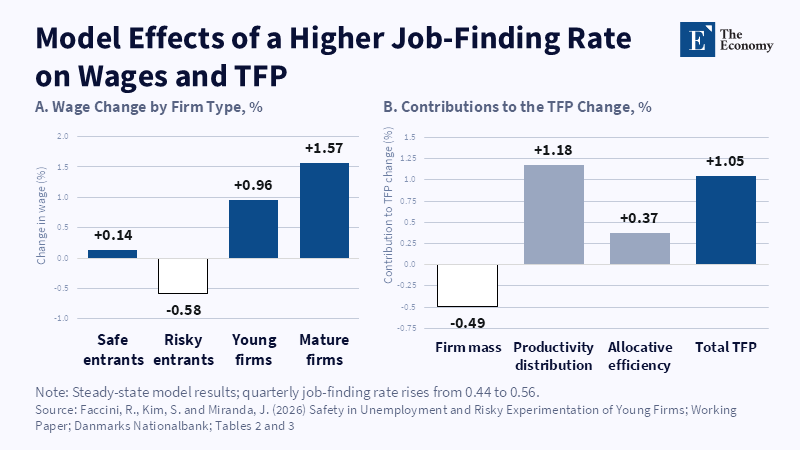
There is no need to change how current industries operate. These industries can remain the same while increasing the amount of money that workers get when they leave to work for a new company. Allowing young companies to sell their products to the government can help them grow as well, which will create more jobs and lower the cost of unemployment. There are many things that can be done to lower the cost of unemployment in Europe. But Europe needs to start somewhere.
Even with the unemployment rate hitting new lows, Europe can remain in this trap. Finding a way to lower the cost of unemployment may help create more new industries. There are 4.2 million people in Europe who have been unemployed for over a year. Decreasing that number could start to create more innovative businesses in Europe.
The views expressed in this article are those of the author and do not necessarily reflect the views of The Economy, its Editorial Board, or any affiliated institution.
References
Dietrich, Anita, Dorn, Florian, Fuest, Clemens, Gros, Daniel, Presidente, Giorgio, Mengel, Philipp-Leo and Tirole, Jean (2024) ‘Europe’s middle-technology trap’, EconPol Forum, 25(4), pp. 32-39.
Draghi, Mario (2024) The future of European competitiveness. Brussels: European Commission.
European Commission (2026) Employment and social developments in Europe 2026. Luxembourg: Publications Office of the European Union.
European Parliament and Council of the European Union (2013) ‘Directive 2013/36/EU on access to the activity of credit institutions and the prudential supervision of credit institutions and investment firms’, Official Journal of the European Union, L 176, 27 June.
Eurostat (2025a) ‘New lows for EU unemployment in 2024’, Eurostat News, 23 May. Luxembourg: Eurostat.
Eurostat (2025b) ‘Long-term unemployment in EU regions, 2024’, Eurostat News, November. Luxembourg: Eurostat.
Eurostat (2025c) ‘Euro area unemployment at 6.4%’, Euro Indicators, 2 December. Luxembourg: Eurostat.
Faccini, Renato, Kim, Seho and Miranda, Javier (2026) Safety in unemployment and risky experimentation of young firms. Working paper. Copenhagen: Danmarks Nationalbank.
Mengel, Philipp-Leo (2026) European competitiveness: a new EU innovation policy to address the middle-technology trap. PhD thesis. Milan: Bocconi University.
National Bureau of Statistics of China (2025) China’s expenditure on research and experimental development exceeded 3.6 trillion yuan in 2024. Beijing: National Bureau of Statistics.
Prudential Regulation Authority and Financial Conduct Authority (2023) PS9/23 Remuneration: ratio between fixed and variable components of total remuneration. London: Bank of England.
Working across research, policy, and data-driven analysis, the Editorial Board ensures that published pieces reflect a consistent institutional perspective grounded in quantitative reasoning and long-term structural assessment.