Pay Transparency Meets a Labor Market That Is Hiring Less

Working across research, policy, and data-driven analysis, the Editorial Board ensures that published pieces reflect a consistent institutional perspective grounded in quantitative reasoning and long-term structural assessment.
Authored On
Modified
Pay transparency redirects job searches but not proven hiring outcomes
AI-exposed employers hold wages steady while hiring fewer workers
Disclosing hiring data could matter more than posted pay

The latest worker displacement survey from the Bureau of Labor Statistics was published on 27 August 2026. While the reemployment rate remained at 66.1 percent, the more interesting statistic was the pay of those reemployed. When looking at workers who were laid off between 2023 and 2025 with a long tenure at their job and reemployed full-time by January 2026, only about 49 percent were earning the same or more than before. This compared with roughly 62 percent in the survey two years earlier. While people were still being reemployed, they were less likely to be reemployed at a similar wage. This is a difficult statistic to square with the pay transparency movement. Countries around the world continue to pass pay transparency laws. The logic behind pay transparency is that if a person knows what a job pays, they are more likely to look for higher-paying jobs and there is evidence to suggest that they do. The question is whether they end up in better jobs.
Pay Transparency and What It Doesn't Address
With the European Pay Transparency Directive calling for member states to implement salary disclosure by 7 June 2026, only Italy, Lithuania, Malta and Slovakia had fully transposed it by that date, which means the rest of Europe is currently legislating pay transparency into a very different labour market than the one it was designed for in 2023. The U.S. saw the first pay posting law in Colorado in January 2021. At that time, the country was in the midst of the Great Resignation, with counteroffers and sign-on bonuses. Often, the constraint on a worker's wage was what they didn't know other companies would pay. Fast forward to 2026 and that constraint looks a little different, especially in jobs most exposed to generative AI. Companies have been able to increase output with less headcount. Now, if a company posts a job and applicants can see what it pays, they know what that job is worth. They just don't know if that job will be filled.
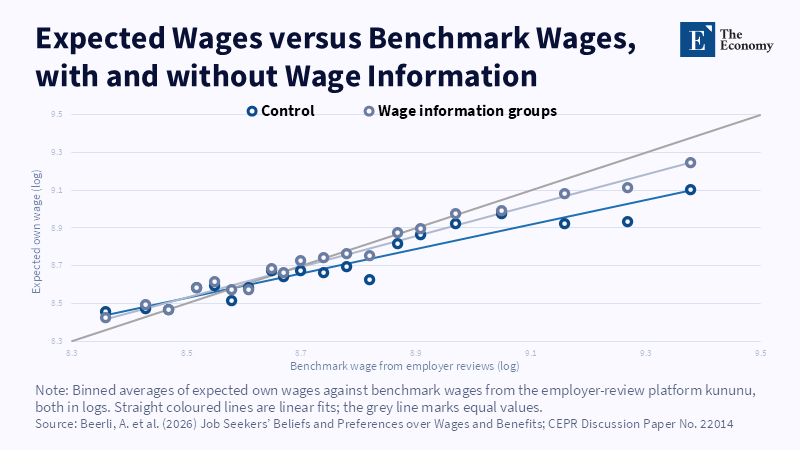
The best data on this topic comes from a field experiment conducted on over 100 job boards in Switzerland by ETH Zurich's KOF Swiss Economic Institute, Bocconi University and the University of Vienna. They randomly displayed wage and benefits information, using data from an employer review site, to around 265,000 people over the course of more than 12 million decisions made on nearly 200,000 job postings. When the displayed wage was 1% higher, it increased engagement with an ad by around 0.4%. Surveys that accompanied the experiment found that job seekers underestimated wage gaps by about 50% and did not know much about benefits employers provided, such as working from home or childcare. Once they were shown the actual wage gap, they only updated partially. As a result, the researchers estimate that the true wage elasticity of job applications is much higher than the 0.4 seen in the click data, probably somewhere between 2.5 and 2.9.
Looked at closely, this study measures how people search for jobs, not what happens once they find a job. They measured clicks and applications but not job offers or wages. The authors don't even attempt to speculate on what happens after a person applies. If more people apply to higher-paying jobs, this could lead to more people in line for those jobs. If the number of high-paying jobs stays the same, this could be detrimental to job seekers. An applicant who was not getting a job before likely still won't, having simply applied for more jobs and spent more time not getting hired. There is value in having this information. It just isn't known how much that translates into employment and wages.
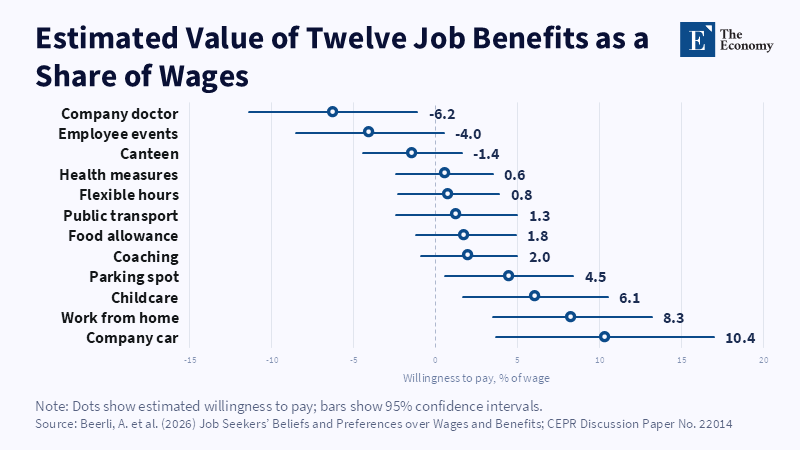
The study also found that, of the 12 benefits displayed, only 4 carried significant value for job seekers. A company car was valued at around 10% of wages. Home working was valued at 8% of wages. Childcare from the employer was valued at 6% of wages and parking at 4% of wages, with the average job providing benefits worth 11% of wages. Jobs that pay more will likely also provide more benefits, meaning that the gap between good jobs and bad jobs is larger than just the wage. These values come from people who have jobs to choose from, which is a safe assumption on Swiss job boards, but perhaps not in occupations where people are choosing between a job and no job.
Hiring Slows before Layoffs Arrive
Layoffs are the obvious way automation reduces jobs and they have started to appear. According to Challenger, Gray & Christmas, there have been 121,401 planned job cuts attributed to AI in the U.S. through October 2026. This is more than double the 54,836 recorded for the whole of 2025. This is likely a smaller impact than reduced hiring. In July 2026, the U.S. had a hiring rate of 3.2%. The Richmond Fed calculated that only 7% of months since December 2000 have had a lower hiring rate. Layoffs have remained near historic lows. The 3.1% hiring rate in February was the lowest since April 2020. When companies are neither hiring nor firing, those already employed are safe, while those looking for a job or recently laid off struggle and there is no news story about that.
ADP is the largest payroll company in the United States. Researchers at Stanford's Digital Economy Lab used ADP's payroll data to see how employment changed for different age groups. Workers who were between 22 and 25 years old in the occupations most exposed to AI saw their employment fall by 13% relative to less exposed occupations, after controlling for company-specific shocks. They also found that older workers in the same occupations did not see this drop; their employment held steady or grew. The researchers noted that the adjustment came primarily through employment, not wages. This is important for the pay transparency conversation because companies are able to maintain wages in occupations exposed to AI and just hire fewer people. That is not something a salary posting can reveal.
A worker with multiple job offers can negotiate wages and benefits. A worker with only one job offer, from an employer that mentions it is restructuring, will likely be more concerned with keeping that job and may give up some of the benefits valued above. Pay transparency is not built to address this. If an employer were required to disclose how many people it hired last year and how many jobs it didn't fill, applicants would have a better understanding of what they were getting into.
The Case that Pay Transparency Already Works
There are studies that show pay transparency increases wages. A working paper from the National Bureau of Economic Research in 2025 found that when states required companies to post wage information, they saw a 30-percentage-point increase in jobs that listed pay and wages increased by 1.3 to 3.6% depending on the data set used. They did not see any change in employment, jobs posted, or skill and education requirements. It appears that posting wages is a great way to increase wages without costing jobs. The Budget Lab at Yale has also been tracking the occupational mix of the workforce and found that there has been no noticeable change in the types of jobs people are working in due to AI. Most of the recent shift was already underway in 2021.
Why, then, worry about pay transparency? If pay transparency increased wages but did not increase jobs, then it is increasing wages for people who have jobs and doing nothing for people who don't. Research from Harvard Business School and Brown University found that when states protected workers' right to talk about wages with other workers, wages fell by about 2%, because companies didn't want to give raises to one person and have everyone else ask for a raise. The researchers also found that this effect was smaller when workers didn't have much bargaining power. If workers in occupations exposed to AI have less bargaining power due to automation, the wage effects of transparency would be expected to be smaller for them. The absence of major changes in jobs being created or destroyed could also be hiding the impact AI is having on certain age groups and occupations.
Disclosing Hiring alongside Pay
To ensure that pay transparency continues to work, employers should start posting hiring information as well. The EU already requires companies to post the starting wage or range of a job before the interview. Member states could go one step further and require companies to post how many people they hired last year and how many jobs they didn't fill. Companies that are publicly traded already discuss headcount with their investors. Job sites have most of this information and could easily start displaying it.
Public job sites could also start tracking this information. The most recent displacement survey found that 44.4% of workers who were long-term employees were displaced because their job or shift was eliminated, which is probably where automation would take effect. If public job sites started to track this for each occupation, job seekers would know how likely they are to get reemployed in that occupation and what their earnings would be if they decided to switch occupations.
For workers who can find another job that pays what they used to earn, there is value in knowing what other jobs pay. People are not accurately estimating the wage difference between jobs, which can hurt them if they are in an occupation that is hiring. Young workers in occupations less exposed to AI are still finding employment. Companies, however, are going to adapt to this. If jobs that last are what people are looking for, companies that can provide them will be able to pay less. This will undo some of the effects of pay transparency. How this plays out remains to be seen. The next displacement survey will be conducted in January 2028 and will cover job losses from 2025 to 2027, a period that includes the year in which AI-attributed job cuts more than doubled. If the share of reemployed workers earning their previous pay continues to drop, pay transparency may not be having the intended effect.
The views expressed in this article are those of the author and do not necessarily reflect the views of The Economy, its Editorial Board, or any affiliated institution.
References
Arnold, David, Quach, Simon and Taska, Bledi (2025) The Impact of Pay Transparency in Job Postings on the Labor Market. NBER Working Paper No. 34480. Cambridge, MA: National Bureau of Economic Research.
Beerli, Andreas, Fiorin, Stefano, Gulyas, Andreas, Kopp, Daniel, Khoshnama, Mahsa and Siegenthaler, Michael (2026) Job Seekers’ Beliefs and Preferences over Wages and Benefits: Experimental Evidence from Online Job Boards. CEPR Discussion Paper No. 22014. London: Centre for Economic Policy Research.
Brynjolfsson, Erik, Chandar, Bharat and Chen, Ruyu (2025) Canaries in the Coal Mine? Six Facts about the Recent Employment Effects of Artificial Intelligence. Stanford, CA: Stanford Digital Economy Lab.
Bureau of Labor Statistics (2026a) Job Openings and Labor Turnover: February 2026. Washington, DC: US Department of Labor.
Bureau of Labor Statistics (2026b) Worker Displacement: 2023-2025. Washington, DC: US Department of Labor.
Challenger, Gray & Christmas (2026) Job Cut Announcement Report: October 2026. Chicago: Challenger, Gray & Christmas.
Cullen, Zoë B. and Pakzad-Hurson, Bobak (2023) ‘Equilibrium effects of pay transparency’, Econometrica, 91(3), pp. 765-802.
European Parliament and Council of the European Union (2023) ‘Directive (EU) 2023/970 on pay transparency and enforcement mechanisms’, Official Journal of the European Union, L 132.
Gimbel, Martha, Kinder, Molly, Kendall, Joshua and Lee, Maddie (2025) Evaluating the Impact of AI on the Labor Market: Current State of Affairs. New Haven, CT: The Budget Lab at Yale.
L&E Global (2026) EU Pay Transparency: Member States Near Transposition Finish Line. Brussels: L&E Global.
Macaluso, Claudia and O’Trakoun, John (2026) ‘Visualizing the low-hire, low-fire labor market’, Macro Minute. Richmond, VA: Federal Reserve Bank of Richmond.
Working across research, policy, and data-driven analysis, the Editorial Board ensures that published pieces reflect a consistent institutional perspective grounded in quantitative reasoning and long-term structural assessment.