From Phone Calls to Smart Glasses: How Technology Is Erasing Distance in the Global Office

Working across research, policy, and data-driven analysis, the Editorial Board ensures that published pieces reflect a consistent institutional perspective grounded in quantitative reasoning and long-term structural assessment.
Authored On
Modified
Each new communication tool shrank distance in office work
Time zones now constrain services trade more than kilometres
Smart glasses could integrate the Global Office beyond the Factory

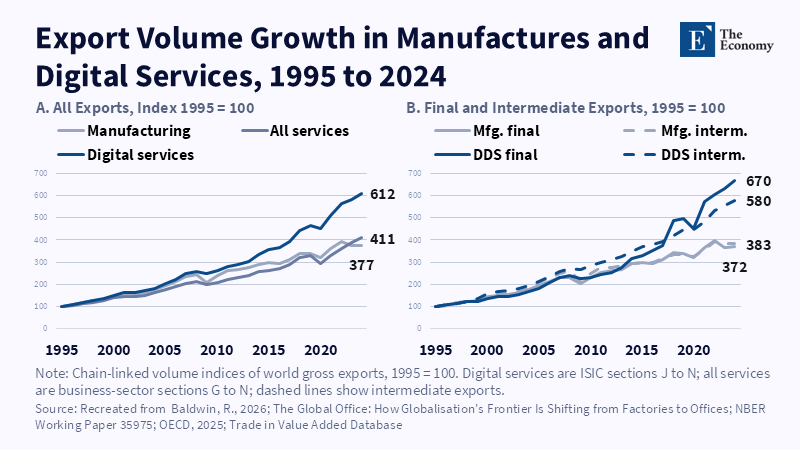
The image of globalisation still conjures container ships, manufacturing plants and forklifts. Richard Baldwin suggests in his most recent VoxEU article that this picture should now be considered outdated. Based on his NBER Working Paper 35975, he notes that the growth in intermediate exports of digitised services has been 113 percent over the period covered, versus 46 percent for industrial intermediate exports. From software to telecommunications to financial, insurance and business services, many of these are exported as an intermediate input to another company’s own production process - hence part of a global value chain. Baldwin labels this the “Global Office” and contrasts this with the “Global Factory”, which has been the main driver of globalisation since the 1990s.
Baldwin focuses primarily on which activities are exported to which destination countries. He touches only briefly on the means that allow office-based work to be performed remotely, but office work fundamentally relies on the exchange of information and dialogue. Therefore, the key barrier to distance in the office has historically been communication cost, which has decreased successively with the introduction of the phone, e-mail, video conferencing and collaboration platforms such as Slack/Teams. The next innovation on the horizon is smart glasses and virtual/mixed reality applications, which, if realised, could significantly enhance the integration of the Global Office beyond the Global Factory, as it would no longer be bound by the movement of physical goods.
From Phone to Platforms: How Each Tool Shrank Office Distance
The phone allowed communication between offices in different locations with just a call. However, it did not allow more than the transmission of voice - there was no visual element and no way to indicate where on a page/diagram/figure, etc. one was referring to. Moreover, international phone calls used to be very costly and were used sparingly. So, while it was possible to conclude an agreement over the phone, the rest of the activity would still be performed at the office location.
The fax and later e-mail, enabled the transmission of documents and with e-mail in a fast, large-scale and trackable manner. This facilitated offshoring of tasks between two offices with a significant time difference (e.g. completion of a task by one office and handover to the next upon start of their working hours). The surge in offshoring to India in back office and customer service roles in the 1990s/2000s is in large part attributable to the development of cheaper long-distance phone calls and e-mail. The drawback of e-mail was that communication could be slow - if a query was sent at the end of one office’s working day, it could be a further 8 hours before a response was received and several days if clarification was needed.
Video conferencing was available to firms for much longer before widespread uptake. It was typically provided via costly, fixed devices. With the advent of Skype (2003) and subsequently Zoom (2011), video conferencing became accessible on laptops at a minimal cost. It allowed colleagues to see each other’s facial expressions and cues and thereby increased communication effectiveness compared to the phone.
The development of collaborative cloud platforms (Google Docs, Slack in 2014, Microsoft Teams in 2017) further reduced distance by allowing simultaneous input by multiple users and bringing communication about the task, the file and other relevant information to one place. As such, distance became less salient in the office work process.
In summary, the successive introduction of these means of communication and collaboration enabled more aspects of office work to be done from a remote location. It therefore enabled progressive ‘unbundling’ of office work from geographic proximity. Certain activities such as negotiation, induction and informal discussion/spontaneous ideation remain difficult to conduct remotely and therefore continue to require physical co-presence of office workers.
Remote Working During and Post-Covid: Home or Abroad?
Zoom experienced a surge in usage from 10 million daily meeting participants in December 2019 to 300 million in April 2020. Companies rapidly expanded their infrastructure to facilitate remote work by employees from the comfort of their own homes. This created a platform to subsequently enable remote work from abroad, with relatively few further changes to company policy and processes. Baldwin argued in 2020 that for a virtual office, whether someone works in a nearby suburb or abroad is effectively equivalent. So remote working abroad became a realistic prospect for the first time for many businesses following the pandemic.
Since a remote worker abroad operates through the same digital means as a remote worker at home, it is natural that the data shows growth in offshore provision of services. As highlighted by Baldwin, the Global Office exhibits a star pattern centred around the US, unlike the Global Factory with regional blocs centred around China. All net employment gains from 2008-22 associated with trade were driven by trade in digitised services and these roles are on average higher-paid. The Global Factory thus continued to be led by China, whereas the Global Office is led by the U.S.
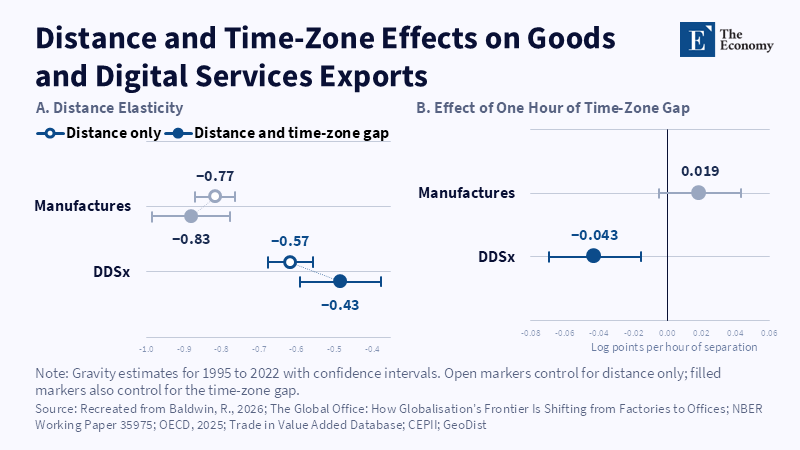
A key caveat to this is the role of time zones. Baldwin’s gravity model finds that distance (km) is less important for Office trade compared to Factory trade, whereas time zone difference is more important. There is an average decrease in Office exports of ~4 percent for each additional hour of time difference between the exporter and importer (with no impact on Factory trade). Given the real-time nature of most office work, this is an obvious constraint which is not present in manufacturing. Baldwin noted in October 2026 that AI will help overcome some international frictions for office work, but other factors (e.g. geography, trust and time zones) remain relevant.
Additionally, language, country-specific requirements (e.g. for certain professions) and regulatory/organisational differences also contribute to the distance in the Global Office. These are not distance (km) related but still represent barriers to the offshore delivery of services. It is too early to assess if services can replicate the growth in GDP seen from globalisation of manufacturing in developing countries, though Baldwin concludes that exports of digitised services remain too small to generate significant growth.
Smart Glasses and Mixed Reality: The Next Step for the Global Office
Despite the advances in digital communication, it is still difficult to create the illusion that co-workers are physically present in the same space (e.g., during a video call). Smart glasses and virtual/mixed reality applications seek to create this illusion and thereby reduce distance between remote co-workers. A 2025 study by researchers at Tsinghua University and the University of Rochester investigated this using a mixed reality system in a remote assistance task. They found that co-presence was similar between the mixed reality setting and the in-person setting and the use of verbal communication decreased and direct manipulation of objects increased in the mixed reality setting compared to video calls. Further research is needed to understand the applicability of this technology in broader office settings (the mixed reality setting was experienced through a VR headset and a virtual representation of the recipient’s environment). Meta has announced the rollout of a hologram feature for video calls on its Meta Ray-Ban Display glasses for U.S. consumers (early access) later in 2026. The glasses were released in 2025 at $799. While this will enhance communication for individual consumers, it remains some distance from facilitating a virtual shared office for distributed teams.
Nevertheless, this is in line with the trajectory of the above technologies, i.e., reducing the distance required to perform office work from another location. If the perception of distance between workers can be reduced through smart glasses/VR, the remaining activities that have been difficult to shift to remote (e.g., negotiation, training and informal discussions) could be enabled. One consideration is that, since these technologies will facilitate synchronous work more effectively, the distance due to time zones could increase in importance, as it will be more costly to work at non-optimal hours. This may lead to more intra-regional trade in services (e.g. between the Americas, Europe/Africa, Asia/Southeast Asia), which is broadly in line with Baldwin’s expectations.
The main difference between the Global Factory and Global Office is that the former relies on the movement of goods, which is costly and leads to the formation of regional blocs (centred around China). The latter is based on the movement of information, which has become cheaper with each new communication technology. With the potential for smart glasses and mixed reality to further reduce perceived distance, the Global Office has the potential to become more unbundled than the Global Factory. However, as with other forms of globalisation, there are limits to the extent of unbundling associated with the cost of coordination of activities. Baldwin notes that globalisation 2.0 appears to be plateauing, but globalisation 3.0 is gaining traction. Regulation and controls imposed by advanced economies could be a major factor in the evolution of globalisation 3.0.
The views expressed in this article are those of the author and do not necessarily reflect the views of The Economy, its Editorial Board, or any affiliated institution.
References
Baldwin, R. (2020) ‘Is COVID-19 accelerating a shift of service jobs to the developing world?’, interview, Brink.
Baldwin, R. (2026a) ‘The Global Office: Globalisation’s frontier is shifting from factories to offices’, VoxEU Column, Centre for Economic Policy Research, 9 November.
Baldwin, R. (2026b) The Global Office: How globalisation’s frontier is shifting from factories to offices. NBER Working Paper 35975. Cambridge, MA: National Bureau of Economic Research.
Baldwin, R. (2026c) Understanding, navigating and thriving in a fragmenting global economy: World War Trade, the Global Office and New Zealand’s choices. Presentation to the New Zealand Treasury, Wellington, 26 October.
Meta (2026) New features for Meta Ray-Ban Display. Menlo Park: Meta Platforms.
Yin, J., Zheng, W., Wang, Y., Tong, X. and Yan, Y. (2025) ‘A comparison study understanding the impact of mixed reality collaboration on sense of co-presence’, 2025 IEEE Conference on Virtual Reality and 3D User Interfaces (VR). IEEE.
Zoom Video Communications (2020) Q1 fiscal 2021 prepared remarks. San Jose: Zoom Video Communications.
Working across research, policy, and data-driven analysis, the Editorial Board ensures that published pieces reflect a consistent institutional perspective grounded in quantitative reasoning and long-term structural assessment.