When AI Makes Copying Cheap: Can Europe Rewrite Its Comparative Advantage?

Working across research, policy, and data-driven analysis, the Editorial Board ensures that published pieces reflect a consistent institutional perspective grounded in quantitative reasoning and long-term structural assessment.
Authored On
Modified
AI reverse engineering cuts the engineer-hours that copying once needed
Imitation turns capital-intensive, shifting Heckscher-Ohlin predictions toward Europe
Gains depend on adoption speed and the transition creates losers

Since around the mid-20th century, East Asia has enjoyed a comparative advantage over Europe in engineering-intensive activities. The intuition is straightforward: it required many engineer-hours to learn and replicate/repurpose another’s technology and these engineer-hours could be procured at lower cost from East Asian economies than from Europe. With the advent of LLM-based AI agents that can reverse-engineer compiled code to replicate software, this required time is falling dramatically, as evidenced by REA accumulating 230k+ GitHub stars within just 8 days (October 2026). Through the lens of the Heckscher-Ohlin framework, this may imply limited impact on relative wage differentials, but a significant change in the factor intensity of reverse-engineering and related activities. This poses the question of whether Europe can re-establish its comparative advantage in engineering-intensive tasks and if so, at what transitional cost.
Catching Up Once Required Thousands of Engineer-Hours
In 1953, Sony obtained a licence from Western Electric for $25,000, subject to Japanese government clearance of foreign currency allocation. The licence came with documentation from Bell Labs. However, this was of course insufficient to actually produce a commercially viable transistor, which Sony took another ~2 years to achieve (TR-55, 1955). This pattern held through the introduction of the Walkman in the West (1979): licence/purchase of technology -> engineer-hours to develop/replicate/reproduce. Comparative advantage was determined by which economies could convert the acquired knowledge into mass-producible products at sufficiently low cost.
A similar approach was adopted by Samsung for its DRAM products. When licensing from larger incumbents was not possible, they acquired a licence for Micron’s 64K DRAM in June 1983 and produced a prototype by November 1983. For the next generation (256K), Samsung opted to reverse-engineer the technology from competitors and produced a prototype by July 1985. By 1993, Samsung was the world’s largest DRAM manufacturer. China has pursued a similar approach at an unprecedented scale, aided by national policies, localisation of suppliers and continued expansion of the domestic engineer workforce. Each of these economies has exhibited distinct characteristics in their pursuit of technology development, so they should not be conflated - e.g., Japan’s focus on consumer electronics development, Korea in memory chip production, or China’s vast domestic manufacturing footprint. However, in each case, they could procure engineer-hours to learn and replicate others’ technologies at lower cost than European/U.S. economies.
This procurement cost is decreasing rapidly. As of October 6, 2026, REA (Reverse Engineer Anything) had <10,000 stars on GitHub. It had increased to 234,477 by October 14th, 2026. REA, developed by user ‘Morluto’, is capable of leveraging existing tools (e.g., Ghidra, IDA, Hopper) to analyse and reverse-engineer binary code through LLM-based agents. In an interview with Scientific American, Morluto said he created REA because people have grown used to coexisting with black-box software. Similarly, an AI agent (Claude Opus 5.5) recently helped a developer produce open-source replicas of key Adobe products, while open-weight models (e.g. GLM-5.3 from Z.ai) remove concerns over vendor lock-in.
SIAI suggests that RE is primarily a form of pattern recognition, for which LLMs are well-suited. In a 2025 paper, METR found that on average, skilled software developers were 19% less efficient (on 246 coding tasks) when using LLM assistance, despite expecting a 24% gain beforehand and perceiving a 20% gain afterwards. SIAI interprets this as evidence that the lower bound of LLM augmentation is in domains where the developer is already familiar with the codebase. RE and related tasks sit on the other extreme, where, by definition, the codebase is foreign.
While these examples pertain to software, hardware cannot be duplicated to this degree (e.g. a photolithography system would need to be reverse-engineered physically, at considerable risk of irreversibly damaging the technology under investigation) and relies substantially on tacit knowledge of individual engineers and trade secrets. TrendForce, citing The National Interest, reported that China attempted to reverse-engineer ASML equipment with limited success, but this has not been independently verified. That said, an increasing share of modern technology is comprised of software (e.g., machine control units, automotive systems) and the declining engineer-hours to replicate this technology will progressively reduce the comparative advantage of East Asian economies in replicating others’ products. How substantial will the resulting change in the global pattern of trade and comparative advantage be?
Heckscher-Ohlin Shows How AI Can Shift Comparative Advantage
Under the Heckscher-Ohlin theorem, each country will specialise in producing and exporting goods that make intensive use of its relatively abundant factors, assuming a common production function. This has driven comparative advantage to East Asia in engineering-intensive replication/adaptation of technologies for ~40 years, given their lower engineer-hour wages relative to Europe. To illustrate, consider two economies, A (representing Europe) and B (representing East Asia). A has high engineer wages, but abundant advanced industrial capital, automation and sophisticated local demand for products; B has lower engineer wages and a deep pool of localised suppliers and experience in replicating/repurposing technologies. Assume that a task requires 10k engineer-hours and engineer wages are €80/hr in A and €25/hr in B (for simplicity). Total costs to complete the task in A vs B are €800k vs €250k and the firm is incentivised to complete the task in B. If the advent of AI reduces this to 500 engineer-hours, the cost differential is now €27.5k. This can be closed by other cost considerations (e.g. relative compute/energy prices, IP accessibility, lead times, etc.) and the benefit of having engineers co-located with the end user.
Notably, this does not change the relative abundance of factors in the two economies. Rather, the activity in question has transitioned from labour-intensive to capital-intensive, i.e., it now makes intensive use of capital (AI tools, computing, physical equipment to build the product), which is relatively abundant in economy A. This is therefore analogous to a change in factor intensity of the activity, which can cause a switch in the comparative advantage. The extent to which this will occur will depend on the precise reduction in engineer-hours required and the broader resource intensity of the product.
This can be considered in the context of the Edgeworth box used to discuss US-China trade in a previous article. Here, the initial endowment determines the set of feasible allocations and the relative gains to the two parties from reaching an efficient allocation. While AI will not alter the initial endowments of labour in the two countries, it will alter the relative productivity of those factors (a labour-augmenting TC), thereby changing the effective endowments in the box and the resulting optimal allocations. Thus, previous allocations of trade/tasks may no longer be efficient following the arrival of AI. Exploring this more formally would require an extended H-O model that relaxes the assumption of a common production function.
However, this need not imply a re-shoring of these tasks to Europe. East Asian economies will similarly benefit from the reduced engineer-hours and likely have other advantages in the global supply chain unaffected by this (e.g., economies of scale, supplier networks), which may compound their existing cost advantage. Hence, while H-O predicts that comparative advantage can change, it does not indicate the direction of change in this scenario.
Europe’s Opportunity Depends on How Fast It Adopts AI
Europe has substantial reserves of capital, advanced manufacturing infrastructure, research institutions and sophisticated end users. If AI reduces the engineer-hours required to develop/adapt products, Europe may see these tasks move back towards local markets. For example, a German machine manufacturer may no longer outsource the process of developing control units for its machines, due to lower local development costs with AI. This effect is limited to the engineering stages of production and will not close the wage differentials that underpin offshore/outsourcing of physical production.
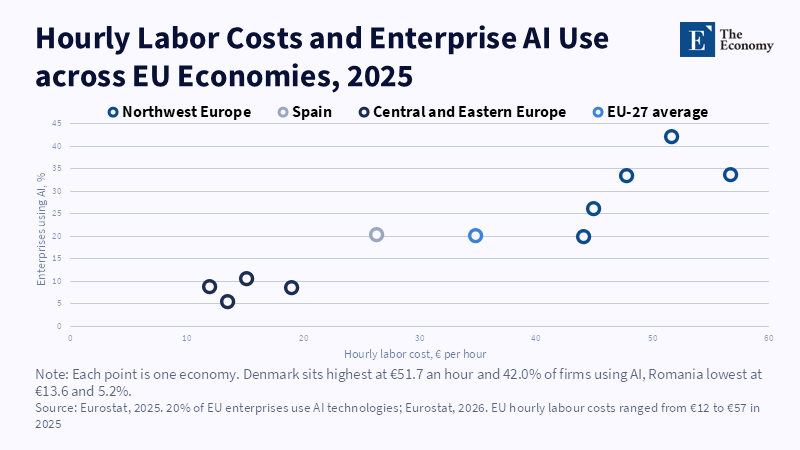
The number of advertised job openings in engineering/IT occupations in Germany decreased by ~28% (from an average of 148,230 to 106,310 in 2024 Q1 to 2025 Q2). This is suggestive of reduced engineer-hour requirements, but could also be attributable to macroeconomic conditions. World Bank data show that ~20% of the European and Central Asian workforce is exposed to AI, while adoption rates remain low (<10% of firms, with basic applications). This slow adoption is identified as a key challenge for the region.
Recent CEPR research on the U.S.-China tariff war offers a way to consider the distributional impacts on third economies. Since 2017, China’s share of U.S. imports has decreased from 22% to ~8% (2026), leading to considerable interest in identifying other economies with similar export baskets that may be positioned to replace China in U.S. trade. However, CEPR demonstrates that export similarity is a poor predictor of impact on individual economies and breaks down the effects into export & import competition, consumer and input cost savings. In this scenario, Asian economies would similarly face higher export competition, while European consumers and producers benefit from lower product costs and Asian producers benefit from reduced costs and improved speed of technology development. The distributional effects of this across economies will therefore be mixed.
Furthermore, transitioning to this new equilibrium will involve reallocations of factors and resources (e.g. physical manufacturing locations/processes, engineers, capital flows), which will imply some losses for certain locations/firms. The potential gains to some economies will therefore not fully offset the losses to others, meaning the transition to this new equilibrium will not be Pareto-improving.
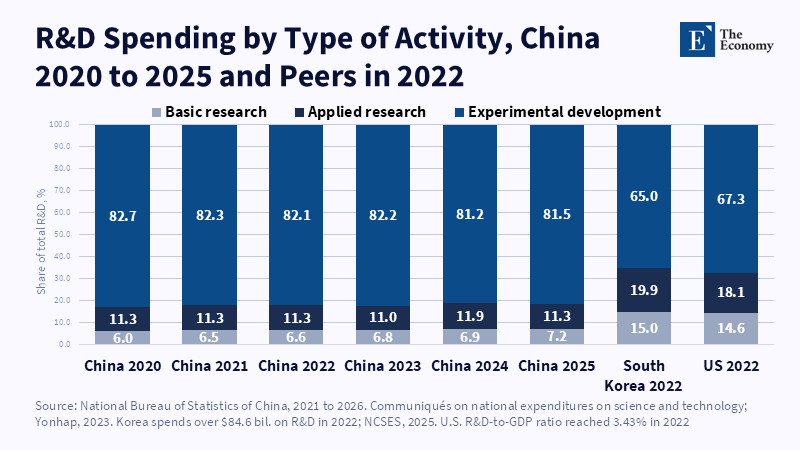
It remains to be seen whether East Asian economies will continue to maintain their current pattern of R&D expenditure. China’s 2024 R&D spend was 3.63 trillion RMB (+8.9% YoY) and Korea’s was ~5% of GDP (2nd highest in the OECD, behind Israel), predominantly undertaken by companies (79.2%). This has largely been spent on experimental development of existing products (~81% of China’s R&D spend, with <7% on fundamental research in China and ~15% in Korea). Whether these economies can shift towards more fundamental research and thereby continue to maintain their lead over others in developing new technologies will be key.
Ultimately, if Europe can adopt these technologies and combine them with its capital endowments and localised sophisticated demand, it can compete in a wider range of activities with fewer engineer-hours required. The race will be to determine how quickly each economy can adopt and integrate these tools into its production, which will unfold in the coming years.
The views expressed in this article are those of the author and do not necessarily reflect the views of The Economy, its Editorial Board, or any affiliated institution.
References
Antràs, P., Kulesza, A. and Presbitero, A. (2026) The Remains of the Trade: The U.S.-China Trade War and its Aftermath. CEPR Discussion Paper No. 21948. London: Centre for Economic Policy Research.
Becker, J., Rush, N., Barnes, E. and Rein, D. (2025) Measuring the Impact of Early-2025 AI on Experienced Open-Source Developer Productivity. METR.
Ministry of Science and ICT (2024) 2023 R&D Activity Survey. Sejong: Ministry of Science and ICT.
National Bureau of Statistics of China (2025) Statistical Communiqué on National Expenditures on Science and Technology in 2024. Beijing: National Bureau of Statistics.
Scientific American (2026) ‘An exclusive conversation with the developer of REA, the viral AI reverse engineering tool’, Scientific American.
Swiss Institute of Artificial Intelligence (2026) ‘AI is eliminating East Asia’s reverse-engineering advantage’, SIAI Memo, 3 November.
World Bank (2026) Europe and Central Asia Economic Update: Making AI Work: Jobs, Firms, and Productivity. Washington, DC: World Bank.
Working across research, policy, and data-driven analysis, the Editorial Board ensures that published pieces reflect a consistent institutional perspective grounded in quantitative reasoning and long-term structural assessment.
Similar Post