U.S.-China Trade Diversion Rewrites the Equilibrium for Both Sides

Working across research, policy, and data-driven analysis, the Editorial Board ensures that published pieces reflect a consistent institutional perspective grounded in quantitative reasoning and long-term structural assessment.
Authored On
Modified
Export similarity to China poorly measures trade diversion exposure
The U.S. and China both face costly re-equilibration
Third countries may gain from cheaper redirected Chinese goods
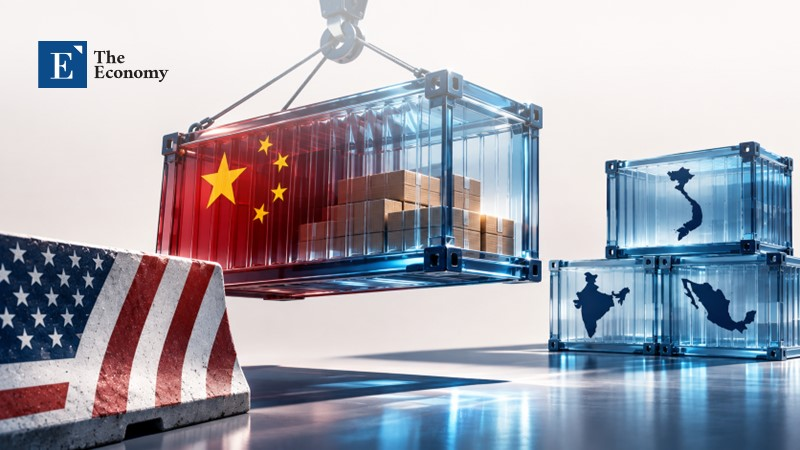
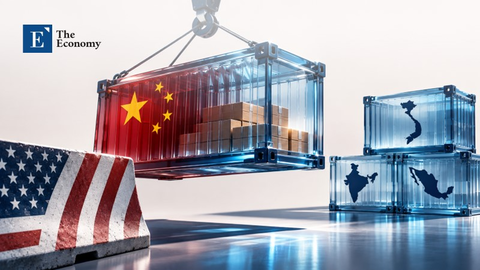
The share of U.S. imports coming from China has dropped from 22% in 2017 to around 8% in 2026, the lowest since China entered the WTO. Many of these goods have been redirected to the rest of the world, and much discussion of U.S.-China trade diversion has focused on identifying which countries are best placed to intercept them. Broadly, this has meant looking at countries with export compositions similar to China’s, an approach ECB staff used in 2025 to assess which countries may substitute for China in the US. However, a recent VoxEU article by Harvard and IMF economists, based on NBER Working Paper 35785, shows this is a crude measure of vulnerability to trade diversion, and its findings go beyond the paper's remit.
Similarity to China is a Poor Guide to Exposure
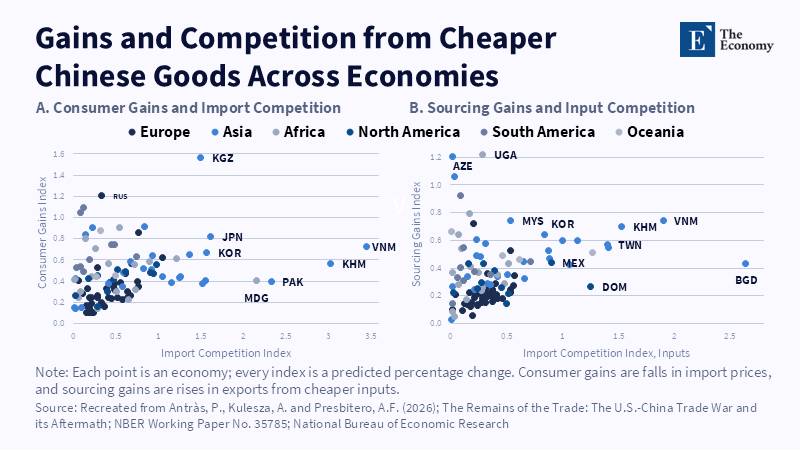
As the VoxEU piece points out, trade diversion can affect economies with similar export profiles to China in very different ways. Two economies with identical export baskets can experience divergent shocks to trade as Chinese imports arrive. Existing similarity metrics do not account for the magnitude of the trade shock across individual product categories, nor do they distinguish whether economies are affected as competing producers or as buyers. The authors propose four alternative metrics to better characterise trade diversion: competition as an exporter in third countries; import competition for domestic producers; import benefits to final-goods consumers; and import benefits to firms sourcing inputs. For example, Germany ranks sixth for export similarity with China, but is not in the top 20 for competition as an exporter with China in third countries. India has significant import competition from China with respect to mobile phones, which make up almost a third of this metric, against about a fifth for South Korea.
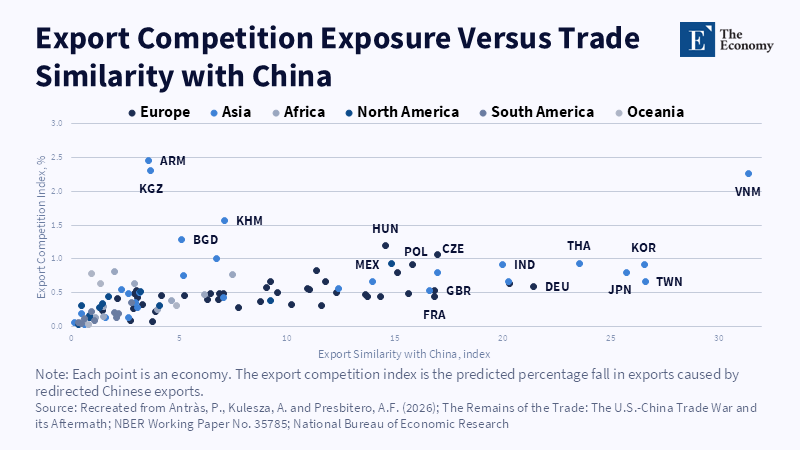
These metrics characterise where the initial effect of the change in the price of Chinese imports will fall in each economy, conditional on the existing distribution of trade and elasticities of trade between each economy and China. There will inevitably be a second-order effect as the global economy converges to a new equilibrium following US-China trade diversion, which the metrics above do not address.
No Partner Can Stand In for China at the Old Prices
As per the Heckscher-Ohlin model of international trade, countries will have comparative advantages in specific products according to their factor endowments, and thus will trade to benefit from accessing other goods and services at a relatively lower cost. If there is an obstruction to trade between the U.S. and China, this simply means each must find alternative partners to trade with, subject to the factor endowments of those partners and their resulting comparative advantages. For instance, Vietnam can produce many of the same goods as China using cheap manufacturing labour, but will not have equivalent levels of capital and intermediate inputs to supply all of the US. As such, goods whose production moves to Vietnam will not simply be produced at an equivalent price to those previously coming out of China.
Conceptually, it is possible to picture each bilateral trade relationship between two countries as an Edgeworth box with the initial factor endowments of each country and a new equilibrium level of trade and relative price between the traded goods. But of course multiple countries are trading in each product, so there is no unique Edgeworth box for each pair of economies, only a general equilibrium trade price in each product. Nevertheless, the point is that each new trade partner of the U.S. and China will represent a new Edgeworth box, with a new equilibrium relative price for goods previously supplied from China. Furthermore, the diversion of trade also reflects intermediate goods and production networks. For example, a recent working paper from the Kiel Centre for Globalization, updated in August 2026, finds that Vietnamese firms increased imports from China and exports to the U.S. following the U.S. tariffs on Chinese goods, suggesting some re-routing of production to Vietnam and/or transshipment. It is unclear to what extent the inputs of production have been similarly diverted to Vietnam.
U.S.-China Trade Diversion Leaves the U.S. With Its Own Adjustment Bill
It is likely that most analyses of trade diversion will focus on the impact on the Chinese economy. However, the U.S. is also seeking to trade with new partners to replace the trade it lost with China, and therefore faces an analogous adjustment process:
- initial shock: loss of existing trading partner
- seek to replace with new partners
- will experience lower/higher prices as they sell to/import from new partners
- will need to satisfy demand/supply constraints of the new partners
- will incur transition costs to reach a new trading equilibrium
China can seek to export the goods to other regions of the world and potentially do so at a lower price, requiring lower profit margins per unit and/or reconfiguring its supply chain to meet the demand of the new market. Similarly, the U.S. will need to find alternative sources of imports from which to meet demand, which will be more costly and/or require supply-chain reconfigurations to source new inputs and produce the desired quantity/quality of goods. The U.S. and China will both be forced to operate at new equilibrium relative prices of the goods they import/export to these new partners.
Adjustment Speed May Decide Who Bears More of the Cost
So far, the analysis has not considered how quickly each economy will converge to this new equilibrium. This will be dependent on many factors, including adjustment costs across goods and factors, immobility of capital, supply-chain and input relationships, and labour mobility. As such, there are also questions of how much is lost to the U.S. and Chinese economies during this transition period, and how long that period is expected to last. This will determine whether the U.S. or China is better positioned to weather the trade diversion. For example, if China can re-route its exports within 2 years, but it takes U.S. firms 5 years to re-source and scale new imports, then the Chinese economy may be less impacted overall by the U.S. tariffs. The opposite could be true, with weaker internal demand in China and greater trade barriers in the EU and other emerging economies on China’s horizon. Of course, the time to convergence will not be indicative of how profitable the new equilibrium will be for Chinese exporters or U.S. importers.
Third Countries May Collect Gains From the Trade War
Further, the distributional implications of trade diversion may not favour the US. If other economies increase their exports to the U.S. to make up the loss of Chinese imports, prices will rise for U.S. importers to the extent that supply in the short term cannot expand to match the U.S. increase in demand. Some studies, including a 2019 study by economists at Columbia, UCLA, Yale and Berkeley, suggest U.S. consumers and import firms bore approximately USD 51bn, about 0.27% of GDP, of the costs from the 2018 round of U.S. tariffs, aimed largely at Chinese imports, before accounting for tariff receipts and domestic producer surplus. On the other hand, China may decrease its price to sell its exports to these economies, increasing consumer and producer surplus, as identified in the VoxEU paper, to the detriment of Chinese producer surplus. So there is the potential for economies that are not directly involved in the US-China trade dispute to experience net benefits from trade diversion. This is subject to FX movements, potential retaliation against those economies, rerouting of trade through those economies and U.S. tariffs on goods from the diverted economies.
Given the above, it seems counterintuitive to seek out economies similar to China to replace China in trade with the US; after all, comparative advantage is predicated on each economy being different. Each new partner the U.S. or China seeks to trade with will be subject to its own endowments of factors, and therefore will need to be able to produce the goods in question at a price that the U.S. or China is willing to pay and that allows it to continue production. There is a role for tariffs in forcing the U.S. and other economies to reduce dependence on China for certain goods, but it remains to be seen if the costs incurred in the transition will be worth that benefit.
The views expressed in this article are those of the author and do not necessarily reflect the views of The Economy, its Editorial Board, or any affiliated institution.
References
Antràs, P., Kulesza, A. and Presbitero, A.F. (2026a) ‘Similarity is not exposure: measuring spillovers from US-China trade frictions’, VoxEU Column. London: Centre for Economic Policy Research.
Antràs, P., Kulesza, A. and Presbitero, A.F. (2026b) The remains of the trade: the U.S.-China trade war and its aftermath. NBER Working Paper No. 35785. Cambridge, MA: National Bureau of Economic Research.
Fajgelbaum, P.D., Goldberg, P.K., Kennedy, P.J. and Khandelwal, A.K. (2020) ‘The return to protectionism’, The Quarterly Journal of Economics, 135(1), pp. 1-55.
Gunnella, V., Stamato, G. and Kobayashi, A. (2025) ‘The implications of US-China trade tensions for the euro area: lessons from the tariffs imposed by the first Trump Administration’, Economic Bulletin, Issue 3/2025. Frankfurt am Main: European Central Bank.
Zou, T. and Gong, Y. (2026) Just passing through? The US-China trade war and reconfiguration of global value chains through Vietnam. KCG Working Paper No. 38. Kiel: Kiel Centre for Globalization.
Working across research, policy, and data-driven analysis, the Editorial Board ensures that published pieces reflect a consistent institutional perspective grounded in quantitative reasoning and long-term structural assessment.