Why American Drug Prices Are Higher: The Hidden Economics of State-Funded Healthcare

Working across research, policy, and data-driven analysis, the Editorial Board ensures that published pieces reflect a consistent institutional perspective grounded in quantitative reasoning and long-term structural assessment.
Authored On
Modified
MFN pricing does not explain why U.S. drug prices are higher
Public payers abroad delay access through assessment and budgets
Trade pressure shifts costs without settling who funds innovation

In May 2025, the President of the United States issued EO 14297 directing pharmaceutical companies to offer drugs in the U.S. at the lowest price available in a peer group of advanced economies, i.e., that they "not allow [Americans] to pay to underwrite cheap prescription drugs for the citizens of peer nations". Subsequently, as of December 2025, 13 pharma companies have entered agreements with the administration to offer their drugs at MFN prices via the TrumpRx website. The central assertion in the EO and associated press coverage is that the reason drug prices are higher in the U.S. is that they are held down in Europe, Japan and South Korea. The solution is to enforce MFN prices in the US.
A recent VoxEU article by authors affiliated with the CEPR critiques this claim and concludes that U.S. prices are not elevated by lower prices in peer nations and that raising peer-nation prices to U.S. levels would impose material costs on their healthcare systems, only generating limited savings for the US. The conclusion of the article holds. However, one aspect of their argument - which they present as context - merits further scrutiny: that lower prices in peer nations are enabled by the structure of their healthcare systems and that this in turn contributes to higher U.S. prices. When a new medicine is approved in England, Germany, Japan, or South Korea, its price is not simply set by the company. There is a public or publicly mandated payor who determines whether and how they will reimburse that medicine, having assessed its added benefit in relation to the payor's budget constraints. The medicine may be authorised and on the market, but inaccessible to the bulk of the population, until the payor determines it will reimburse it.
MFN Pricing Does Not Explain U.S. Drug Prices
Prices are set by pharma companies on a market-by-market basis to maximise their revenue. In the US, there are a number of payors and their procurement is fragmented across Medicare, Medicaid, employer-sponsored insurance and PBMs. Medicare, until recently, was prevented from negotiating drug prices (the IRA allowed negotiation for a small set of drugs). U.S. drug prices are estimated to be approximately 2.3x the mean price of 32 other OECD countries (RAND). U.S. prices already reflect what the U.S. payer base will accept. If pharma could push U.S. prices even higher, why would they want to hold down prices in Belgium? There is no mechanism whereby a reduced price in one peer nation will be "recovered" in the US. The U.S. price would have already been determined based on what U.S. payors will pay. It is therefore hard to identify a causal link between low European prices and high U.S. prices.
However, it is clear that by pegging U.S. prices to the lowest European price, pharma will be reluctant to grant discounts / lower prices in smaller European markets, as this would have knock-on effects in the largest market (the U.S.), representing ~40% of global pharma spending. They will therefore either try to negotiate a higher price in these countries or defer entry to Europe. As the CEPR article highlights, aggregate pharma profits are largely unaffected by an MFN policy, but national revenues and the speed of access to medicines in European countries would be negatively impacted.
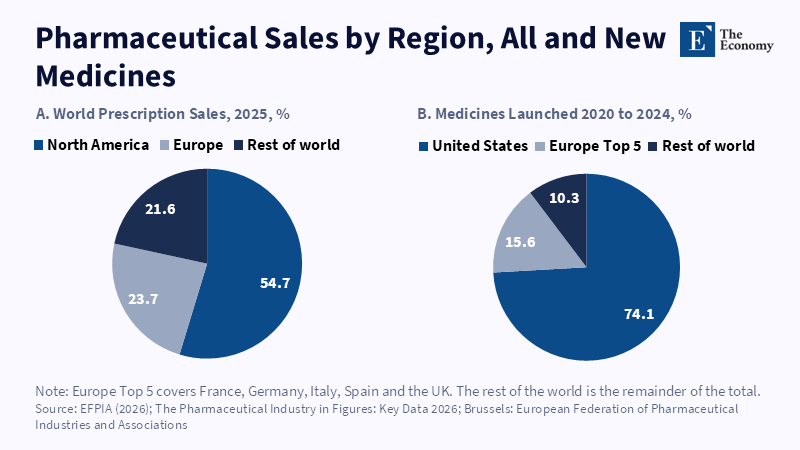
We are already seeing potential indications of this. Euronews referenced a paper in The Lancet that predicts MFN pricing could lead to later access to new medicines in Europe (September 2026). The European Patients Forum has published on similar concerns that MFN will defer medicines to European patients without delivering the desired U.S. savings from Medicare price reductions. A paper referenced by EU Perspectives (August 2026) estimates that the launch of cancer and ATMP drugs subject to JCA in Europe has decreased by 22.9%, consistent with MFN adding to an existing trend of deferral to Europe that is endogenous to European healthcare systems. EU Member States recently asked the EC to look into the potential impact of MFN on European drug launch. It remains to be seen to what extent MFN will defer access to new medicines to Europeans, but it is unlikely that this will be matched by equivalent savings for U.S. patients.
Approval Is Not Access in Public Healthcare Systems
An important consideration that is often overlooked in discussions of US-EU drug prices is the difference between marketing authorisation and reimbursement. Authorisation (by the EMA for the EU) confirms that the drug is appropriate to bring to market. Reimbursement (by national payors) determines whether and at what price the healthcare system will cover the cost of that drug and further considerations (e.g. hospital trust formulary decisions, local restrictions) affect whether patients can access it. As a result, medicines can be approved for the whole EU, yet only become reimbursed (and accessible to patients) in some Member States and after a delay. This can be particularly pronounced in smaller / lower income countries.
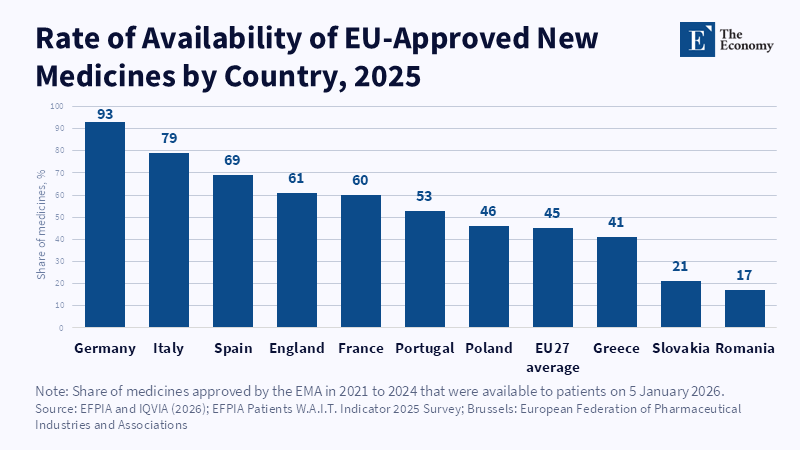
The NHS in England is a good example of this. NICE provides guidance to the NHS on whether to adopt new medicines based on a cost-effectiveness threshold of £20k-£30k/QALY. Companies seeking to enter the NHS will therefore seek to price/discount their drugs below this threshold. In December 2025, this threshold was increased to £25k-£35k/QALY (from April 2026) as part of the US-UK trade agreement, in exchange for no tariff on UK-made pharmaceuticals. NICE estimates that this will permit the adoption of 3-5 additional drugs p.a., although commentators suggest it may add up to £3bn to NHS medicines spend. This is a further indication of the extent to which drug prices in Europe are influenced by politics and susceptible to negotiation with the U.S.
In Germany, companies are able to freely set a price when they launch and it is covered by payors for an initial period. G-BA evaluates the added benefit of the medicine vs. existing therapies and the sickness funds (represented by the GKV-SV) will then negotiate a level of reimbursement in line with the added benefit. If there is no agreement, this will be determined by the Schiedsstelle. This period of free pricing was reduced from 12 to 6 months by the GKV Stabilisation Act (November 2022), as well as further conditions to ensure price-setting aligns with added benefit. Germany had previously been an attractive launch market for pharma given this longer window. Industry criticised the change, anticipating it may drive launches out of Germany. An evaluation of the impact was published by the German Ministry of Health and noted insufficient time to assess the impact.
Similarly, in South Korea, new drugs are subject to assessment and price negotiation with the HIRA and listing with the MOHW prior to reimbursement. These processes take place sequentially and can lead to substantial delays between authorisation and reimbursement (e.g. some orphan drugs > 3 years, despite a nominal assessment period of 240 days). There is a soft cost-effectiveness threshold (~25m KRW/QALY; ~50m for oncology and rare disease), which has not changed substantially since the introduction of pharmacoeconomic evaluation in 2006. Prices are published in Korea and form the basis of reference pricing by other countries, meaning pharma had an incentive to defer launch. Recently, the Korean government has taken measures to reduce these barriers, including a confidential/flexible price agreement system (June 2026), a fast-track reimbursement scheme (H2 2026) and differentiated cost-effectiveness thresholds (2027). South Korea is included in the list of 19 peer countries under the proposed U.S. GLOBE and GUARD models, meaning its prices may also be subject to MFN enforcement.
Drug prices in Japan are listed by the NHIA after new authorisations and benchmarked against an existing comparator drug or determined via cost-plus (with allowances for innovation). Listed prices are periodically reduced. Japan therefore offers rapid listing of new drugs, but the level of price is determined by the NHIA and reduced over time. This has led to comments in Japan that it results in a number of drugs not being submitted for authorisation in Japan.
Across these countries, the common feature is that prices are determined by a (quasi)public body responsible for procuring and financing medicines for a large share of the population and so incentivised to limit healthcare expenditure. There will also be limits to how rapidly healthcare spending can grow to accommodate new expensive treatments. In addition, prices in one European country feed into reference pricing by others (the VoxEU article cites ~300 references across EU rules). This makes it attractive for pharma to enter the U.S. market first and patients in these countries will wait for their respective payors to clear the price and reimbursement hurdle.
Who Should Fund New Medicines?
There are high fixed costs of drug development that require long periods of research and clinical trials (often > 10 years), but marginal costs of producing each subsequent unit are low. Pharma will seek to recover its fixed costs across multiple countries, charging each market as much as it can. The payer in each country will seek to procure maximum treatment given their budget constraint. To the extent that different markets will be prepared to pay different prices, differential pricing can efficiently allocate funding of these fixed costs of innovation. U.S. healthcare is amenable to being charged higher prices for medicines.
Of course, it does not follow that this will incentivise only new and valuable medicines. It will also incentivise 'me-too' drugs, spending on promotion, patent evergreening, etc. But some of the revenue generated from European markets will also fund R&D of new medicines. Indeed, one paper cited in the CEPR article finds that U.S. and EU revenues both promote new medicine registrations and pharma is marginally more responsive to EU revenues. Lower European prices are therefore not a pure subsidy from U.S. patients.
However, public healthcare systems also face challenges that are less commonly discussed by supporters of universal healthcare. By fixing a cost-effectiveness threshold over a long period of time and failing to adjust for inflation, public systems will systematically deny coverage to new treatments as costs increase. ABPI notes that NICE's threshold would be ~£48,300 if adjusted for inflation since its introduction in 1999, whereas a paper from Bangor University suggests the threshold should be ~£13,000/QALY to generate more value to the NHS. The Korean government has implicitly acknowledged that overly conservative assessments have caused delays to patients' access to innovative therapies and is taking steps to reform. There may be a role for higher cost-effectiveness thresholds and/or faster assessment to permit greater uptake of new treatments. It is not clear that this is best achieved through negotiations with the U.S. under the threat of tariffs.
The extent to which peer nations pay 'too little' or the U.S. 'too much' is an interesting, but secondary, discussion. More fundamentally, a group of wealthy countries is financing pharmaceutical innovation in very different ways and there is no agreement between them on how costs should be distributed. Imposing higher prices on these countries via U.S. trade policy will result in redistribution between countries and slower access to some medicines for patients in certain countries, but will not solve this issue. The CEPR authors rightly call for coordinated action by the EU and a related VoxEU article outlines the case for a centralized European payor to negotiate prices for innovative medicines on behalf of ~450m patients and with higher-contributing Member States sharing some of the cost. This would also serve to better defend against future attempts by the U.S. to negotiate prices. It does not, however, answer the question of whether public systems are paying enough for truly novel treatments or whether patients in certain countries are waiting too long to access medicines that are available elsewhere. This is a challenge inherent to running a public healthcare system and should be addressed as such. Recent developments in Germany, the UK and Korea go some way towards addressing it and their outcomes will need to be monitored in due course.
The views expressed in this article are those of the author and do not necessarily reflect the views of The Economy, its Editorial Board, or any affiliated institution.
References
Association of the British Pharmaceutical Industry (2025) UK-US deal is good news for NHS patients and will help to support UK life sciences competitiveness, says ABPI. London: ABPI.
Bangor University (2026) Why raising NHS spending on new drugs by 25% is the wrong decision for health. Bangor: Bangor University.
CEPR (2026) Harmonising access and reinventing the procurement of innovative medicines in Europe. VoxEU Column. London: Centre for Economic Policy Research.
CEPR (2026) Little gain for American patients, real harm for European ones: Why Europe must answer the US’ most-favoured-nation pricing as a Union. VoxEU Column. London: Centre for Economic Policy Research.
Council of Economic Advisers (2026) Savings from Most-Favored-Nation (MFN) Drug Pricing Policy. Washington, DC: The White House.
EU Perspectives (2026) ‘US pricing, EU assessment push new drugs out of Europe, says researcher’, EU Perspectives, August.
Euronews (2026) ‘US push to cut drug prices could mean longer waits for European patients’, Euronews Health, 14 September.
Executive Office of the President (2025) ‘Executive Order 14297: Delivering Most-Favored-Nation Prescription Drug Pricing to American Patients’, Federal Register, 90(93), pp. 20749.
Mulcahy, A.W., Schwam, D. and Lovejoy, S.L. (2024) International Prescription Drug Price Comparisons: Estimates Using 2022 Data. Santa Monica, CA: RAND Corporation.
Pharmaceutical Journal (2025) ‘NICE cost-effectiveness thresholds increased as UK strikes trade deal with United States’, The Pharmaceutical Journal, December.
Simon-Kucher (2022) Germany: How the GKV-FinStG law is transforming the pharma P&R landscape. Bonn: Simon-Kucher & Partners.
Simon-Kucher (2026) Korea pharma market access: Inside the 2026 drug pricing policy reforms. Bonn: Simon-Kucher & Partners.
Working across research, policy, and data-driven analysis, the Editorial Board ensures that published pieces reflect a consistent institutional perspective grounded in quantitative reasoning and long-term structural assessment.