Why Supporting Families Is Not the Same as Supporting Working Mothers

Working across research, policy, and data-driven analysis, the Editorial Board ensures that published pieces reflect a consistent institutional perspective grounded in quantitative reasoning and long-term structural assessment.
Authored On
Modified
Tax codes can penalise married mothers who take jobs
Europe and Asia tax second earners through different channels
Retaining working mothers should be costed over a lifetime

Just 2/3 of US mothers of young children are in the labour force and for many low-income married mothers, the second earner penalty identified below is a significant factor. A married mother working in a household at the bottom of the income distribution will face an effective participation tax rate of >25% in many circumstances and as high as 60%, including childcare. That is, she can give up over 50% of her income by deciding to enter the workforce.
The Second Earner Penalty Begins at the Pay Stub
The second earner penalty arises from the interaction of two policies: the Child and Dependent Care Credit (CDCC) and the Earned Income Tax Credit (EITC). The CDCC caps the qualifying expenses and is not refundable, meaning it offsets only a small proportion of actual childcare costs. The EITC is based on total family income, so as the second earner’s (typically the mother’s) income rises, the EITC the couple is entitled to on the first earner’s income falls. The combined effect of these two is to penalise low-income couples who want to work more. If the family’s income is low enough that they don’t pay tax, the CDCC will offer limited support and as the second earner’s income grows, the EITC phases out.
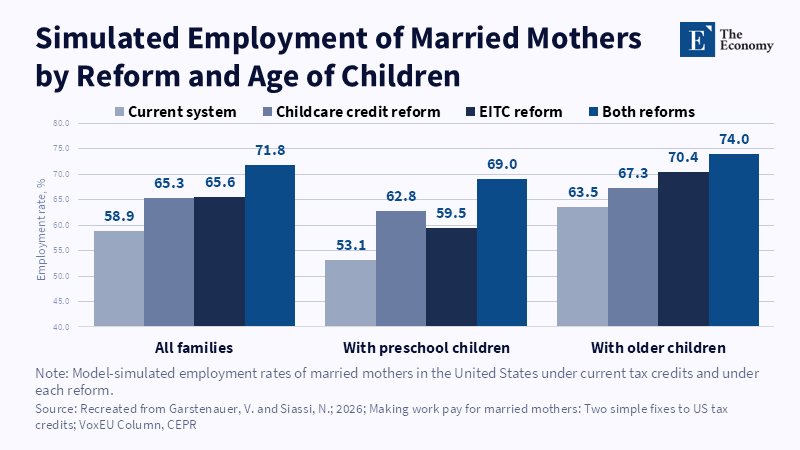
The remedies suggested would be to make all childcare expenses qualify for the CDCC and base the EITC on the greater of the two incomes. The former would primarily benefit couples with a higher first earner (>$40k) and the latter would benefit lower-income couples. Taken together, in the model, they increase the employment rate of married mothers from 59% to 72%. The related working paper suggests they are revenue-neutral over the working lives of these mothers. Naturally, these results are for one narrow slice of the US population, but they indicate the magnitude of the issue.
The authors point out that a number of other OECD countries apply the same principle in their respective in-work tax credits (NZ, FR) and childcare tax credits (BE, FR, ES), though this article does not go on to consider the implications. Indeed, OECD countries spend substantial amounts supporting families with children, but the participation tax rate faced by a mother increasing her hours is a different concept.
Europe and Asia Tax the Second Wage in Different Ways
In Germany, the tax unit of a married couple means that a low-earning second earner (overwhelmingly a mother) will pay high marginal tax rates on her initial income. The 2025 OECD Economic Survey of Germany concluded that joint assessment increases the effective tax rate of second earners and that individual taxation would increase their (predominantly women’s) labour supply. It also noted that this would lead to increased tax for some single-earner households. Germany has been reluctant to abandon the joint assessment of married couples for this reason.
France offers a refundable tax credit at 50% of childcare costs up to a maximum of €3,500 per child p.a., partly similar to the change proposed for the US CDCC above. However, the French in-work tax credit (the prime d’activite) is calculated on household income, such that increased income of a second earner will reduce this payment and partially offset the childcare tax credit.
Sweden taxes individuals and limits the fees charged for childcare, resulting in a lower tax rate and lower childcare costs for mothers. A high-cost system to emulate but informative.
In Switzerland, the people recently voted in favour (54%) of the Federal Act on Individual Taxation, to take effect on 1 Jan 2032. This will replace the joint taxation of married couples at all three levels of government. It is expected that dual-income couples will see tax reductions, while those with a high-earning and a lower-earning partner will see a tax increase. There will be little direct impact on mothers’ childcare costs, which are currently among the highest in Europe.
In Japan, mothers will limit their working hours to keep their income below certain thresholds (‘income walls’) that cause the loss of a spousal tax allowance or entry into the social insurance system as a payor. The 2026 OECD note ‘Strengthening work incentives for second earners’ considers the impact of removing the spousal tax allowance and smoothing the fees charged for childcare for under-3s. The latter would lead to lower net costs at almost all income levels as mothers earn more. Abolition of the spousal allowance would provide additional benefits at higher incomes. The Japanese government has taken some action to adjust income walls, but there remains a spousal allowance and stepwise fees for childcare.
In Korea, the Earned Income Tax Credit distinguishes single- and dual-earner households, although it is calculated on household income. Childcare is widely subsidised and Korean mothers are increasing their labour supply (to 64.3% in H1 2025 for mothers of children under 18). Nevertheless, this remains below the OECD average of 71% and 47% of women’s jobs are in the non-regular sector, vs. 31% for men (OECD report on declining population). The Korean Ministry of Gender Equality and Family found that 56.7% of women surveyed (aged 19-54) had taken a break from the labour market. Of these, those who took a break after marriage/birth of a child took 7.5 years to return, vs. 1.7 years for breaks due to poor pay/conditions. While the EITC would help incentivise a return to work, it does not address the loss of status/seniority on return and the propensity for women to be hired into the non-regular sector at lower wages.
China has introduced a monthly tax deduction of RMB2,000 for each child under 3 to be split between parents or allocated to one and from 2025 a cash payment of RMB3,600 p.a. to parents with children under 3. These will reduce the costs of rearing children but do not create a work incentive. The deduction would also be of little benefit to those below the tax threshold. In Singapore, the Working Mother’s Child Relief provides for income tax relief of S$8,000, S$10,000 and S$12,000 for the 1st, 2nd and 3rd+ child (respectively) to mothers in employment. This directly incentivises mothers to work, but is more valuable to higher-income mothers (as a tax relief and not refundable).
What a Mother Keeps From Extra Work Is the Number to Measure
Rather than comparing levels of government expenditure on children and families, it would be more useful to calculate the net return to the family from increasing a second earner’s hours.
Net return to work = Additional earnings - Additional taxes - Lost benefits - Net childcare costs
Using the tax-benefit module and modelling childcare costs for a second earner increasing from 0 hours to part/full-time, the component factors of this equation can be derived for the OECD countries using existing tools (OECD Tax-Benefit Calculator and EUROMOD). This could be applied to a standardised family (e.g. two adults and one pre-school child), keeping the income of the first earner constant.
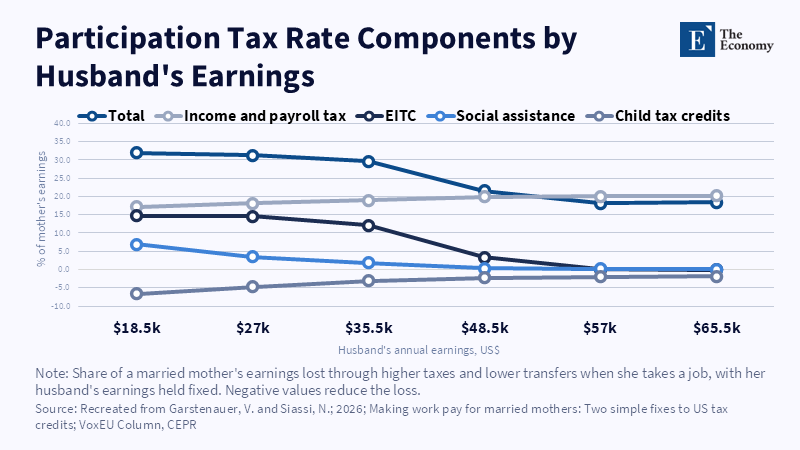
Table 1: Drivers of the Second Earner Penalty Across Nine Economies
| Country | Issue(s) driving penalty | Key policies | Comments |
|---|---|---|---|
| US | EITC & CDCC | EITC based on household income; CDCC capped and non-refundable | Up to ~60% participation tax rate for low-income married mothers |
| Germany | Joint taxation | Married couple tax unit | Tax rates on initial earnings of second-earner reflect first-earner’s marginal tax rate |
| France | Household-based in-work credit | Married-couple tax unit; 50% refundable childcare tax credit (capped) | Substantial support to childcare, but household-based in-work credit offsets |
| Sweden | n/a | Tax unit is individual; limited childcare fees | Low marginal tax rate and childcare cost for second-earner |
| Switzerland | Joint taxation | Married couple tax unit | Married couples will see reduction/increase in tax depending on relative income of spouses |
| Japan | Income walls | Spousal tax allowance; social insurance system | Hours limited by second-earner to remain below threshold |
| South Korea | Career interruptions | EITC distinguishes single/dual-earners; extensive childcare subsidies | 47% of working women are in the non-regular sector |
| China | n/a | Tax deduction/cash payment for young children | No work incentive |
| Singapore | Insufficient value for lower incomes | Working Mother’s Child Relief provides income tax relief for working mothers |
The U.S., Germany and Japan have high second-earner penalties built into their tax-benefit systems, while others have addressed one issue (e.g. FR’s childcare cost, CH’s tax unit) and not others. South Korea does not face the same penalty on return to work, but the interruption to mothers’ careers will reduce their lifetime earnings and tax.
Lifetime Earnings Turn Work Incentives Into Tax Revenue
The human capital of working women will grow and that of those out of the workforce will decline. This will result in the policies being revenue-positive. It is therefore useful to think of policies to support mothers’ return to work not simply in terms of annual budget cost, but against the lifetime earnings of women that would be lost. The OECD projects Japan will have an ageing dependency ratio of 56 in 2026 (100 working age: 65+) and South Korea will surpass it by 2060. Both countries therefore have an imperative to retain women in the labour market.
Whether improving work-motherhood compatibility would lead to higher birth rates is unclear. Cross-country correlation is indicative, but causal inference would require further study and consideration of a wide range of policies to facilitate mothers in the labour market. However, while family support and work incentives could be assessed separately, it is likely that they are funded from the same pool. Some of the measures taken to support families will undermine work incentives for mothers and vice versa. The U.S. could introduce the measures proposed with limited budget costs and with revenue-positive effects. Other countries would need to consider how to implement similar reforms and who would bear the costs. The Swiss vote is a start.
The views expressed in this article are those of the author and do not necessarily reflect the views of The Economy, its Editorial Board, or any affiliated institution.
References
Bär & Karrer (2026) Individual taxation approved in referendum. Briefing, 8 March. Zurich: Bär & Karrer.
China Daily (2025) ‘China introduces childcare subsidy system in push for population growth’, China Daily, 11 September.
Garstenauer, V. and Siassi, N. (2026) ‘Making work pay for married mothers: Two simple fixes to US tax credits’, VoxEU Column. London: CEPR.
Inland Revenue Authority of Singapore (2026) Working Mother’s Child Relief (WMCR). Singapore: IRAS.
Ministry of Gender Equality and Family (2026) 2025 Survey on Women’s Economic Activity and Career Interruption. Seoul: Ministry of Gender Equality and Family.
National Data Agency (2025) 2025 Regional Employment Survey: Employment Status of Married Women. Daejeon: National Data Agency.
OECD (2025) OECD Economic Surveys: Germany 2025. Paris: OECD Publishing.
OECD (2026a) Exploring Korea’s Fertility, Work and Family Policy Trends. Paris: OECD Publishing.
OECD (2026b) OECD Economic Surveys: Japan 2026. Paris: OECD Publishing.
OECD (2026c) Strengthening Work Incentives for Second Earners in Japan. OECD Studies on Tax and Benefit Reforms. Paris: OECD Publishing.
Service-Public (2026) Impôt sur le revenu: Frais de garde d’enfant hors du domicile (crédit d’impôt). Paris: Direction de l’information légale et administrative.
Working across research, policy, and data-driven analysis, the Editorial Board ensures that published pieces reflect a consistent institutional perspective grounded in quantitative reasoning and long-term structural assessment.