Rare Earth Supply Shocks: The Strategic Costs Beyond GDP Losses

Working across research, policy, and data-driven analysis, the Editorial Board ensures that published pieces reflect a consistent institutional perspective grounded in quantitative reasoning and long-term structural assessment.
Authored On
Modified
An 80 percent rare earth cut could cost Japan 1.8 percent GDP
Missing export licenses halted Ford, Suzuki and European suppliers
China’s dominance will fade, but slowly and at cost

All the rare earths together represent only a very small proportion of global trading volumes and values. Compared with major commodities such as oil, gas and copper, their total value is modest and they were often little more than an aside in general predictions of future macroeconomic performance. From 2025, however, Chinese restrictions on exports of seven medium and heavy rare earth elements, or REEs and certain permanent magnets led to lost production across the US, Japan and parts of Europe, depriving producers of an input that they appeared previously to have taken for granted and which was unavailable regardless of the offered price. Any review of events from late 2026 will need to consider the scale of lost production, as well as the wider implications of being at the mercy of others for key industrial inputs.
GDP Impact of a Rare Earth Supply Shock
In a VoxEU piece, a group of IMF authors considers the effects on various economies of cutting their supply of imported rare earths by 80 percent. Over horizons of less than a year, this would reduce GDP by around 1.8 percent for Japan, 1.5 percent for the U.S., 1.3 percent for Germany, 0.7 percent for France, 0.6 percent for India and 0.6 percent for the UK. These are all hypothetical exercises. Nevertheless, they are clearly very significant compared to the overall traded value of rare earths.
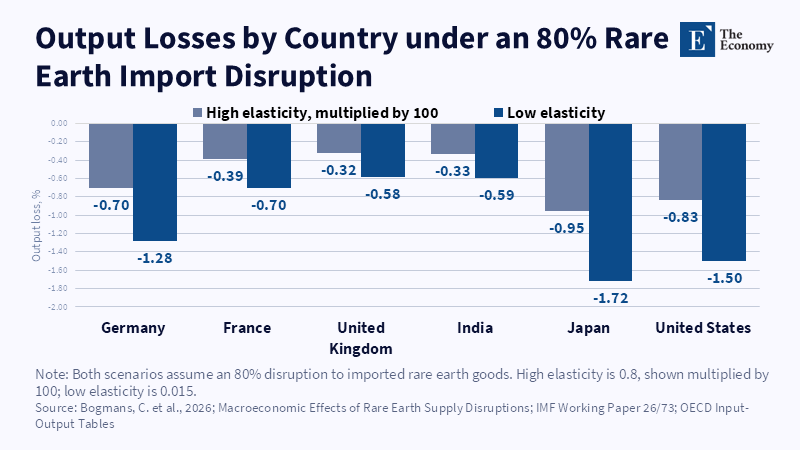
If only the proportion of total costs represented by rare earths in various industries were considered, multiplied by the gross output for those industries, the totals would look much smaller. But many users, notably the auto and wider electronic and mechanical engineering industries, are key nodes in the domestic economy, supplying and sourcing a wide range of products. It is easy to see how loss of supply to one set of products, such as motors, could cascade to a large number of other industries supplying and dependent upon that manufacturer. There would also be little scope in the short term for switching to other inputs.
Clearly, all these knock-on effects are captured by the methodology used in the above IMF paper, so it goes well beyond the effect of the higher cost of the inputs alone. Whatever additional effects arise from the strategic nature of relying on others for supply, therefore, would be a separate dimension of vulnerability rather than an addition to these fairly substantial numbers. Obviously, the value of lost production over some time period is very different from the risks posed by another country controlling supply, although this latter effect may barely register in measured national income. It is worthwhile to emphasize the extent of reliance on China for these inputs. According to the IEA's 2026 report, China produced around 91% of all refined REEs used to make magnets and 94% of sintered magnets globally in 2024. Clearly, there would be very little opportunity to source from other countries if supply from China were cut off.
Strategic Costs Beyond Lost Output
There were a number of examples of production being lost in 2025 as a result of inadequate supply of rare earths and magnets. Ford stopped making Explorers in Chicago for around one week in May; Suzuki stopped making Swifts for a period in Japan due to a range of missing components attributed by Reuters to Chinese restrictions; many lines and plants supplying car makers were shut down across Europe and the industry body, CLEPA, warned of further shutdowns as stocks ran down, with only about a quarter of license requests granted. Presumably, all of these manufacturers had adequate demand and financing available.
With most commodities, if prices increase significantly, the purchaser may decide to tolerate reduced profits, raise selling prices, use lower-specification inputs or otherwise pay premium prices. If an indispensable input becomes unavailable and no suitable alternative source is available, none of these alternatives is open. Offering any price will be pointless if no license to purchase has been granted. All production will be constrained by whichever input is most limited. Of course, finding alternative suppliers may itself take time to gain appropriate approvals to supply particular customers.
There are thus a number of areas where national interests could be damaged, over and above immediate lost output. Firstly, the many military applications of REEs and their alloys would be affected if deliveries to manufacturers were delayed, or even if servicing and replacement parts were delayed. Secondly, companies would suffer loss of business and possibly delay in R&D and the introduction of new models, for example in chips, robots or scanning equipment, compared with competitors able to continue production. Thirdly, countries would be disadvantaged in any negotiations, knowing how much their industries depended on receiving licenses.
It appears from shipping statistics reviewed by CSIS in November 2026 that deliveries of some restricted products to the US and Japan have fallen markedly, compared to total deliveries over the same period. It may be coincidence, delays in gaining licenses, changes in the location of various stages of manufacture or other reasons, so it would be presumptuous to assume all or most was intentionally directed away from those two countries. Nevertheless, it illustrates the potential effect. China announced it would keep suspending the wider range of controls it announced in October 2025 until January 10, 2027. This did not affect the requirement to obtain licenses for many products since April 2025. Although clearly a positive diplomatic step, it still left open a major lever over many industries.
A Slow Correction Leaves Years of Exposure
Presumably, there are many reasons China would not want or be able to maintain its current dominant position in supply. Imposing various restrictions has encouraged research into new methods, improved efficiency and alternative materials to achieve the same ends. A recent NBER paper by Alfaro et al. concludes that there was significant innovation spurred by China's 2010 restrictions. It is also not surprising that the magnitude of the macro impact described above declines substantially as the time period lengthens, allowing substitution and new sources to be developed.
However, simply discovering more deposits to mine would not by itself address these concerns, as there are many further steps required to reach usable magnets for final manufacturers, each requiring substantial expenditure and approval and some dependent on processes only carried out by a limited number of producers. Accordingly, the IEA's 2026 assessment finds that current plus planned capacity outside China is insufficient to meet expected requirements by 2035, particularly at the refining and magnet stages.
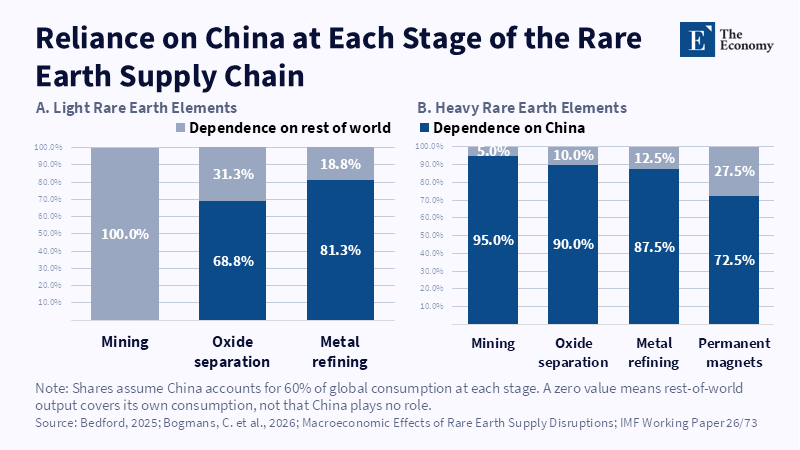
Given the long lead times involved in bringing new capacity into production, perhaps up to 10 years, it is clear that all areas of concern described above will continue for several years at least. Various mitigations can be undertaken: holding stocks of various grades of oxides and magnets would clearly help bridge a period of a few months, although finance departments may chafe at the carrying costs after any emergency has abated. Other options include building more refining and magnet capacity in other friendly nations, assured orders from users to facilitate required investment, reclaiming from scrapped products and developing motors requiring less or no heavy rare earths. Producing all requirements domestically would be feasible but may well prove an expensive solution. Japan has tried to develop other sources since around 2010 and has clearly achieved some success, but remains very reliant on China, illustrating the length of time likely to be needed to reduce dependency. Presumably, all measures will gradually reduce China's pre-eminence, but the cost and to whom, of the interim period is difficult to assess.
The views expressed in this article are those of the author and do not necessarily reflect the views of The Economy, its Editorial Board, or any affiliated institution.
References
Alfaro, L., Fadinger, H., Schymik, J.S. and Virananda, G. (2025) Trade and Industrial Policy in Supply Chains: Directed Technological Change in Rare Earths. NBER Working Paper 33877. Cambridge, MA: National Bureau of Economic Research.
Bogmans, C., Jerez-Osses, M., Miranda Pinto, J. and Natal, J.-M. (2026a) Macroeconomic Effects of Rare Earths Supply Chain Disruptions. IMF Working Paper 26/73. Washington, DC: International Monetary Fund.
Bogmans, C. et al. (2026b) ‘Macroeconomic effects of rare earth supply disruptions’, VoxEU, Centre for Economic Policy Research, November.
Center for Strategic and International Studies (2026) One Year After Busan: Has China Kept Its Rare Earth Promises? Washington, DC: CSIS.
CLEPA (2025) Urgent Action Needed as China’s Export Restrictions on Rare Earths Disrupt European Automotive Supply Chains. Press release, Brussels, 4 June.
Griffin, O. (2026) ‘“China’s Export Control Reprieve Buys Time,” but EU Supply Chain Independence Faces a Dilemma’, The Economy, 12 November.
International Energy Agency (2026) Rare Earth Elements: Pathways to Secure and Diversified Supply Chains. Paris: IEA.
Reuters (2025a) ‘Factbox: Auto companies face shortages due to China’s rare earth restrictions’, Reuters, June.
Reuters (2025b) ‘Ford struggles with supply of rare earth magnets, CEO says’, Reuters, 13 June.
Working across research, policy, and data-driven analysis, the Editorial Board ensures that published pieces reflect a consistent institutional perspective grounded in quantitative reasoning and long-term structural assessment.