When Seeing Is No Longer Believing: AI and the End of Traditional Financial Authentication

Working across research, policy, and data-driven analysis, the Editorial Board ensures that published pieces reflect a consistent institutional perspective grounded in quantitative reasoning and long-term structural assessment.
Authored On
Modified
Cheap AI imitation erodes voices and faces as identity proof
Cryptographic tokens cannot stop deceived staff approving payments
Stronger payment checks raise costs, mostly for smaller firms
As recently as September 2019, in series 1 of The Capture, a member of the armed forces watched CCTV recordings of an offence that he knew he hadn't committed. "Correction" was used extensively, involving altering images from real-time CCTV to depict all sorts of fabricated occurrences. It's hardly surprising that at the time many reviewers thought this was absurd fantasy. Much of financial authentication now suffers from similar shortcomings, except typically there would be someone talking and visible on-screen, and funds transferred, well before verification took place.
Deepfake CFO Costs $25 Million
Around the beginning of 2024, an employee of Arup was induced to pay out HK$200m (c.$25m) following a video call with the company's CFO "and others". All of these other participants were deepfakes created by AI. Presumably nothing seemed amiss; otherwise the employee might have questioned the authenticity of the call. The employee merely took the prudent course of double-checking with several apparent senior management staff.
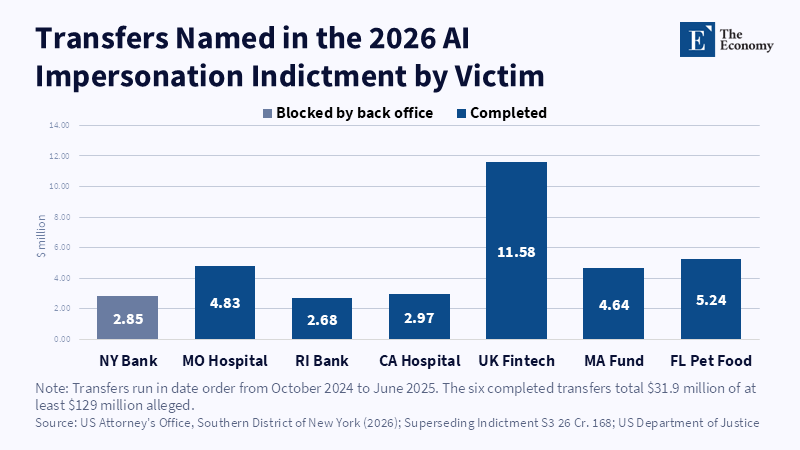
In November 2026 details were released of an indictment by the SDNY against 3 individuals, alleging total payments of at least $129m from July 2024 to February 2026 as a result of a number of different frauds. Naturally, all these facts are currently only alleged and the defendants are the subject of extradition proceedings. Broadly, targets would receive an email seemingly requesting an e-signature from the CEO, have them sign a stand-alone confidentiality agreement, then receive a call from a purported lawyer at a 'major' law firm instructing them not to inform colleagues due to securities law constraints. A synthetic version of the CEO would speak, and sometimes appear on screen, during these calls. Victims include a group of hospitals in Missouri totalling $4,829,580 and a UK FinTech losing $11,578,474.
Particularly notable was one attempt upon someone with relevant authorities at a major NY-based investment bank to pay around $2.85m in October 2024. Apparently, this was intercepted when processed by back-office functions. There is no further explanation as to how in the indictment. It would therefore seem to be the sole successful prevention as a result of some unknown process.
Pretending to be senior executives on video calls predates AI. From 2015-17 someone successfully appeared on numerous calls wearing a mask resembling Jean-Yves Le Drian, then the French Minister of Defence, obtaining over €50m. Presumably this involved considerable preparation, including at least one skilled mask-maker, suitable premises and audacity. Today, all that is needed is a short length of suitable speech to synthesize an individual's voice, so, unsurprisingly, there are thousands of attempted victims referred to in the indictment.
If Easy to Replicate, What Use Are Identity Checks?
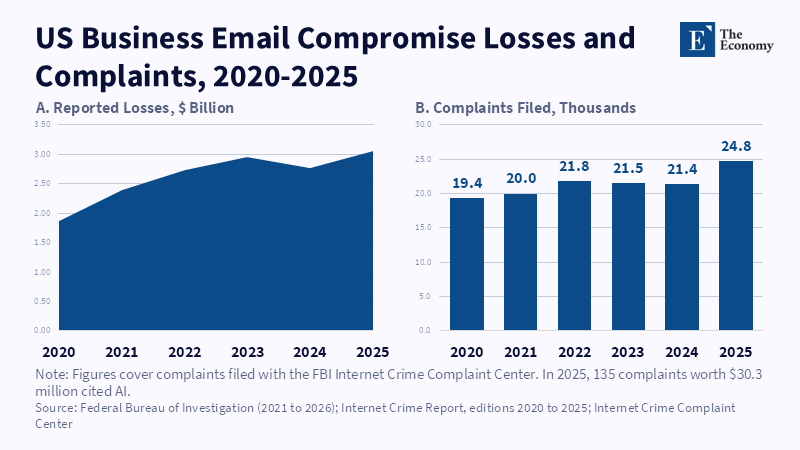
Clearly, any feature used to verify another's identity will be of limited value if readily simulated. Be it tone of voice, appearance, signature, knowledge of previous discussions and so on, all would have required significant effort, time and possibly put the fraudster at risk. As described above, these become trivially straightforward and hence, although still 'present', they cease to distinguish the true identity. Of course, there is ample material available publicly, such as results calls and other events, from which to generate an individual's speech, image and much biographical information.
It would seem intuitive to apply a number of such checks concurrently to increase security. However, as each could equally readily be generated by reference to the same sources, this provides much less reassurance. Virtually any attribute of an individual open to assessment could potentially be captured for input to a generating algorithm, and hence it's difficult to see what aspects could reliably continue to be relied upon to release funds.
An obvious exception would be some form of cryptographic authentication, where the secret is retained by the sender only (typically on a token) and a response is generated each time in response to a variable prompt. Thus, any previous capture would be worthless. Accordingly, NIST, in its recommendations on factors to establish digital identity (SP 800-63B-4), does not regard any characteristic of an individual as reliably 'secret' and only permits the highest levels with tokens providing resistance to phishing. For certain payments within the EU there is an additional safeguard requiring the generated code to relate to a particular payment amount and recipient.
This does not, of course, assist if all authorities are correctly applied by the target of the fraud. It would only certify issuance from an appropriate token, and be totally blind to any preceding deception or duress. As reported by UK Finance, there was a 19% increase in APP1 fraud losses in 2025 to £576.4m, all presumably duly 'authenticated'. Clearly, establishing an individual's identity does not address whether the instructions are genuine or whether the payment is appropriate.
The Rising Cost of Financial Authentication
Writing in VoxEU, Goodhart and Vu postulate an economy consisting purely of promises as to future deliveries, and having analysed data from 1981-2022 spanning 97 economies, conclude that a range of factors affecting the availability and quality of information are key to levels of trust placed in various domestic institutions. Logically, this would result in increasing reliance on face-to-face interactions for higher levels of trust, although they acknowledge being unable to identify any mechanism for maintaining this at greater distances.
Various countermeasures are therefore available to seek to ensure the person instructing a payment is as expected. These include re-calling a pre-agreed number, multiple approvers, maximum amounts per instance and dynamic linking as above, together with various screening activities to detect anomalies in, inter alia, recipients. All clearly require more time, additional people and devices, none of which would be effective against duress, internal complicity or infected equipment, let alone well-intentioned but erroneous instructions by authorized persons.
Clearly, there are varying abilities to absorb such additional checks and costs. It's reasonable to suppose the NY bank described above employs considerable resources reviewing outgoing payments, whereas the owner of a Florida-based manufacturer of animal nutrition, victim to $5,242,747, may well employ only a handful and none specifically tasked with questioning instructions purportedly from their CEO. Thus, it seems inevitable there will be greater costs (and delays) incurred making payments, particularly to unknown third parties and to other countries, to remotely open accounts and more generally for companies managing their cash. A major focus of FinTech over the last 20 years or so has been eliminating the costs associated with making payments remotely. This now appears set to increase materially as a consequence of the ability to fake the counterparty.
The majority of these activities would continue, albeit with some degree of reduced benefit from lower friction. More problematic will be finding means satisfactory to all parties to allay concerns once reliance has shifted away from the individual. Presumably, whatever solution is found would have to be robust to instruction by a very convincing impersonator to ignore normal procedure. At least one bank apparently achieved this, although how remains unknown.
The views expressed in this article are those of the author and do not necessarily reflect the views of The Economy, its Editorial Board, or any affiliated institution.
References
Associated Press (2026) ‘3 charged in scheme to use AI to impersonate CEOs and attorneys to steal $129 million’, ITV News, 6 November.
Chanan, B. (2019) The Capture, series 1 [Television series]. BBC One, 3 September.
European Commission (2018) Commission Delegated Regulation (EU) 2018/389 on regulatory technical standards for strong customer authentication and common and secure open standards of communication. Official Journal of the European Union, L 69.
Federal Bureau of Investigation (2026) Internet Crime Report 2025. Washington, DC: Internet Crime Complaint Center.
Goodhart, C. and Vu, K.M. (2026) ‘Trust beyond face-to-face contact: AI and the future of finance’, VoxEU Column. London: CEPR.
Jabotinsky, H. (2025) ‘When seeing isn’t believing: deepfakes, financial markets, and the limits of EU enforcement’, EU Law Enforcement, 31 December.
National Institute of Standards and Technology (2025) Digital Identity Guidelines: Authentication and Authenticator Management, Special Publication 800-63B-4. Gaithersburg, MD: NIST.
Nogacki, R. (2026) ‘Deepfake C.E.O. fraud: inside the $129 million indictment’, Kancelaria Prawna Skarbiec, 7 November.
UK Finance (2026) Annual Fraud Report 2026. London: UK Finance.
US Attorney’s Office, Southern District of New York (2026) United States v. Soall, Hazan and Sheetrit, Superseding Indictment S3 26 Cr. 168. New York: US Department of Justice.
Working across research, policy, and data-driven analysis, the Editorial Board ensures that published pieces reflect a consistent institutional perspective grounded in quantitative reasoning and long-term structural assessment.