The Fiscal Conversion Gap: Why AI-Led Growth May Fail to Rescue Public Finances

Working across research, policy, and data-driven analysis, the Editorial Board ensures that published pieces reflect a consistent institutional perspective grounded in quantitative reasoning and long-term structural assessment.
Authored On
Modified
Productivity growth alone barely narrows OECD long-run fiscal gaps
AI gains may reach profits faster than taxable wages
Wealth taxes cannot reliably capture the AI productivity dividend

One of the most entrenched tenets of public finance is that it is possible to grow out of high levels of public debt. Clearly, there are great attractions in being able to reduce the debt-to-GDP ratio simply by growing GDP, avoiding the unpopularity of raising taxes and cutting spending. And there seems little reason to doubt that widespread use of AI could substantially increase productivity across many office-based jobs and other areas such as healthcare. So this is very tempting material to salve the wounds of over-spending. However, in a VoxEU column of 15 November, an OECD economist writing for CEPR uses OECD projections out to 2060 to show why greater growth probably won't be sufficient to restore sound public finances, and some reduction in spending will be required. There are good reasons for this conclusion. But attention is then drawn away from questions over the adequacy of tax revenues given continued reliance on labour income as a key source of taxation.
Why Faster Growth Barely Narrows the OECD Fiscal Gap
The associated OECD paper, dated September 2026, calculates projected fiscal gaps over the period to 2060 for 35 OECD members and accession candidates. To maintain the debt-to-GDP ratio at approximately current levels, and to provide the current range of services and payments to individuals, the median country would need to improve its fiscal position by 4.7 percentage points of GDP over the period from 2027. For 10 countries, the equivalent figure exceeds 8 percentage points. These are the adjustments necessary simply to stabilise debt ratios. No allowance is made to pay down existing debt stocks, although in political discussion the two objectives are frequently conflated.
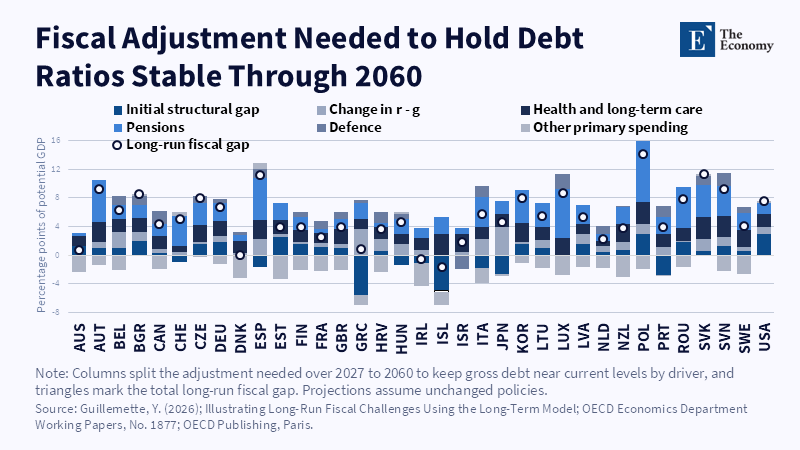
Many variables play a role in determining changes in debt ratios. To the extent that increased borrowing offsets higher GDP, there will be little or no impact on debt ratios. Productivity growth is likely to be associated with higher equilibrium rates of interest, so the difference between interest rates and growth rates would be expected to narrow to a lesser extent. Various items of expenditure track developments in private-sector pay and prices, and pension payments will also rise to the extent they are related to earnings. Expenditure will also increase with an ageing population, which would also tend to reduce the proportion of the population in employment.
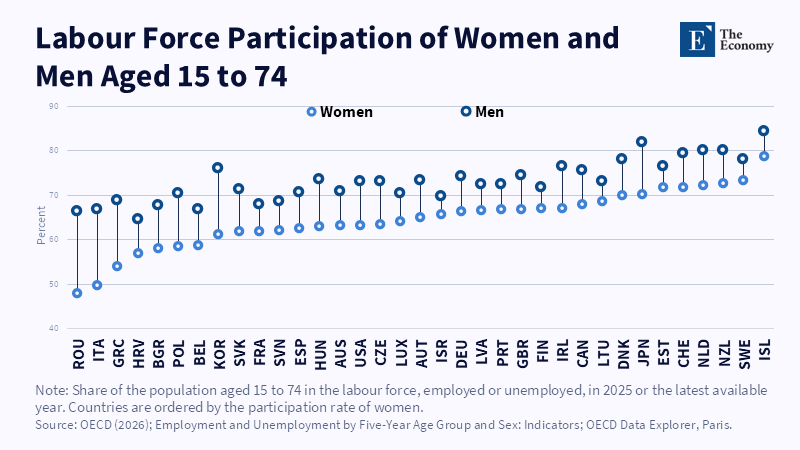
Of particular interest is the comparison of alternative scenarios which deliver identical increases in output by 2060. Increasing productivity to achieve 10% higher potential output has negligible impact on the projected median fiscal gap. On the other hand, if 10% higher output is achieved via increased employment, the projected gap falls by around 2.5 percentage points of GDP. It should therefore come as no surprise that once the effects flow through the public finances, increased employment generates substantially greater benefit. Not only are additional employees subject to taxation and social security contributions, but some government transfers will also presumably fall away; whereas higher earnings resulting from increased productivity will be associated with higher expenditure on many items.
There is considerable scope for public expenditure to rise as a consequence of higher living standards more generally. Hence, significant gains in productivity could result in a substantial proportion of this being used to finance increased public expenditure. An obvious extension to this analysis would therefore be to consider scenarios where productivity increases do not generate equivalent increases in taxable incomes.
How AI-Led Growth Can Outrun the Taxable Income Base
It would be expected that increased productivity would lead to greater payment of wages and salaries, and hence increased private spending, profits and associated taxes (income, social security, VAT and corporate taxes). To some extent, AI may alter the relative importance of these sources of receipts, short of causing large-scale job losses. To the extent a relatively small number of businesses were able to take significant advantage of using AI, one would anticipate substantial increases in profits and share prices for those companies, relative to a more limited rise in total pay bills. Thus, there could be considerable additional profits, IP-related income, distributions to shareholders and unrealised share-price appreciation.
There would be a tendency towards concentration of these additional returns on relatively few individuals and companies, depending on, for example, the level of associated capital and skills, flexibility, and market power. In addition, there would be changes in the relative importance of various categories of income for tax purposes; profits, investment income and unrealised increases in wealth all have varying degrees of taxation and methods and timing of collection. Finally, the increased productivity could occur domestically but with some associated payments to overseas providers of technology, IP, shareholders, and so on. These considerations point to possible reductions in domestic taxable income relative to output from the use of AI, potentially long before any significant job losses occurred, as discussed in a number of papers by The Economy Review.
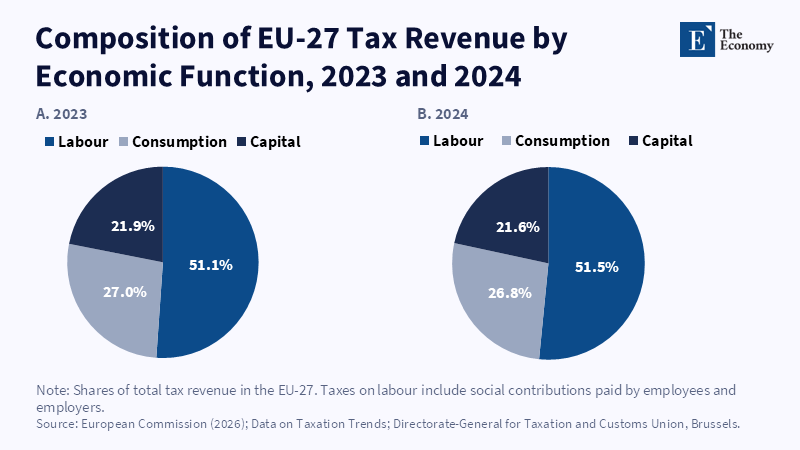
It is instructive to note the extent to which EU tax receipts rely on labour income. In 2024, taxes on labour represented 51.5% of total taxes levied in the EU-27, compared with 26.8% on consumption and 21.6% on capital. With most of it deducted at source, this is an extremely reliable source of funds.
None of these considerations imply reduced total tax revenues as a consequence of increased use of AI, and significant amounts could be raised from the very highest earners alone. Moreover, it should be stressed that studies examining individual tasks have suggested greater productivity benefits for less experienced workers. For example, a recent paper in the QJE considers the effect of AI on the performance of call centre operators, finding significantly greater effects for lower-tenure staff. Further improvements in efficiency within government departments may also mitigate the extent of expenditure linked to increased living standards.
Nonetheless, it seems plausible to suppose that certain types of growth may be associated with a reduced relationship between overall output and the level of income subject to domestic taxation. One indicator of this is "buoyancy", ie the ratio of the percentage increase in tax receipts to the percentage increase in nominal GDP, with values persistently less than unity indicating lower growth in the former. Actual buoyancy values would, of course, be affected by deliberate changes in tax policy and cyclical effects. If the increase in profits relative to other forms of income resulted in lower growth of expenditure linked to wages, this could be expected to partially offset part of the pressure on public finances identified by the OECD. However, this would be countered by reduced employment and related social security contributions and increased expenditure required to address the causes of unemployment. It is difficult to see how such questions can be addressed with broad assumptions about rates of productivity growth.
Why Wealth Taxes Cannot Be Counted On to Close the Gap
Presumably, one response would be to seek to raise the level of taxation borne by those benefiting most from these changes. There are a variety of ways in which returns to capital could be taxed. However, this will depend critically on form, residence, legal structure and timing. There will be a continuous flow of taxation on wages, whereas appreciation in asset values may remain unrealised indefinitely; profits may arise in a number of different countries and there may be difficulties in allocating income arising from certain types of assets. Various countries impose periodic taxes on net wealth. France now confines its tax to real estate following major reforms in 2018, whereas Norway continues to levy a fairly wide-ranging annual tax. Spain currently has a limited temporary tax on very substantial wealth. A range of other taxes on income and capital gains and on inheritance are discussed in an IMF discussion paper as possible ways of taxing wealth. A number of features of taxes on capital gains are highlighted in OECD work, all creating difficulties and trade-offs for policymakers. So clearly it is possible to levy substantial levels of tax on the wealthy. However, it would be over-optimistic to suppose all or most of the additional benefits from increased productivity due to AI could be tapped in an acceptable and efficient manner.
For countries with very substantial existing debt levels, there will be considerable future increases in spending on pensions and health, in addition to other pressures such as defense and higher interest payments. If at the same time there were significant gains from the use of AI concentrated on a few companies and individuals, increases in overall GDP alone would be insufficient. Various measures could increase revenues: more effective collection of taxes due, wider apportionment of profits and other rents internationally; greater reliance on various taxes on investment income and distributions, with attendant dangers of postponement and avoidance via relocation; measures to support levels of employment, recognizing the very significant benefits identified above from increased labour supply; and reductions in expenditure, bearing in mind possible detriments to growth and inequality. Imposing a tax on the use of AI itself would seem inappropriate, seeking to tax the cause rather than the resulting rents, as discussed previously by The Economy Review.
At present, little information is available to indicate to what extent current systems would be able to tax an appropriate proportion of additional value created from use of AI, without deterring its use. Thus, it remains an open question whether countries would be able to raise adequate revenues from an increased national income to meet their existing liabilities, let alone reduce debt levels. Increased wealth for a country does not automatically translate into adequate resources for government.
The views expressed in this article are those of the author and do not necessarily reflect the views of The Economy, its Editorial Board, or any affiliated institution.
References
Agencia Estatal de Administración Tributaria (2026) Impuesto Temporal de Solidaridad de las Grandes Fortunas. Madrid: AEAT.
Brynjolfsson, E., Li, D. and Raymond, L. (2025) ‘Generative AI at work’, Quarterly Journal of Economics, 140(2), pp. 889–942.
Direction de l’information légale et administrative (2026) Impôt sur la fortune immobilière (IFI). Paris: Service-Public.fr.
European Commission (2026) Data on Taxation Trends. Luxembourg: Publications Office of the European Union.
Guillemette, Y. (2026a) ‘Growth alone is an unlikely fiscal saviour: Resolving long-run fiscal tensions in OECD countries also requires expenditure restraint’, VoxEU, CEPR, 15 November.
Guillemette, Y. (2026b) Illustrating Long-Run Fiscal Challenges Using the Long-Term Model. OECD Economics Department Working Papers, No. 1877. Paris: OECD Publishing.
International Monetary Fund (2024a) Broadening the Gains from Generative AI: The Role of Fiscal Policies. IMF Staff Discussion Note SDN/2024/002. Washington, DC: IMF.
International Monetary Fund (2024b) How to Tax Wealth. IMF How To Note 2024/001. Washington, DC: IMF.
Norwegian Tax Administration (2026) Net Wealth Tax and Valuation Discounts. Oslo: Skatteetaten.
OECD (2018) The Role and Design of Net Wealth Taxes in the OECD. OECD Tax Policy Studies, No. 26. Paris: OECD Publishing.
OECD (2025) Taxing Capital Gains: Country Experiences and Challenges. OECD Tax Policy Studies. Paris: OECD Publishing.
OECD (2026a) Global Debt Report 2026. Paris: OECD Publishing.
OECD (2026b) OECD Economic Outlook, Volume 2026 Issue 1. Paris: OECD Publishing.
Working across research, policy, and data-driven analysis, the Editorial Board ensures that published pieces reflect a consistent institutional perspective grounded in quantitative reasoning and long-term structural assessment.