“Melting Ice Ignites Arctic Arms Race”: Canada Accelerates Type 212CD Partnership With Germany and Norway

Anne-Marie Nicholson is a fearless reporter covering international markets and global economic shifts. With a background in international relations, she provides a nuanced perspective on trade policies, foreign investments, and macroeconomic developments. Quick-witted and always on the move, she delivers hard-hitting stories that connect the dots in an ever-changing global economy.
Authored On
Modified
Expanded Chinese and Russian military activity in Arctic intensifies security burden along Northwest Passage
First deliveries targeted for 2034 as trilateral construction, maintenance and training network takes shape
Canada accelerates rebuilding of Arctic deployment capacity and generational renewal of undersea fleet
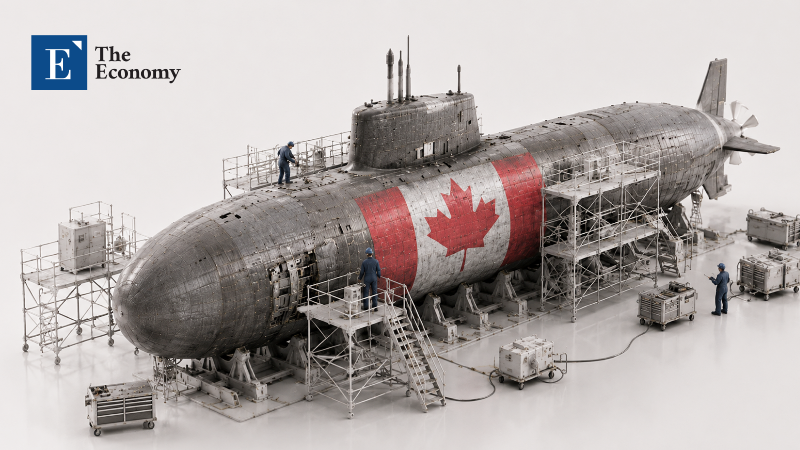
Canada, which selected Germany’s TKMS as the preferred bidder for its next-generation submarine program, is accelerating negotiations and operational preparations to join the joint Type 212CD framework established by Germany and Norway. As declining sea ice drives a surge in traffic along the Northwest Passage and Chinese and Russian military activity expands toward North America, the procurement of up to 12 submarines has evolved into a strategic initiative linking Canadian Arctic sovereignty with NATO’s northern defense. If a final contract is concluded, a trilateral undersea warfare network built around as many as 24 submarines of the same class will connect the North American Arctic with Europe’s High North.
Trilateral Type 212CD Cooperation Takes Shape
According to German defense publication hartpunkt on the 12th, government and military officials from Germany, Norway and Canada joined representatives from major defense contractors including TKMS, KONGSBERG and Multiconsult at a four-day “212CD program joint planning event” held in Kiel late last month. The meeting was convened within three weeks of TKMS defeating a consortium led by South Korea’s Hanwha Ocean to secure preferred-bidder status in the Royal Canadian Navy’s Canadian Patrol Submarine Project (CPSP).
Participants reportedly discussed the next phases of the Type 212CD program, the formation of a trilateral working-level organization and preparations for final contract negotiations between Canada and TKMS. The agenda also covered cooperative arrangements required for force operation, including submarine construction, combat-system integration, base infrastructure, maintenance and training. The participants agreed to establish close coordination among the three navies, defense procurement agencies and defense contractors while laying the institutional foundations for long-term logistics support and maximum operational efficiency.
Canada’s decision to join the previously German-Norwegian Type 212CD program has substantially expanded the initiative into a multinational North Atlantic Treaty Organization (NATO) cooperation project. The framework is designed to maximize interoperability among allied navies while generating cost savings and maintenance synergies throughout the submarines’ lifecycle. The three countries expect the arrangement to strengthen their capacity to respond proactively to mounting maritime security threats in the North Atlantic and Arctic Ocean. Participating governments and defense contractors are expected to conduct detailed negotiations toward a formal agreement within the coming weeks.
Northwest Passage at the Front Line of North American Defense
Canada’s entry into the Type 212CD program reflects the rapidly changing security environment surrounding the Arctic. Canada’s Defence Investment Agency (DIA) has specified that the new submarines must detect, track and deter hostile forces across the Atlantic, Pacific and Arctic oceans while securing a sustained naval presence in the Arctic. The planned acquisition of up to 12 vessels was calculated around the geographic requirement to cover three oceans simultaneously. The submarine program has consequently been elevated into a strategic initiative supporting territorial sovereignty, continental defense and NATO collective security.
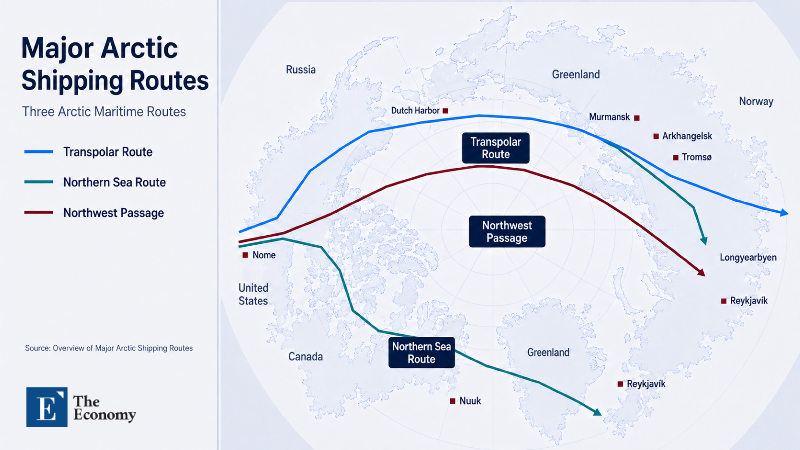
The strategic value of the Northwest Passage has increased as sea ice recedes. Canada’s heightened sense of urgency was set out in detail in its Arctic foreign policy released in 2024. The Canadian government declared that the era in which the North American Arctic remained insulated from geopolitical tension had ended, identifying Russian military activity and China’s dual-use research and surveillance operations as major risk factors. The northern waters constitute a strategic gateway between the Atlantic and Pacific and an aerial and maritime approach corridor into the North American continent. Surveillance and tracking capabilities secured in the region directly determine Canada’s ability to control its borders.
Russia Revives Arctic Bases as China Expands Its Operational Reach
The Russian Northern Fleet presents the most immediate threat. Russia has concentrated strategic ballistic-missile submarines, attack submarines, missile systems and air-defense assets around the Kola Peninsula and the Barents Sea. According to NATO, Russia has established an Arctic Command, reactivated a succession of Soviet-era military installations, airfields and deep-water ports, and continued testing advanced weapons. Submarines departing from the region can enter the North Atlantic through the Arctic Ocean, placing maritime reinforcement routes and subsea communications networks linking North America and Europe within their operational reach.
China’s Arctic expansion, coupled with Russian military capabilities, has further raised Canada’s level of vigilance. In its 2018 Arctic policy white paper, China designated itself a “near-Arctic state” and presented plans to develop Arctic shipping routes as a “Polar Silk Road.” China has since expanded the operating range of its icebreakers and research vessels in pursuit of energy resources, critical minerals and maritime transport corridors. Research data covering seabed topography, water temperature, salinity and the acoustic environment carries considerable potential for use in underwater detection and submarine operations. These capabilities underpin the Canadian government’s classification of Chinese research vessels and surveillance platforms as dual-use assets.
Chinese-Russian cooperation has translated into military activity near North America. In July 2024, two Russian Tupolev Tu-95 bombers and two Chinese H-6 bombers jointly entered the Alaska Air Defense Identification Zone, prompting tracking and interception by the North American Aerospace Defense Command (NORAD). Four coast guard vessels from the two countries conducted a joint patrol in the Bering Sea that September. The vessels remained within Russia’s exclusive economic zone (EEZ), while the bombers did not violate US or Canadian sovereign airspace, but the patrol marked the northernmost location at which the US Coast Guard had detected Chinese coast guard vessels.
Integration With NATO’s Arctic Defense Architecture
As joint Chinese-Russian military activity expands toward North America, Canada’s next-generation submarine procurement has increasingly aligned with NATO’s Arctic defense architecture. Finland and Sweden joined the alliance following Russia’s invasion of Ukraine, raising the number of NATO members among the eight Arctic states to seven. The enlargement has driven a reorganization of command arrangements connecting the North American Arctic with Europe’s High North. NATO assigned Denmark, Finland and Sweden to the area of responsibility of Joint Force Command Norfolk (JFCN) in Virginia last December and launched “Arctic Sentry” in February this year to integrate allied surveillance and deterrence activities. The arrangement would give Canada direct access to a combined undersea warfare network spanning the North American Arctic and Europe’s High North.
Canada’s existing fleet lacks the capacity to meet these operational requirements. Its four operational Victoria-class submarines were commissioned by the Royal Navy in the early 1990s and acquired secondhand by Canada in 1998. Heavy maintenance requirements and limited availability have persisted for years, while the entire fleet is approaching retirement in the mid-to-late 2030s. The Canadian government’s decision to set 2034 as the delivery target for the first four new submarines is intended to prevent a capability gap between the outgoing and incoming fleets. The next-generation submarines are expected to serve as the undersea operational component of the surveillance and response network Canada is building across its northern territories.
Investment in the northern military infrastructure required to support the fleet is already underway. Canada plans to invest approximately $28.1 billion in NORAD modernization over the next 20 years and secure initial operational capability for Arctic over-the-horizon radar by 2029 to track aircraft and missiles approaching from the north at long range. Northern operational support hubs equipped with runways, logistics facilities and materiel will also be established in Iqaluit, Inuvik and Yellowknife. Canada plans to connect satellites, maritime sensors, unmanned aircraft, icebreakers and submarines into a multilayered defense network spanning detection, identification, tracking and response.
Arctic Sailing Distance Doubles in a Decade, Accelerating Type 212CD Cooperation
Climate change is bringing this military timetable forward. The Canadian government estimates that the Arctic is warming at roughly four times the global average and projects that the Arctic Ocean could emerge as a major summer shipping route between Europe and Asia by around 2050. Receding sea ice extends the navigable season while increasing operational hazards caused by drifting ice, rapidly changing weather and insufficient nautical charts. As commercial vessels, research ships and foreign government vessels increase their activity along the Northwest Passage through the Canadian Arctic Archipelago, Canada faces a mounting burden encompassing traffic management, marine pollution response, search and rescue, and military surveillance.
Vessel movements are already rising rapidly. According to the Arctic Council’s Protection of the Arctic Marine Environment (PAME) Working Group, the number of ships entering waters covered by the International Maritime Organization’s (IMO) Polar Code increased 37% between 2013 and 2023, while their total sailing distance rose 111% from 6.1 million nautical miles to 12.9 million nautical miles. The Canadian government said TKMS’s proposal satisfied all naval performance requirements, with the assessment also evaluating the degree to which strategic, security and economic interests were integrated. If a final contract with TKMS is concluded, Germany, Norway and Canada will operate as many as 24 submarines of the same class, while Norway’s operational data from the High North following delivery of its first Type 212CD in 2029 will feed into Canada’s force-generation process during the 2030s.
Anne-Marie Nicholson is a fearless reporter covering international markets and global economic shifts. With a background in international relations, she provides a nuanced perspective on trade policies, foreign investments, and macroeconomic developments. Quick-witted and always on the move, she delivers hard-hitting stories that connect the dots in an ever-changing global economy.
Similar Post