Why Japan Keeps Productive Small Firms Small

Working across research, policy, and data-driven analysis, the Editorial Board ensures that published pieces reflect a consistent institutional perspective grounded in quantitative reasoning and long-term structural assessment.
Authored On
Modified
Japan’s productive small firms struggle to scale
Capital constraints, not culture, drive the gap
Mergers can unlock investment and productivity

Small companies employ two out of every three working people in Japan. Yet the country ranks twenty-ninth out of thirty-eight OECD members for labor productivity. Hourly output was worth $56.80 in 2023. That is barely 58 percent of the American figure of $97.70. For decades, the standard explanation blamed small firms directly. They were too traditional, too slow to adopt new tools and too comfortable coasting on loyal local customers. That explanation is tidy. It is also largely wrong. Japan's small firm productivity gap is not just a story of weak management inside millions of workshops and family shops. It is a story about which firms get access to capital, customers and scale and which do not. New firm-level research suggests something different. The low productivity attached to small Japanese companies looks less like a cause of national stagnation and more like a symptom. It is a symptom of a market that keeps many small firms small against their will.
The Real Story Behind Japan's Small Firm Productivity Gap
For most of the 2000s, whatever productivity growth Japan managed came from inside existing large firms. Big manufacturers squeezed out gains through internal restructuring. They made incremental process improvements and kept tight cost control. Resources rarely moved from weak firms to strong ones. Economists studying Japanese firm data through that period found something telling. The reallocation effect, the boost an economy gets when capital and workers shift toward stronger performers, stayed flat or even turned negative. That pattern has since reversed. Since the early 2010s, internal gains at large incumbents have slowed. Part of the reason is that big companies underinvested in digital tools and staff training. Reallocation has taken over as the main engine of national productivity growth. Small firms are not uniformly backward. Since 2010, they have shown faster productivity growth than large firms, adapting more quickly to digital shifts and changing demand.
This shift matters now because Japan is running short on time. The working-age population keeps shrinking. Labor shortages are pushing firms of every size to compete harder for fewer workers. Corporate bankruptcies reached 10,261 in 2025, a rise of 3.6 percent on the year before. Labor shortages played a role, along with the end of pandemic-era cheap loans and a growing number of owners who cannot find anyone to take over the business. If policy keeps treating small firm weakness as a fixed cultural trait, it will keep reaching for the wrong tools. Subsidies that prop up firms regardless of performance. Protections that freeze the market in place. Calls for small business owners to try harder but none of that explains why so many capable small firms stay small in the first place.
Why Capital, Not Culture, Holds Small Firms Back
Access to capital in Japan runs on two tracks and small firms sit on the weaker one. As of March 2025, close to 45 percent of small and medium firms held loans backed by public credit guarantees. Those guarantees cover 80 percent of a private bank's risk and are worth 5.3 percent of 2024 GDP. Public institutions supplied a further 4.2 percent of GDP as direct loans. These guarantees were built to widen access to finance and in a narrow sense they work. They also dull the incentive for banks to tell a promising small firm apart from a struggling one, however, since the public purse absorbs most of the downside either way. Lenders end up smoothing over small firm risk rather than pricing it carefully. A genuinely strong small firm competes for capital on the same flat terms as a firm with little chance of growing.
The venture capital market makes the gap worse. Japan's domestic pool of late-stage venture money is small for an economy its size. That pushes promising firms toward early public listings before they reach real scale. Others simply stay small because no domestic investor will fund the next stage of growth. Firms that might expand into new markets, hire aggressively or invest in bigger production runs often cannot raise the money to do it. What looks like a productivity problem inside the firm is frequently a financing problem outside it. This is the overlap that a purely cultural account misses. Small size and low measured productivity often show up together for a reason. Thin bank risk assessment, a shallow venture capital market and heavy reliance on personal collateral from owners all work in the same direction. They cap firm growth and they depress the productivity numbers attached to firm size.
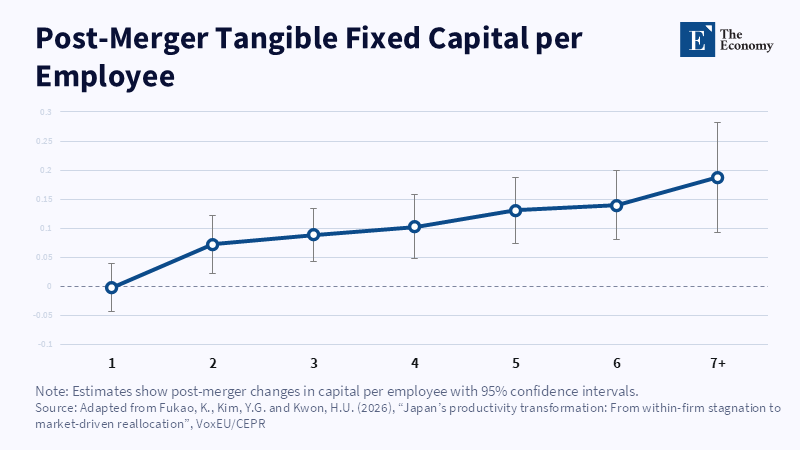
The clearest proof that capital access, not some inner weakness, drives Japan's small firm productivity gap comes from what happens after a small firm is absorbed by a larger one. Acquiring firms tend to sharply expand their capital stock after a merger, investing in equipment and infrastructure the smaller firm likely could never have financed alone. Labor productivity in these combined firms stays 10 percent to 20 percent higher than pre-merger levels for years afterward. Total factor productivity often stalls at first, while the two organizations integrate their operations. The lasting lift, though, comes overwhelmingly from capital the merged firm can finally access. That is not a small firm becoming smarter overnight. It is a firm finally getting the resources it always needed to grow past the ceiling that had held its measured productivity down for years.
What Mergers Reveal About Productive Firms Leaving the Market
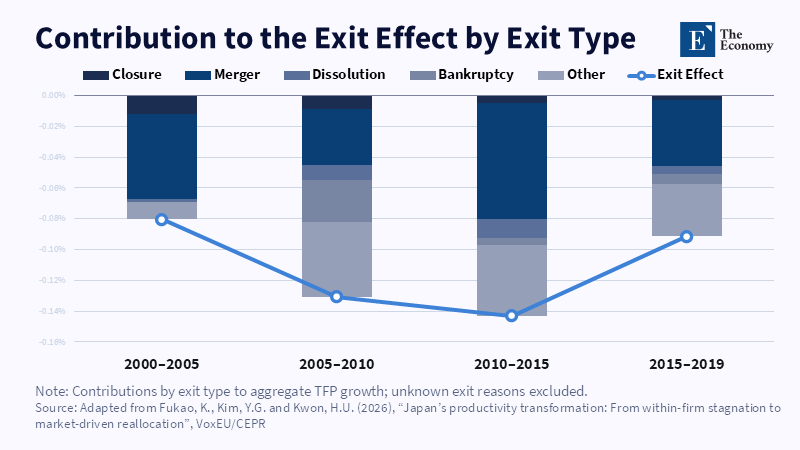
Japan has long shown an odd pattern in its firm exit data. In most developed economies, the firms that leave the market are the weakest ones. Their departure raises average productivity among the survivors. Japanese data has often shown the reverse. Exiting firms frequently measure more productive than the ones left behind, which drags aggregate productivity down instead of lifting it. Recent research that splits exits into separate categories helps solve the puzzle. Firms that disappear through bankruptcy or forced closure are indeed weak performers, exactly as theory predicts. Firms that exit through merger tell a very different story. Their total factor productivity runs 6 percent to 8 percent higher than surviving firms in the same industry. Nearly half of Japan's entire negative exit effect traces back to mergers involving these high-productivity firms.
The scale of this churn is rising fast and much of it now runs through succession rather than strategy. More than half of Japanese companies surveyed in 2024 reported having no identified successor. Roughly 1.27 million small business owners aged 70 or older are expected to retire without one, close to a third of all firms in the country. Officials estimate that 6.5 million jobs and 22 trillion yen of output are at risk if the trend continues unchecked. In 2024 alone, more than 69,000 profitable Japanese businesses closed anyway. Local commentators call this pattern kuroji haigyo, insolvency while still in the black. These are not weak firms exiting a market that no longer wants them. They are productive, well-run businesses disappearing because the only path built for them was survival as an independent firm, with no bridge toward a buyer.
Read together, the merger premium and the succession crisis point to one conclusion. Japan is not short of productive small firms. It is short of ways for those firms to combine with others, reach new revenue streams and keep operating under new ownership rather than closing down. A healthy market economy handles this kind of transition automatically once ownership transfer becomes cheap, well understood and culturally unremarkable. Japan's market has historically made that transfer expensive and for many owners, quietly shameful. Selling a business to an outside buyer has often been treated as a personal failure rather than an ordinary business decision. That attitude is now colliding with demographic reality and the collision is producing exactly the kind of market-driven consolidation that the productivity data has been pointing toward for years. Firms that could not grow on their own are finally growing through someone else's balance sheet, even if the cultural language to describe that shift honestly has not caught up yet.
The Policy Case for Clearing the Path to Consolidation
None of this argues for less support to small firms. It argues for support that actually closes Japan's small firm productivity gap, aimed at growth and transition rather than bare survival. Regulators should keep trimming the broadest public credit guarantees, which the OECD has flagged as a drag on business dynamism and shift that support toward firms with a proven growth path. Succession-linked merger subsidies, tax relief for owners who sell rather than liquidate and faster regulatory review for small and mid-sized deals would clear friction from transactions that already make economic sense on their own. A deeper domestic venture capital and growth-equity market would give ambitious small firms an alternative to early public listing or permanent stagnation. Corporate governance reform, already reshaping how large listed firms handle unsolicited offers, should reach further down the size distribution. Unsolicited and negotiated acquisitions of unlisted small firms grew sharply through 2025 and 2026, without matching guidance for the owners navigating them.
Critics will object that consolidation risks hollowing out local economies, handing community institutions to distant owners with no stake in the area or cutting jobs once cost savings are found. Those risks deserve real scrutiny and regulators are right to watch merger terms closely in sectors where a single buyer could dominate a local market. Even so, the evidence from Japanese mergers points the other way on the central question of jobs and output. Acquiring firms expand their capital base and sustain higher labor productivity for years after a deal closes, which tends to support wages rather than erode them. The likely alternative for most of these small firms is not continued independent operation. It is closure, given how many owners have no successor at all. A well-run consolidation keeps far more local jobs in place than an insolvency filing does and it keeps the underlying business, along with its suppliers and customers, inside the local economy rather than removing it entirely. The honest comparison is not between a small firm staying independent forever and one being absorbed. It is between a small firm being absorbed on reasonable terms and a small firm disappearing entirely once its owner retires with no one left to hand the keys to.
Japan still employs two out of three workers in firms it treats as structurally weak. It still ranks near the bottom of the OECD on the productivity those workers generate. Firm-level data gathered over the past decade tells a more specific and more hopeful, story than that ranking suggests. Many small firms are not underperforming because they are small. They are small and counted as unproductive because Japan has not built the ordinary machinery that lets capable firms grow or change hands. Deep credit markets. A functioning venture capital sector. A market for ownership transfer that carries no stigma. Closing Japan's small firm productivity gap will not come from asking millions of small business owners to work harder inside a system stacked against their expansion. It will come from giving the productive ones among them a real path to scale, through capital, through merger and through an economy finally willing to let ownership move to where it can do the most good.
This article reflects the analytical judgment of The Economy Editorial Board and does not constitute policy advice or the official position of any affiliated institution.
References
Fukao, K., Kim, Y.G. and Kwon, H.U. (2026) Sources of Productivity Growth by Firm Size and Causes of the Negative Exit Effect. RIETI Discussion Paper 26-E-007. Tokyo: Research Institute of Economy, Trade and Industry.
Japan Productivity Center (2024) International Comparison of Labour Productivity 2024. Tokyo: Japan Productivity Center.
Law.asia (2026) Japan's 2025 M&A Boom Hits Highs: Reforms Reshape Deals. Hong Kong: Law Business Research.
Organisation for Economic Co-operation and Development (2026) OECD Economic Surveys: Japan 2026. Paris: OECD Publishing.
Suthenthiran, A. (2026) Small, Low-Productivity Firms Hold Back Wage-Driven Growth in Japan. Oxford: Oxford Economics.
World Economic Forum (2025) Japan's Succession Problem: How the Country Is Safeguarding Heritage Through Business. Geneva: World Economic Forum.
Working across research, policy, and data-driven analysis, the Editorial Board ensures that published pieces reflect a consistent institutional perspective grounded in quantitative reasoning and long-term structural assessment.