“Workers Replaced by AI vs. Skilled Workers Boosting Their Market Value With AI”: How the Automation of Standardized Tasks Is Widening Income Inequality

Matthew Reuter is a senior economic correspondent at The Economy, where he covers global financial markets, emerging technologies, and cross-border trade dynamics. With over a decade of experience reporting from major financial hubs—including London, New York, and Hong Kong—Matthew has developed a reputation for breaking complex economic stories into sharp, accessible narratives. Before joining The Economy, he worked at a leading European financial daily, where his investigative reporting on post-crisis banking reforms earned him recognition from the European Press Association. A graduate of the London School of Economics, Matthew holds dual degrees in economics and international relations. He is particularly interested in how data science and AI are reshaping market analysis and policymaking, often blending quantitative insights into his articles. Outside journalism, Matthew frequently moderates panels at global finance summits and guest lectures on financial journalism at top universities.
Authored On
Modified
AI Expands Its Reach Into Standardized Tasks
Automation of Support Functions Reshapes Organizations Around Skilled Workers
Income Divide Widens Between Displaced Workers and Those Who Leverage AI
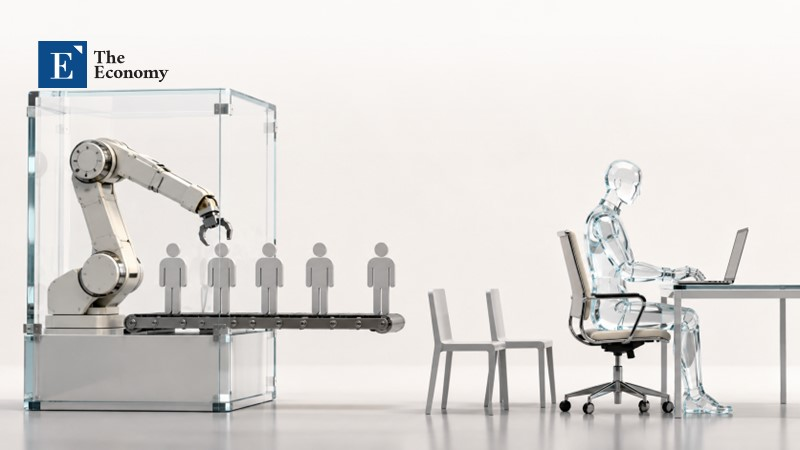
Microsoft founder Bill Gates has proposed deliberately protecting certain jobs for humans, even when artificial intelligence (AI) is capable of performing them. His idea is to designate fields requiring empathy and accountability—such as elder care, childcare and mental health care—as “human-only zones” where AI adoption would be delayed. Yet AI-driven job displacement is already spreading beyond white-collar occupations such as call centers, content production and coding into the care sector. Companies are assigning standardized tasks to AI and concentrating review and final decision-making in the hands of a small number of skilled employees, while reducing the hiring of entry-level and support staff. This has raised concerns that a new form of income inequality could emerge, as workers with expertise and sound judgment use AI to multiply their productivity while those who have traditionally followed prescribed procedures lose ground in employment and wages.
Bill Gates Proposes ‘Human-Only Zones’ to Slow AI Adoption
According to the Financial Times (FT) on the 26th (local time), Gates warned in an essay published that day under the title “The turbulent age of AI is here. The choices we make now will shape the future” that “AI’s rapid progress will cause enormous societal disruption.” He emphasized, “AI will either become the greatest equalizer ever invented or the worst source of inequality,” adding that “even under the best-case scenario, the transition to the new AI era will be one of the most turbulent periods in human history.”
Gates also argued that society is currently ill-prepared for such upheaval. “Unfortunately, right now, we are not preparing for it,” he said. “It is hard to find evidence that leaders, experts and communities are adequately confronting these challenges. Nor is there a plan to smooth the transition into the AI era.” His point is that while the proliferation of AI could sharply boost productivity, the benefits of technological progress may not be distributed evenly across society if the transition results in mass job losses and widening inequality.
As an alternative, Gates proposed designating human-only zones where AI adoption would be deliberately prohibited or delayed, much like nature reserves. The aim would be to mitigate the displacement of human workers by AI. He cited jobs involving elder care, childcare and mental health care—fields in which empathy and caregiving are essential—as examples of work that could be included in such zones. Gates also warned that the transition to the AI era could create three major risks, one of which concerns employment. In his view, large-scale job displacement by AI could cause many occupations to disappear permanently.
White-Collar Displacement Becomes a Reality
The question is what criteria should determine which forms of labor are absorbed by AI and which remain the preserve of humans. The decisive factor separating jobs vulnerable to AI replacement is not educational attainment or wage level, but the extent to which the work can be standardized. Roles that produce outputs according to fixed formats and procedures are more rapidly automated. The displacement trend that began in call centers and customer service has already spread to marketing copywriting, advertising design, data analysis and market research, as well as software coding. Companies are restructuring workflows so that a small number of skilled employees review drafts and analytical results generated by AI. As AI and one or two supervisory employees take over work previously divided among several staff members, hiring demand for white-collar workers is also declining.
The scale of workforce reductions is also growing. Salesforce cut its customer-support workforce from 9,000 to 5,000 after introducing an AI customer-service system, and AI now handles roughly half of all customer inquiries. Fintech company Block decided in February to dismiss 4,000 of its 10,000 employees, while Amazon eliminated an additional 16,000 corporate positions in January following 14,000 layoffs last October. Some 30,000 jobs disappeared in approximately seven months after Chief Executive Officer (CEO) Andy Jassy predicted that the spread of generative AI would reduce the size of the company’s corporate workforce. Meta likewise cut 8,000 employees in April and scrapped another 6,000 positions it had planned to fill.
The repercussions of displacement have also reached the content and media industries. In Hollywood, writers, directors and producers are being paid between $12 and $200 an hour to teach AI how to write screenplays, develop filming schedules and produce project proposals. Netflix used AI in the production process for 300 of the 1,000 titles it released this year. According to the U.S. Bureau of Labor Statistics, employment in the motion picture and sound-recording industries fell 28%, from 450,000 in July 2022 to 326,000 in May this year, while the number of filming days declined 48% between 2021 and 2025. As AI absorbs production tasks such as screenplay drafting, video editing, visual effects and filming plans, work previously performed by writers’ assistants, assistant editors and production coordinators has contracted.
Table 1. Changes in Entry-Level Hiring Requirements Amid the Spread of AI
| Category | Key Details | Changes and Implications |
|---|---|---|
| Skills Required of Entry-Level Hires | Motivational leadership, team building, personnel and stakeholder management, business-process management, mentoring and data-driven decision-making | Skills previously required mainly of experienced employees are increasingly appearing in entry-level job postings |
| U.S. Job Postings | Growing demand for leadership, judgment and management capabilities in entry-level postings within highly AI-exposed sectors | Such postings are seven times more likely to include these capabilities than in 2019 |
| Changes in Entry-Level Work | AI handles repetitive and data-intensive junior tasks | Fewer opportunities to build expertise through routine work, coupled with a greater need to demonstrate strategic thinking and judgment at an early stage |
| Labor-Market Impact | Companies demand complex, experienced-worker-level capabilities even from entry-level applicants | Entry-level employment in highly AI-exposed sectors has effectively stagnated worldwide |
Entry-Level Tasks Disappear as Hiring Barriers Rise
The content of entry-level job postings is also changing in sectors heavily exposed to AI. According to the “2026 AI Jobs Barometer,” published by global accounting and consulting firm PwC after analyzing more than 1 billion job postings worldwide, skills such as leadership, judgment and management—previously required mainly of experienced workers—are increasingly appearing in entry-level postings. Relevant entry-level job listings in the United States were found to be seven times more likely than in 2019 to include such requirements. These included motivational leadership, team building, personnel and stakeholder management, business-process management, mentoring and data-driven decision-making.
PwC classified capabilities that appeared frequently in experienced-worker job postings in 2019 but were rarely seen in entry-level advertisements as “skills traditionally required of experienced workers.” “Many entry-level employees can now bypass prolonged periods of performing simple and repetitive work,” PwC said in the report, while adding that “they must therefore demonstrate abilities such as leadership and strategic thinking much sooner.” As AI becomes capable of handling repetitive and data-intensive work, some of the tasks traditionally assigned to junior employees are disappearing. This change is also affecting the labor market. PwC concluded that entry-level employment in highly AI-exposed sectors has effectively stagnated worldwide.
Automation Spreads Into Care Work
Although the jobs first affected by AI share the common characteristic of involving “repetitive tasks,” repeatability alone is insufficient to explain their susceptibility to replacement. The decisive question is whether the work can be processed from beginning to end through data and rules without exceptional circumstances. Occupations are more likely to be replaced by AI or robots when their procedures are standardized, customer needs are predictable, accountability for outcomes is relatively limited, and human trust or relationship-building is less important. Driving, reception work, basic customer service, standardized translation, repetitive content production and elementary data analysis—tasks with clearly defined inputs and outputs—are likely to be affected first.
Automation has already begun even in the care sector, which Gates believes should remain a human-only zone. McKinsey and the American Nurses Association (ANA) analyzed 69 tasks performed by 310 U.S. nurses and estimated that automation technology and the redistribution of work could reduce working hours by as much as 15%. Converted into staffing terms, this could offset a projected shortage of up to 300,000 nurses in U.S. inpatient units. Patient documentation, searches for medical supplies, medication management, shift handovers and patient repositioning were identified as priority targets for automation. Japanese nursing-care facilities have already deployed robots that transfer patients from beds to wheelchairs or assist with mobility, toileting and bathing, as well as sensors that detect falls.
Conversely, the jobs that survive will not necessarily be those only humans can perform, but those for which humans must bear responsibility. Work that requires defining problems under uncertain conditions, persuading stakeholders, interpreting customers’ emotions and circumstances, exercising ethical judgment and assuming final accountability is unlikely to disappear easily. Workers who combine these abilities with specialized knowledge and proficiency in using AI are likely to emerge as agents of “superhuman labor,” in which a single individual performs multiple roles. Higher-order thinking—the ability to identify flaws in AI-generated results and combine knowledge from different disciplines to devise new solutions—is emerging as a core competitive capability. Corporate demand for labor is consequently shifting away from staff who execute prescribed tasks and toward a small number of versatile employees capable of directing AI and assuming responsibility for a broader range of work.
AI Productivity Divide Spills Over Into Wage and Wealth Inequality
As AI penetrates more deeply into the workplace, productivity disparities are likely to widen even within the same organization. In a Harvard Business School study, employees using generative AI reduced the average time required to write an article from 87 minutes to 22 minutes, representing an approximately fourfold increase in speed. However, employees who lacked the specialized knowledge required for the task produced work that was 13% lower in quality than that of experts, even with AI assistance. This means that people with accumulated knowledge and experience can use AI to increase their workload capacity substantially, whereas those with weak foundational capabilities may still fall behind in quality despite working faster.
The productivity gap is already translating into disparities in wages and hiring opportunities. PwC’s 2026 survey found that jobs requiring AI-related skills carried an average wage premium of 62%, while their hiring growth rate was approximately eight times that of the overall labor market. In particular, occupations in which AI amplifies skilled workers’ expertise recorded twice the hiring growth and 42% higher wage growth than occupations in which barriers to entry had fallen.
Such productivity polarization could develop into a new form of inequality that simultaneously divides employment, wages and investment income. The International Monetary Fund (IMF) analyzed that AI could combine with the work of high-income employees to raise productivity and wages, while profits generated by AI-adopting companies flow to capital owners, widening the divide between labor income and investment income. Even among workers who retain their jobs, differences in compensation based on AI proficiency and professional expertise could accumulate over time, further expanding income inequality.
Matthew Reuter is a senior economic correspondent at The Economy, where he covers global financial markets, emerging technologies, and cross-border trade dynamics. With over a decade of experience reporting from major financial hubs—including London, New York, and Hong Kong—Matthew has developed a reputation for breaking complex economic stories into sharp, accessible narratives. Before joining The Economy, he worked at a leading European financial daily, where his investigative reporting on post-crisis banking reforms earned him recognition from the European Press Association. A graduate of the London School of Economics, Matthew holds dual degrees in economics and international relations. He is particularly interested in how data science and AI are reshaping market analysis and policymaking, often blending quantitative insights into his articles. Outside journalism, Matthew frequently moderates panels at global finance summits and guest lectures on financial journalism at top universities.
- Previous “Limited Hand Dexterity, Snowballing Production Costs”: The Paradox of China’s Humanoid Robot Boom, Where Sales Outpace Commercial Viability
- Next “Neither Side Can Deliver a Fatal Blow”: U.S. and Iran Hit Political and Economic Limits as Ceasefire Talk Emerges After Protracted War of Attrition
Similar Post