China’s Battery-Swapping Market Expands: Three-Minute Swaps Eliminate Charging Waits, Easing EV Fast-Charging Bottlenecks

Anne-Marie Nicholson is a fearless reporter covering international markets and global economic shifts. With a background in international relations, she provides a nuanced perspective on trade policies, foreign investments, and macroeconomic developments. Quick-witted and always on the move, she delivers hard-hitting stories that connect the dots in an ever-changing global economy.
Authored On
Modified
EV charging constraints drive growing demand for battery swapping
Joint corporate investment and local government support expand swap networks
A wider range of compatible models is expected to increase swapping’s share of the charging market
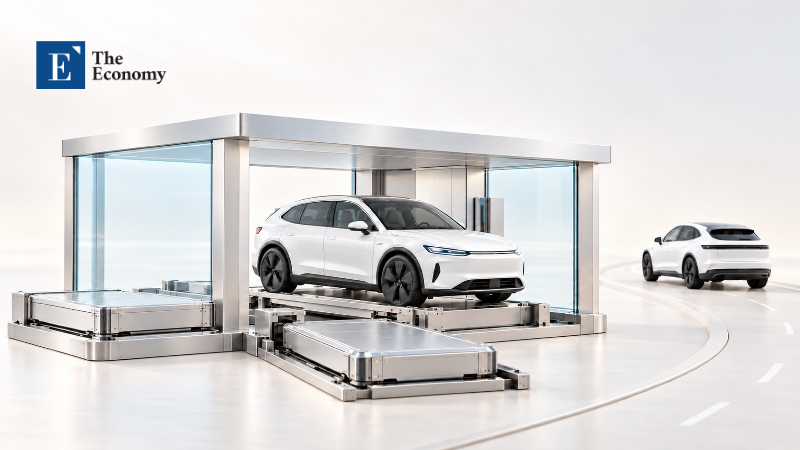
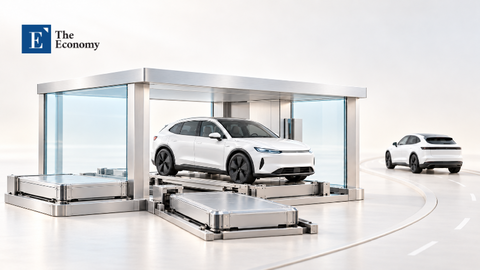
Battery swapping is becoming an established means of easing the charging burden for electric vehicles in China. As use of swap services increased during the holiday period, when long-distance travel surged, automakers and battery manufacturers also moved to expand swapping infrastructure through business consolidation and joint investment. Local governments are supporting these efforts with equipment subsidies, while partnerships with European companies seeking to adopt Chinese swapping technology are taking shape. With mass-market adoption of next-generation all-solid-state batteries expected to remain several years away, battery swapping is projected to account for a growing share of the EV charging market as networks expand and more vehicle models become compatible.
1.19 Million Battery Swaps During National Day Holiday
According to charging and battery-swapping figures released by Chinese EV manufacturer Nio on October 12, a total of 1,192,221 battery swaps were completed at 4,168 stations across China during the National Day holiday from October 1 to 7. That amounted to approximately 170,000 swaps a day, up 22% from the same period last year. Daily records were broken twice as demand concentrated at the start of the holiday and during the return travel rush. On October 1, the first day of the holiday, swaps reached 183,469, surpassing the previous record of 177,627 set during this year’s Lunar New Year holiday. On October 5, when return travel demand peaked, the figure rose to 183,664. Overall usage, including charging services, also increased. A total of 2,071,582 service sessions were recorded across 9,567 charging and swapping facilities nationwide, with average daily usage rising 20.5% year on year.
Battery swapping was also widely used on highways, where long-distance travel was concentrated. Nio operates 1,073 highway swap stations connecting more than 550 cities across China, and 250 of those stations set new daily swapping records during the holiday. Electricity supplied by highway charging and swapping facilities exceeded 24.83 million kilowatt-hours (kWh) over the same period, up 30.8% year on year and equivalent to 13.7% of all electricity supplied to EVs on China’s highways. A total of 203,581 users replenished their vehicles’ energy exclusively through battery swapping during long-distance holiday trips. The swap station at the Rizhao service area on the Shenyang–Haikou Expressway in Shandong Province handled as many as 211 swaps a day, making it Nio’s busiest highway swap station.
Table 1. Corporate Partnerships and Policy Support for Expanding China’s Battery-Swapping Network
| Entity | Initiative | Key Details |
|---|---|---|
| Geely·Nio | Equity investment | Geely plans to acquire a 30% stake in Nio Power by contributing its entire equity interest in Yiyi Power and approximately $95.6 million in cash |
| Business consolidation | Yiyi Power’s swapping business for commercial-use vehicles to be integrated into Nio Power upon completion of the transaction | |
| Shared technology and swap networks | Joint development of common swapping technology and standards for private-use vehicles. Nio Power to provide services when Geely launches swap-compatible vehicles | |
| Charging network integration | Nio plans to acquire a 10% stake in Haohan Energy. The two companies’ charging networks to be interconnected | |
| Nio Power | Swap station expansion | Expansion to 10,000 swap stations by 2030 |
| CATL·Sinopec | Nationwide swap network development | Combining battery and swapping technology with a fuel station network to capture demand from passenger cars and heavy-duty trucks. Long-term target of 10,000 swap stations |
| Shanghai Municipal Government | Equipment investment support | Subsidies covering 40% of investment in charging and swapping equipment at multi-brand swap stations, excluding batteries. Subsidies capped at approximately $89.64 per kW of installed capacity |
Geely and Nio Move to Consolidate Battery-Swapping Businesses
China, which dominates the global battery market, already has the manufacturing base needed to expand swapping services. Automakers are also pursuing equity investment and business consolidation to enlarge the supporting swap network. A prominent example is the charging and battery-swapping partnership announced by Geely Holding and Nio on September 28. Geely agreed to acquire a 30% stake in Nio Power by contributing its entire equity interest in battery-swapping subsidiary Yiyi Power and approximately $95.6 million in cash. Once the transaction is completed, Yiyi Power’s swapping business serving commercial-use vehicles will be integrated into Nio Power. The two companies also plan to jointly develop common swapping technology and standards for private-use vehicles. When Geely launches swap-compatible vehicles, Nio Power will provide the services, allowing the companies to share the swap network. In charging, Nio also agreed to acquire a 10% stake in Geely subsidiary Haohan Energy and interconnect the two companies’ charging networks, while Nio Power announced a target of expanding to 10,000 swap stations by 2030.
Local government investment support is reinforcing cooperation between battery manufacturers and state-owned energy companies. China’s largest battery manufacturer, Contemporary Amperex Technology Co. Limited (CATL), signed an agreement with Sinopec last year to develop a nationwide battery-swapping network, with a long-term target of 10,000 stations. The strategy combines CATL’s battery and swapping technology with Sinopec’s nationwide fuel station network to capture swapping demand from both passenger cars and heavy-duty trucks. Local governments subsidize the upfront cost of installing swap stations. Since April last year, Shanghai has covered 40% of investment in charging and swapping equipment, excluding batteries, at stations capable of serving multiple brands and vehicle models. The subsidy is capped at approximately $89.64 per kilowatt (kW) of installed capacity.
Chinese Battery-Swapping Technology Gains Traction in Europe
Against this backdrop, the EV industry is watching the potential for China’s battery-swapping model to spread to overseas markets, including Europe. Germany’s Fraunhofer Institute for Material Flow and Logistics (IML) concluded in a recent analysis that battery swapping could be useful for freight transport operations with tight schedules and limited grid connection capacity. It explained that swapping could reduce the time vehicles remain stationary for charging and spread electricity demand by adjusting when batteries stored at swap stations are charged. Projects to introduce Chinese swapping technology in Europe are also taking shape. CATL and Britain’s Octopus Energy announced in June that they would jointly build a battery-swapping network for electric trucks. The companies plan to open their first swapping hub in the United Kingdom in 2027 and establish more than 30 sites across Europe by 2035.
The principal advantage of battery swapping is its ability to reduce the time spent waiting for a vehicle to finish charging. Ultra-fast charging requires large amounts of electricity to be delivered over a short period, making grid connection capacity and energy storage essential, alongside technology to limit battery heating and degradation. Moreover, a charger’s maximum output is not sustained throughout the charging process. According to the U.S. Department of Energy, most EV batteries reduce charging power between 80% and 100% state of charge, potentially extending the additional time needed to reach a full charge. Battery swapping, by contrast, involves installing a precharged battery, with Nio reporting an average swap time of just three minutes. While the driver resumes the journey with a charged battery, the station recharges the returned battery separately.
Cost and Production Scale Remain Obstacles to All-Solid-State Battery Adoption
Experts expect battery swapping to remain a major means of easing the EV charging burden for the time being, as mass-market adoption of all-solid-state batteries remains several years away. Even if these batteries are installed in some vehicle models, additional time will be needed to achieve prices and supply volumes accessible to mainstream consumers. At the mass-production stage in particular, manufacturers must consistently reproduce the performance achieved during development across individual products. Unstable contact between electrodes and solid electrolytes can increase internal resistance and impair charging and discharging performance, requiring manufacturing processes that precisely control contact between materials. Manufacturers must also reduce defect rates and increase production speeds to lower the battery costs reflected in vehicle prices.
The commercialization timelines outlined by the Chinese government and battery manufacturers also reflect the time needed to develop mass-production capabilities. Last month, the Chinese government set a target of initial large-scale deployment of all-solid-state batteries in 2030, identifying improvements in solid electrolyte performance and reductions in manufacturing costs as priorities. The aim is to address performance and production costs together before expanding vehicle applications. CATL likewise plans small-scale production in 2027 but considers deployment in millions of vehicles before 2030 unlikely. Even after small-scale production succeeds, manufacturers must still increase output while maintaining consistent quality, leaving an expected gap between initial vehicle applications and widespread mass-market adoption.
China’s Expanding Swap Network Eases Reliance on Fast Charging
Given the commercialization timetable for all-solid-state batteries, incentives to invest in swapping services using existing batteries are expected to persist for the time being. Companies can expand services for swap-compatible vehicles already on sale and incorporate additional technologies as next-generation battery development progresses. CATL has previously stated that newly developed battery technologies will be applied to vehicle models compatible with Choco-Swap. Its integrated charging and swapping strategy unveiled this year also includes installing ultra-fast charging equipment alongside Choco-Swap stations for passenger cars and Qiji swap stations for heavy-duty trucks. The design allows shared use of stations’ electrical transformation equipment and charging modules, with stored batteries supplying electricity to chargers when needed.
Expansion of charging and swapping networks is also expected to change how consumers use EVs. Drivers without space to charge at home or work could reduce their reliance on public fast chargers if they can exchange batteries at nearby swap stations. As more models adopt common swapping standards, the requirement to choose a particular brand to access the service could also diminish. Consumers would have greater scope to select vehicles based on price and performance while using a swap network shared by multiple brands. Battery swapping is expected to absorb some fast-charging demand, particularly in regions where station accessibility and vehicle choice improve together.
Anne-Marie Nicholson is a fearless reporter covering international markets and global economic shifts. With a background in international relations, she provides a nuanced perspective on trade policies, foreign investments, and macroeconomic developments. Quick-witted and always on the move, she delivers hard-hitting stories that connect the dots in an ever-changing global economy.
Similar Post