“Neither Side Can Deliver a Fatal Blow”: U.S. and Iran Hit Political and Economic Limits as Ceasefire Talk Emerges After Protracted War of Attrition

Aoife Brennan is a contributing writer for The Economy, with a focus on education, youth, and societal change. Based in Limerick, she holds a degree in political communication from Queen’s University Belfast. Aoife’s work draws connections between cultural narratives and public discourse in Europe and Asia.
Authored On
Modified
U.S. unleashes barrage of economic sanctions on Iran; Tehran retaliates with threat to “expand the battlefield”
Iranian economy pushed to the brink; U.S. also faces mounting public-opinion risks ahead of midterm elections
Prospects for ceasefire agreement gain traction as prolonged war of attrition drags on
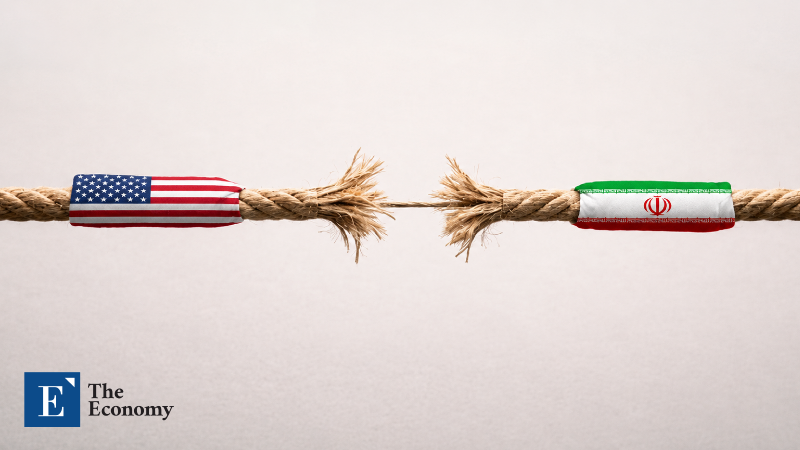
Tensions between the United States and Iran are escalating once again. Washington has unveiled sweeping new economic sanctions targeting Iran, while Tehran has vowed a forceful response, intensifying the confrontation between the two countries. Some observers, however, say the standoff is unlikely to escalate into a broader military conflict. Iran has reached its economic limits amid disruptions to crude oil exports, soaring inflation and currency depreciation, while the United States is also contending with mounting public-opinion risks ahead of the November midterm elections.
U.S. Tightens Economic Stranglehold on Iran
On August 25, local time, The New York Times reported that Iran’s leadership may be considering a resumption of military action. As the United States seeks to shift its strategy toward sanctions designed to economically isolate Iran, calls have reportedly grown within the country to respond with a show of force rather than capitulate. U.S. President Donald Trump had warned on August 19 that any country providing Iran with an “economic lifeline” in any form would face consequences. The following day, Treasury Secretary Scott Bessent also threatened the “strongest sanctions in history,” pressuring countries including China to halt transactions with Iran.
On August 24, Bessent held a press conference at the Treasury Department headquarters in Washington, D.C., where he formally announced the launch of the so-called “Operation Economic Outcast.” “Our goal is to sever every economic lifeline sustaining the Iranian regime anywhere in the world and leave Tehran standing alone,” Bessent said, declaring that the United States would launch an “economic onslaught” against Iran’s global financial network. The centerpiece of the initiative is a sweeping expansion of the reach of U.S. secondary sanctions. The Treasury Department’s Office of Foreign Assets Control will sanction individuals and companies worldwide that trade with or support Iran across five sectors: digital assets, advanced technology, gold, aviation and shipping. More than 60 companies, individuals and vessels around the world accused of supporting Iran’s acquisition of nuclear and missile technology, cyber operations and oil revenue generation have also been added to the new U.S. sanctions list.
Iran Signals Forceful Response
Since Washington’s plans for additional sanctions began to take shape, senior Iranian officials have issued a succession of increasingly combative statements. Mohsen Rezaei, secretary of Iran’s Supreme National Security Council, warned on state television on August 22 that “any country participating in America’s economic war will be regarded as an enemy,” adding that Iran would impose a blockade to ensure that “not a single drop of oil leaves the Persian Gulf.” Acting Iranian Defense Minister Majid Ebn Alreza similarly stressed that “all pressure threatening the livelihoods and security of our people is clearly part of the war,” adding, “To protect our people, we too have no choice but to expand the battlefield.”
Assertions that the U.S. sanctions will prove ineffective have also grown louder. Iranian Economy Minister Seyed Ali Madanizadeh said in a recent interview with Islamic Republic of Iran Broadcasting that “the government has already prepared an economic plan covering the next two years,” claiming that “plans to counter sanctions were established long ago, and we are fully prepared for the new measures.” Although the war dealt a severe blow to the steel and petrochemical industries, efforts to restore normal operations and rebuild were undertaken within a short period, he said. Parliament Speaker Mohammad Bagher Ghalibaf also wrote on X, formerly Twitter, that “the United States lacks the economic capacity to further restrict its relations with other countries,” arguing that “Iran’s trading partners do not take sanctions threats into consideration.”
Iran Pushed to Its Economic Limits
The credibility of Iran’s claims, however, remains open to question, as the country’s economic conditions have deteriorated rapidly since the outbreak of war. In an update to its World Economic Outlook released last month, the International Monetary Fund projected that Iran’s economy would contract by 5.4% this year. Disruptions to production and trade caused by the war, coupled with prolonged logistical turmoil in the Strait of Hormuz, are weighing on the broader economy. The World Bank similarly concluded in a June report that “Iran’s economy, already weakened by intensified sanctions and social unrest, has suffered an additional blow from the war.” Iran’s gross domestic product is estimated to have contracted by 2.7% even in the 2025/26 fiscal year, before the full impact of the war began to materialize.
Crude oil exports, Iran’s principal source of foreign-currency earnings, have effectively ground to a halt. Central Bank of Iran Governor Abdolnasser Hemmati acknowledged on state television on August 20 that “no crude oil exports are currently taking place.” The Financial Times also reported that tanker traffic from Kharg Island, Iran’s largest crude oil export hub, had virtually ceased since July 31. Inflation and currency instability have become even more acute. The Iranian currency’s market exchange rate has weakened to roughly 2 million to the dollar, while inflation is approaching 90%. Chronic energy shortages also remain unresolved. According to the Iran Fuel Conservation Organization, the country’s daily gasoline demand currently stands at approximately 135 million liters, with the daily supply shortfall reaching 15 million liters.
Table 1. Iran’s Economic Conditions Since the Outbreak of War
| Sector | Current Conditions |
|---|---|
| Economic growth | IMF projects a 5.4% contraction in 2026 |
| Crude oil exports | Exports effectively halted following the cessation of tanker traffic from Kharg Island |
| Inflation and currency | Inflation approaching 90%; currency value plunging |
| Energy supply | Daily gasoline supply shortfall rises to 15 million liters |
Alarm Bells for Trump and the Republican Party
The United States is similarly being pushed to the brink, as public sentiment surrounding the war with Iran has deteriorated sharply ahead of the November midterm elections. According to The Hill, citing a Quinnipiac University poll of 963 registered voters conducted from July 23 to 27, President Trump’s job approval rating stood at just 32%. Only 28% approved of Trump’s handling of Iran, while 66% disapproved. Just 34% supported U.S. military action against Iran, compared with 60% who opposed it. Moreover, 66% of respondents said the war with Iran was “not worth it” when weighing its costs against its benefits, while only 36% believed the United States was winning the war.
Voter sentiment is also wavering in traditional Republican strongholds. On August 24, the Financial Times reported sharp increases in the price of 11-52-0 phosphate fertilizer used during corn planting and in the U.S. average price of diesel fuel used in agricultural machinery. Agricultural exports have also contracted noticeably because of the trade wars with multiple countries that erupted after the second Trump administration took office last year. These developments have dealt a “fatal blow” to U.S. farms already struggling with low grain prices over the past several years. As dissatisfaction grows among farmers, a core constituency of President Trump, political support is beginning to weaken across the Republican-leaning agricultural belt of the U.S. Midwest. Trump told farmers in June that “we will never let you down” and requested an additional $11 billion in emergency assistance from Congress, but the Financial Times concluded that the package would be insufficient to offset the damage sustained by the agricultural sector.
Russian Media Raises Prospect of Ceasefire
The calculus surrounding the cost of the war is equally complex. U.S. Defense Secretary Pete Hegseth told the Senate Appropriations Committee on July 21 that Defense Department spending related to the war with Iran had reached $37.5 billion. The Pentagon has also requested an additional $67.1 billion from Congress to finance military operations and replenish weapons inventories. Stocks of critical interceptor weapons have also declined markedly. According to CNN, the United States is estimated to have expended as much as 80% of the Terminal High Altitude Area Defense interceptors it held before the war, along with roughly half of its Patriot interceptors. Because Patriot and THAAD interceptors typically take two to three years to manufacture, restoring inventories to prewar levels in the near term is likely to prove difficult.
As the United States and Iran remain locked in a grinding war of attrition, some observers argue that the recent economic confrontation between the two countries amounts to little more than bluffing ahead of an agreement. With both sides constrained by their respective economic and political limits and unable to inflict a “fatal blow” on the other, they are now seeking a diplomatic off-ramp while attempting to secure maximum leverage in the final stages of negotiations, according to this assessment. On August 25, Russia’s RIA Novosti reported, citing Pakistani and Iranian sources, that Iran and the United States had reached a ceasefire agreement and that an official announcement was expected within days. RIA Novosti, however, did not disclose the specific terms of the purported agreement, and the credibility of its sources remains unclear.
Aoife Brennan is a contributing writer for The Economy, with a focus on education, youth, and societal change. Based in Limerick, she holds a degree in political communication from Queen’s University Belfast. Aoife’s work draws connections between cultural narratives and public discourse in Europe and Asia.
Similar Post