“Price War Reaches Its Limits, Diversification a Long Haul”: China’s Auto Industry at the Brink

Matthew Reuter is a senior economic correspondent at The Economy, where he covers global financial markets, emerging technologies, and cross-border trade dynamics. With over a decade of experience reporting from major financial hubs—including London, New York, and Hong Kong—Matthew has developed a reputation for breaking complex economic stories into sharp, accessible narratives. Before joining The Economy, he worked at a leading European financial daily, where his investigative reporting on post-crisis banking reforms earned him recognition from the European Press Association. A graduate of the London School of Economics, Matthew holds dual degrees in economics and international relations. He is particularly interested in how data science and AI are reshaping market analysis and policymaking, often blending quantitative insights into his articles. Outside journalism, Matthew frequently moderates panels at global finance summits and guest lectures on financial journalism at top universities.
Authored On
Modified
Domestic sales plunge as subsidies are scaled back and curbs on loss-leading discounts tighten
Surging Chinese auto exports intensify restructuring pressure on European carmakers
Expansion into new businesses still faces obstacles to securing monopoly pricing power
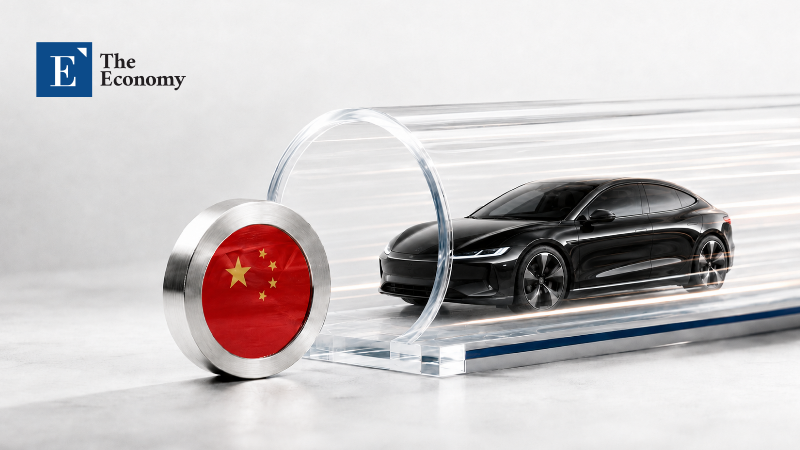
China’s auto industry is confronting the full fallout from its price war. With net profit per vehicle sharply compressed, Beijing has begun scaling back purchase incentives while strengthening rules targeting below-cost sales and delayed payments to suppliers. Excess output that cannot be absorbed domestically is being diverted overseas, while Chinese automakers are expanding into batteries, charging, robotics and urban air mobility. Yet mounting restructuring pressure on global carmakers and a growing survival crisis among smaller Chinese manufacturers are together accelerating an industry-wide shakeout.
China’s Per-Vehicle Net Margin Plunges to 1.5%
According to the Hong Kong-based South China Morning Post on July 28, net margins at Chinese vehicle manufacturers have collapsed to the low-single-digit range, extinguishing consumer expectations for further price cuts while heightening fears of cascading bankruptcies among small and midsize manufacturers. Chen Shihua, deputy secretary-general of the China Association of Automobile Manufacturers (CAAM), said at a recent automotive industry conference that manufacturers now earn only about $230 in net profit on a vehicle sold for roughly $15,500. That implies a per-vehicle net margin of just 1.5%.
Data from the China Passenger Car Association (CPCA) show that the auto sector’s net margin halved within only two months after reaching 3.4% in May. The industry is under severe margin pressure even compared with the 6.1% average profit margin for China’s downstream manufacturing sector. Vehicle sales in mainland China totaled just 8.7 million units in the first half, down 20.2% from a year earlier. Annual sales projections, which had initially anticipated growth for the year, were consequently slashed to a 14% decline. The result is an entrenched pattern in which rising sales volumes coexist with falling profits because top-line growth is failing to absorb mounting costs.
Cost pressures extend beyond discounting. Lithium, automotive memory and high-performance semiconductor prices have risen, while competition over driving range and intelligent features has increased vehicle specifications. Carmakers must also fund warranty repairs, parts inventories, recalls, software updates and charging-network maintenance after a vehicle is sold. New-vehicle development, crash testing and battery-safety validation costs continue to accumulate as well. An industry-wide margin of 1.5% signals that the buffer available to withstand even temporary promotional losses has nearly been exhausted. Economies of scale can still spread fixed costs as volumes rise, but prolonged below-cost selling expands cash outflows rather than reducing them.
Subsidy Cuts and Curbs on Loss-Leading Discounts Signal a Policy Shift
China’s electric-vehicle industry has expanded production capacity and supply chains on the back of years of state support. The Center for Strategic and International Studies (CSIS) estimates that China provided at least $230.9 billion in purchase subsidies, tax breaks, charging infrastructure, research and development support, and government procurement assistance to the EV industry between 2009 and 2023. As the industrial base matures, however, the intensity of government support is gradually weakening. Per-vehicle support fell from $13,860 in 2018 to less than $4,600 in 2023, while Beijing reduced its full exemption on new-energy vehicle purchase tax to a 50% reduction from this year. The cap on the tax reduction per passenger vehicle was also lowered from about $4,660 to roughly $2,330.
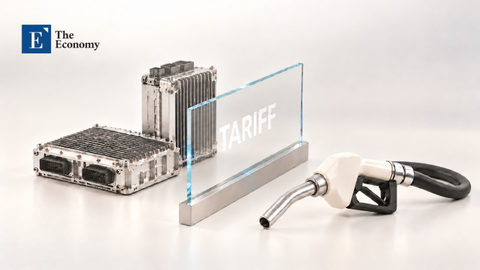
Supply-side discipline has also tightened. In February, China’s State Administration for Market Regulation classified the practice of setting vehicle ex-factory prices below manufacturing cost to exclude rivals and monopolize markets as a major legal risk. It has also encouraged leading carmakers to shorten payment terms for smaller parts suppliers to within 60 days, seeking to block the transmission of discounting pressure through lower procurement prices and delayed settlements across the supply chain. This policy pivot, combined with weaker consumer sentiment caused by reduced purchase incentives and the property slump, is exerting further downward pressure on domestic sales. Chinese passenger-car retail sales fell 20.2% year on year in the first half, while the CPCA cut its full-year forecast from flat growth to a 14% decline, or 20.4 million vehicles.
The Price War Spreads to Global Carmakers
Production capacity that cannot be absorbed in the domestic market is moving into export markets. BYD’s overseas sales reached 175,349 vehicles in June, up 94.7% from a year earlier, while its China sales fell 22%. Overseas volumes offset the domestic shortfall, lifting total sales by 5.5%. JPMorgan estimates that Chinese manufacturers earn about $775 in average net profit per vehicle, with overseas sales potentially generating as much as roughly $3,100 per vehicle.
As price competition expands onto the global stage, international automakers are also facing mounting restructuring pressure. In the second quarter, German carmaker Volkswagen’s sales in China fell 36.6% year on year, while Mercedes-Benz reported a 30% decline. BMW and Porsche also recorded decreases exceeding 30%. Volkswagen executives have floated plans to expand planned job cuts to as many as 100,000 positions and close four German plants after 2030.
The employment shock in Europe is already becoming visible. Germany’s Fraunhofer Institute estimates that employment in Europe’s auto industry could decline by 726,000 jobs by 2040 if electrification, automation, weaker demand and Chinese manufacturers’ market encroachment converge. That would represent roughly 45% of total employment as of 2025. A contest of financial endurance is therefore emerging, pitting the rapid cash burn of Chinese manufacturers against the weakening sales and employment base of incumbent automakers.
In practice, sustained low-price selling by Chinese manufacturers would erode profitability and research-and-development capacity first, while global incumbents that abandon price competition would see declining sales and falling plant utilization feed directly into restructuring. In the memory semiconductor industry, a small number of companies that endured prolonged supply competition ultimately secured oligopolistic positions and pricing power. The auto market, however, is fragmented by country-specific tariffs, safety certification, local production requirements, brand loyalty, sales networks and service infrastructure. Even if Chinese automakers succeed in forcing competitors out, converting market share into monopoly pricing power will remain difficult.
It remains uncertain whether Chinese manufacturers will reach their limits first through low-price selling or whether established global automakers will prove unable to withstand declining sales and workforce reductions. What is clear, however, is that a prolonged market-share battle waged at the expense of profitability could deprive both Chinese and global manufacturers of investment capacity, weakening the industry’s technological development, quality-control and employment foundations.
Table. Business Expansion and Monetization Constraints Among Major Chinese EV Makers
| Company/Category | Key Expansion Areas | Strategic Objective | Monetization Constraints |
|---|---|---|---|
| BYD | Batteries, energy storage systems, ultra-fast charging networks | Capture energy demand beyond vehicle sales | Capacity-expansion competition, falling prices, large infrastructure investment |
| XPeng | Robotaxis, humanoid robots, eVTOL aircraft | Monetize autonomous-driving and AI technologies | Safety certification, prolonged field validation, computing-infrastructure costs |
| Geely | Satellite communications, UAM, mobility services | Build communications and autonomous-driving ecosystems | Long investment payback periods and high regulatory barriers |
| Profitability | Only 3 of 30 companies profitable | Diversify revenue through new businesses | Only 7 companies expected to reach break-even by 2030 |
| Outlook | Simultaneous expansion into adjacent industries | Offset low-margin auto operations | New businesses could be curtailed and restructuring accelerated if financing dries up |
Chinese EV Makers Blur Business Boundaries to Survive
Against this backdrop, Chinese EV makers are widening their business boundaries as it becomes increasingly difficult to secure stable profits through vehicle sales alone. Batteries, energy storage systems (ESS), ultra-fast charging infrastructure, autonomous-driving software, robotaxis, humanoid robots and urban air mobility (UAM) are among their principal targets. The push is widely viewed as an effort to diversify revenue streams by applying battery-control, power-electronics and artificial-intelligence technologies developed through vehicle production to adjacent industries.
BYD is expanding beyond electric and plug-in hybrid vehicle sales into ESS, charging networks and batteries. Leveraging its Blade Battery, the company supplies grid-scale storage systems and commercial and industrial power solutions while investing heavily in ultra-fast charging networks. The strategy is designed to bring post-sale energy demand into its own ecosystem. Yet adding new-business investment while the auto operation’s low-margin problem remains unresolved will inevitably increase cash requirements. Batteries and ESS are themselves exposed to capacity-expansion competition and downward pricing pressure in China, raising the risk that BYD could reproduce the low-return structure of its vehicle business elsewhere.
Other automakers face similar challenges. XPeng is pursuing robotaxi, humanoid robot and electric vertical takeoff and landing (eVTOL) businesses based on its autonomous-driving technologies. Aridge, XPeng’s flying-car subsidiary, has outlined mass-production plans and order volumes, while the company is also pursuing humanoid-robot commercialization. Flying cars, however, cannot be sold until aviation safety certification, operating regulations, insurance and maintenance systems are in place. Robotaxis and robots likewise require enormous computing infrastructure and years of field-validation investment. A substantial time lag separates technological demonstrations from revenue generation.
Geely Automobile has invested beyond vehicle manufacturing in satellite communications, UAM, batteries and mobility services. Its proprietary satellite network can support vehicle communications and autonomous-driving data services, while its aviation-mobility initiatives target the future transportation market. Yet satellite launches, satellite control and aircraft development require far longer investment payback periods and much higher regulatory thresholds than auto production facilities. Without sufficient financial capacity to lock up cash for extended periods, diversification itself could become a source of liquidity strain.
Monetization Remains a Long-Term Challenge
The expansion of Chinese manufacturers beyond automobiles reflects the overlap between the search for new growth engines and survival strategy. Attempts to offset thin vehicle margins through charging, batteries, software and data services are rational, but these industries are also characterized by intense technological competition and capital expenditure. As a result, only a limited number of companies will be able to translate diversification into a genuine earnings buffer. According to consultancy AlixPartners, only three of 30 specialized Chinese new-energy vehicle companies achieved an annual profit last year, while only seven are expected to reach break-even by 2030. Stephen Dyer, head of AlixPartners’ Asia-Pacific automotive practice, said production capacity had expanded faster than demand and that rising technological convergence had made product differentiation more difficult. If funding from vehicle operations weakens before new businesses generate stable cash flows, expansion will function less as revenue diversification than as an accumulation of investment costs.
In the past, a very small number of semiconductor companies endured years of loss-making competition before securing supply leadership and pricing power. The automotive and mobility sectors, however, are densely constrained by country-specific certification requirements, tariffs, distribution networks, service infrastructure and brand trust. Experts warn that even surviving Chinese manufacturers will struggle to secure high margins, while any interruption in financing could quickly turn expansion plans across numerous companies into simultaneous restructuring pressure.
Matthew Reuter is a senior economic correspondent at The Economy, where he covers global financial markets, emerging technologies, and cross-border trade dynamics. With over a decade of experience reporting from major financial hubs—including London, New York, and Hong Kong—Matthew has developed a reputation for breaking complex economic stories into sharp, accessible narratives. Before joining The Economy, he worked at a leading European financial daily, where his investigative reporting on post-crisis banking reforms earned him recognition from the European Press Association. A graduate of the London School of Economics, Matthew holds dual degrees in economics and international relations. He is particularly interested in how data science and AI are reshaping market analysis and policymaking, often blending quantitative insights into his articles. Outside journalism, Matthew frequently moderates panels at global finance summits and guest lectures on financial journalism at top universities.
Similar Post