“Even If We Produce More, There Is No One to Buy”: Debt-Burdened Households and Businesses Struggling to Find Buyers Expose China’s Industrial Stimulus Dilemma

Anne-Marie Nicholson is a fearless reporter covering international markets and global economic shifts. With a background in international relations, she provides a nuanced perspective on trade policies, foreign investments, and macroeconomic developments. Quick-witted and always on the move, she delivers hard-hitting stories that connect the dots in an ever-changing global economy.
Authored On
Modified
Falling incomes and job insecurity strain household finances
Less capacity to repay debt, with consumption also weakening
Weak sales at domestically focused businesses hinder an investment recovery
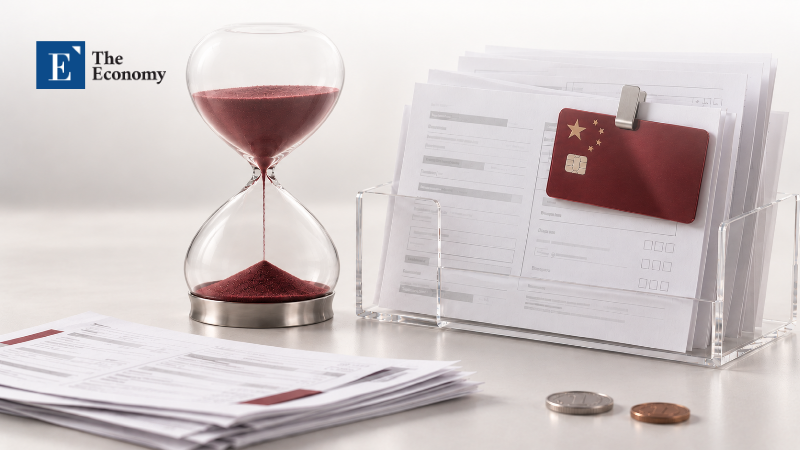
Chinese households are struggling with falling incomes and job insecurity, weakening their ability to repay debt and sustain spending. Rising credit card delinquencies even among middle-aged workers whose repayment capacity banks had trusted reveal increasingly strained household finances. With the property downturn also eroding asset values, households have cut spending, while businesses serving the domestic market are reluctant to expand investment amid weak sales. The Chinese government is trying to fill the gap left by the property slump by developing high-tech industries, but increased production has not translated sufficiently into job and income growth, leaving the consumption recovery without momentum. As industrial support expands production capacity while household purchasing power stagnates, concerns over a prolonged downturn are mounting.
Chinese Bad Loans Put Up for Sale Surge 50% in One Quarter
According to the South China Morning Post (SCMP) on the 26th, newly registered loans on the Banking Credit Asset Registration and Circulation Center, an official nonperforming loan trading platform, totaled CNY 148.1 billion in principal and interest (approximately USD 23.1 billion) in the third quarter of this year, up about 50% from the previous quarter. Delinquent credit card loans accounted for 35.2% of the total, the largest share of any single category. Loans available for sale continue to accumulate, with 82 new loan portfolios registered this month through the 22nd. Cumulative registrations from January through September totaled CNY 322.2 billion (approximately USD 49.1 billion), up 26.4% from the same period last year.
Alongside sales of nonperforming loans, banks are also increasing provisions against potential losses. According to Chinese financial publication Caixin, many listed Chinese banks saw an increase in nonperforming personal loans in the first half of this year, while impairment provisions rose 17.8% year on year. Borrowers’ weakening repayment capacity, combined with tighter loan classification standards, has increased the burden on banks to recognize bad loans and prepare for losses. At all six of China’s major state-owned banks, the nonperforming personal loan ratio at the end of June was higher than at the end of last year. Bank of Communications recorded a ratio of 2.02%, up 0.44 percentage points, while Industrial and Commercial Bank of China’s ratio rose 0.19 percentage points to 1.77%.
As nonperforming personal loans increase, credit card delinquencies are spreading even among middle-aged workers whose ability to repay banks had trusted. The average age of delinquent cardholders disclosed by major financial institutions was generally between 40 and 50, and Ping An Bank also explicitly identified these borrowers as middle-aged. An official handling credit card operations at a state-owned bank’s Shanghai branch said, “Delinquencies are increasing even among customers with stable jobs at state-owned enterprises and government agencies.” Many delinquent customers reportedly said pay cuts or job losses had made it difficult to pay their credit card bills. As their incomes decline, they are prioritizing mortgage principal and interest payments and family living expenses, postponing credit card repayments.
Table 1. Rising Nonperforming Loans and Spreading Personal Loan Delinquencies in China
| Category | Key Item | Details |
|---|---|---|
| Nonperforming loan registrations | New registrations in the third quarter of this year | CNY 148.1 billion in principal and interest Up approximately 50% from the previous quarter |
| Share of delinquent credit card loans | 35.2% of new registrations in the third quarter Largest share of any single category | |
| Cumulative registrations from January through September this year | CNY 322.2 billion Up 26.4% year on year | |
| New registrations in October | 82 loan portfolios through the 22nd | |
| Pressure on bank soundness | Impairment provisions | Up 17.8% year on year in the first half of this year |
| Six major state-owned banks | All six recorded higher nonperforming personal loan ratios at the end of June Compared with the end of last year | |
| Nonperforming personal loan ratios by bank | Bank of Communications: 2.02%, up 0.44 percentage points from the end of last year Industrial and Commercial Bank of China: 1.77%, up 0.19 percentage points from the end of last year | |
| Factors increasing the burden | Weakening borrower repayment capacity Tighter loan classification standards | |
| Spreading credit card delinquencies | Characteristics of delinquent customers | Average age generally between 40 and 50, according to disclosures by major financial institutions Rising delinquencies among customers with stable jobs at state-owned enterprises and government agencies |
| China Everbright Bank sale example | More than CNY 10 billion in nonperforming loans offered for sale in August High proportion of borrowers with at least a junior college education in the loan pool | |
| Reasons for delayed repayments | Income losses due to pay cuts and unemployment Priority given to mortgage principal and interest payments and family living expenses Credit card repayments given lower priority |
100 Million Chinese Adults Unable to Repay Their Debts
Rising delinquencies among middle-aged people with stable jobs are seen as a sign of how much household spending capacity has weakened. An analysis of financial data from 26 banks and other sources by investment research firm Gavekal Dragonomics found that China’s nonperforming household debt reached CNY 2.22 trillion (approximately USD 338 billion) at the end of last year, up 21% in one year. An estimated 100 million adults were unable to repay credit card loans, mortgages and other debts on time. With total household debt roughly tripling over the past decade to CNY 83 trillion (approximately USD 6,346 billion), falling incomes and job insecurity have left more borrowers struggling to repay. China also lacks a nationwide personal bankruptcy system that would allow individuals unable to manage their debts to restructure them or obtain a discharge, leaving insufficient mechanisms to help delinquent borrowers resume economic activity.
The consumption recovery is also being constrained as debt-burdened households cut spending and banks tighten lending requirements. This year, the Chinese government tripled the cap on consumer loan interest subsidies to CNY 3,000 per person (approximately USD 462) and expanded eligibility to include credit card installment payments. Banks, however, continued tightening screening to prevent further bad loans. Demand for borrowing to fund consumption has also been weak, with outstanding short-term household loans falling 7% year on year in June. Even customers with strong credit profiles are cutting card use, making it difficult to stimulate consumption. According to global credit rating agency Moody’s, customers with stronger credit profiles are reducing credit card use, while consumers with weaker credit profiles continue to rely on loans. As borrowing by customers able to repay declines while loan demand persists among financially strained borrowers, banks face increasing credit risk.
Property Slump Drives Simultaneous Weakness in Consumption and Investment
The prolonged property downturn continues to weigh on household willingness to spend. Falling home prices have reduced the value of household assets, apparently prompting people to keep postponing home purchases and other spending. According to China’s National Bureau of Statistics, property investment fell 20.6% year on year from January through September this year, while home sales also weakened. When homes do not sell, developers receive less cash from sales, leaving them short of funds for land purchases and new construction. Weak sales thus also obstruct an investment recovery. The delayed property market recovery has prompted forecasts that weak domestic demand could persist. Last month, Louise Loo, lead economist at Oxford Economics, forecast that China’s residential property investment would not recover until 2031 and lowered her growth forecast for next year to 4.3% to reflect the prolonged property slump.
As the property slump depresses both consumption and investment, concerns are growing that China could enter a “lost decade.” The concern is that if households and businesses whose assets have lost value curb spending and investment to reduce debt, falling sales and weak incomes will trigger further spending cuts in a vicious cycle. According to the Financial Times (FT), some economists view the bursting of the property bubble in 2021 as the start of China’s prolonged downturn and believe the country is already halfway through a “lost decade.” Their analysis suggests that insufficient demand will be difficult to overcome unless the government makes up for spending cutbacks by a private sector focused on repaying debt. Richard Koo, chief economist at the Nomura Research Institute, who has studied Japan’s prolonged slump, also noted that although recognition of the need for fiscal stimulus has broadened within China, the government’s policy stance has not changed sufficiently. The warning is that if the government is also slow to respond while the private sector remains reluctant to spend, the impact of the property downturn could persist for years.
Table 2. Key Indicators of Production, Consumption and Investment in China
| Category | Key Indicator | Year-on-year change, January–September this year |
|---|---|---|
| High-tech industrial production | Value added in high-tech manufacturing | Up 14.3% |
| Lithium-ion battery output | Up 39.5% | |
| Industrial robot output | Up 29.1% | |
| Consumption | Retail sales | Up 1.1% |
| Investment | Total fixed-asset investment | Down 7.2% |
| Investment excluding property development | Down 4.2% | |
| Private investment | Down 10.4% |
Weak Domestic Demand Erodes the Impact of Industrial Stimulus
The Chinese government’s stimulus funds, however, are concentrated on expanding production capacity in high-tech industries, exposing their limitations in offsetting weak private consumption. Even if massive investment in industrial development increases supply, businesses must find overseas markets for the additional output unless domestic purchasing power keeps pace. Production has already risen sharply in the high-tech industries that have received concentrated government support. According to China’s National Bureau of Statistics, value added in high-tech manufacturing rose 14.3% year on year from January through September this year, while lithium-ion battery and industrial robot output increased 39.5% and 29.1%, respectively. In contrast, retail sales grew just 1.1% over the same period, indicating a sluggish recovery in domestic consumption. Businesses unable to find sufficient buyers at home have little choice but to rely more heavily on overseas sales. Ultimately, if production support continues without a recovery in domestic demand, the benefits of subsidies are likely to flow to overseas consumers buying low-priced products.
Weak domestic demand also complicates the government’s plan to fill the gap left by the property slump by developing high-tech industries. Without confidence that more products will sell domestically, businesses are reluctant to spend money building factories or expanding facilities. China’s total fixed-asset investment fell 7.2% year on year from January through September this year. Investment excluding property development also declined 4.2%, showing that the investment contraction extends across multiple industries. Private investment fell 10.4% as well, with little sign of a revival in business expansion. Even as output rises in high-tech sectors receiving concentrated government support, domestic sales prospects have not improved enough to drive a broad recovery in corporate investment.
Weak Employment and Income Growth Impede Economic Restructuring
With the development of high-tech industries failing to spur an economy-wide investment recovery, China’s transition to a new growth model is also proving difficult. Even as new industries grow in an economy long dependent on property and infrastructure investment, time is needed to replace the jobs and income lost in traditional sectors. China has focused on expanding production facilities through local government efforts to attract investment and funding from state-owned banks. According to the International Monetary Fund (IMF), making household consumption an engine of growth also requires changing the allocation of resources concentrated on businesses and local government policy incentives that prioritize investment performance. However, reducing business support and raising taxes to fund social welfare risk causing a short-term economic shock. Unless new industries can sufficiently replace the jobs and income lost in existing sectors, consumption is likely to recover slowly even if household support increases.
The employment structure is another obstacle to translating expanded high-tech production into a recovery in domestic demand. Industries heavily promoted by the Chinese government, such as electric vehicles, rely on large-scale facilities and automation, so increased production has a limited effect on new hiring and household income growth. In a commentary for Reuters on the 25th, Manishi Raychaudhuri noted that investment in high-tech manufacturing had supported growth but had done little to resolve unemployment. He also pointed out that allocating funds with a priority on technological self-reliance had reduced support for labor-intensive industries. In other words, with high-tech sectors failing to expand hiring sufficiently and less support available for industries that employ large numbers of workers, easing job insecurity has become even more difficult. Job insecurity also affects spending by households whose members are employed. They postpone current consumption and increase savings to prepare for the possibility of future income losses or interruptions. A 2024 survey by the People’s Bank of China cited in the commentary also identified the weak labor market as a reason for the rising savings rate.
Anne-Marie Nicholson is a fearless reporter covering international markets and global economic shifts. With a background in international relations, she provides a nuanced perspective on trade policies, foreign investments, and macroeconomic developments. Quick-witted and always on the move, she delivers hard-hitting stories that connect the dots in an ever-changing global economy.
Similar Post