As mortgage rates exceed 7%, downward pressure mounts on U.S. house prices, and with the Iran war prolonging, escape from high interest rates remains uncertain.

Anne-Marie Nicholson is a fearless reporter covering international markets and global economic shifts. With a background in international relations, she provides a nuanced perspective on trade policies, foreign investments, and macroeconomic developments. Quick-witted and always on the move, she delivers hard-hitting stories that connect the dots in an ever-changing global economy.
Authored On
Modified
Prolonged U.S.-Iran war escalates inflation concerns
Mortgage rates surpass 7% following Treasury yields
Buying slowdown leads to widespread price and pre-sale discounts

As the Iran war prolongs and inflation fears rise, the U.S. 10-year Treasury bond yield has broken through the 5% barrier, with the 30-year fixed mortgage rate surpassing 7%. Buyers, struggling to cope with loan interest, are postponing home purchases, leading to an accumulation of listings, prompting both homeowners and builders to reduce prices to attract buyers. Although the slowdown in transactions results in price reductions, war-related inflation concerns and U.S. debt pressures are pushing interest rates higher, continuing to pressure the housing market. Particularly, if peace negotiations fail to provide a breakthrough and oil supply uncertainty lengthens, high interest rates could suppress buying demand and intensify downward pressure on home prices.
U.S. home purchase contracts drop 8.5% as mortgage rates climb
According to Freddie Mac, a U.S. government-backed mortgage lender, as of the 8th, the average 30-year fixed mortgage interest rate was 7.40% annually, rising for the seventh consecutive week to its highest level since November 2023. This marks an increase of 0.12 percentage points from 7.28% the previous week and is 1.10 percentage points higher than one year ago. After falling to 5.98% at the end of February this year, rates have jumped 1.42 percentage points in about seven months, increasing borrowers' repayment burdens. Borrowing $400,000 (approximately US$308,700) results in monthly principal and interest payments rising by about $376 (approximately US$385). This rise is influenced by surging oil prices and inflation fears driven by the Iran war. As inflation concerns push the U.S. 10-year Treasury yield up, linked mortgage rates have also continued rising.
The increased burden of principal and interest payments is suppressing housing purchase demand. According to real estate information firm Zillow, last month, if buyers cover 20% of the home's price in cash, the monthly mortgage payment for a representative home value was $1,922 (approximately US$2,000), an increase of 6.7% compared to a year earlier. Adding taxes, insurance, and maintenance costs, the housing burden on a median income household reaches 34.3% of income. As monthly housing costs rise, newly signed home purchase contracts have declined. Last month, new signed home purchase contracts decreased by 8.5% year-over-year, and the median time between listing and contract extended by two days to 29 days.
Accumulating inventory leads to falling home prices and widespread pre-sale discounts
As buyers weaken under interest burden, home sellers have started lowering asking prices. Zillow data show that last month, 27.4% of all listings had price reductions, up 1.1 percentage points from the previous month. More than one in four homes have lowered prices to attract buyers. Meanwhile, listings waiting for buyers have piled up. Nationwide inventory last month reached 1.39 million homes, a 2.5% increase year-over-year, marking 34 consecutive months of growth. Housing value indicators show declines as well. The national home value index fell 0.5% compared to the previous month, while Dallas and Houston home values dropped 1.9% and 1.8%, respectively, from a year ago.
In response to price adjustments by existing home sellers, builders are also offering pre-sale discounts. According to the National Association of Home Builders (NAHB), 38% of builders reduced prices last month, up 3 percentage points from the previous month. The average discount from these firms reached 6%. In addition to lowering prices, promotional offers have expanded, including mortgage rate assistance or free upgrades to home equipment. The proportion of firms providing such benefits increased from 63% in August to 66% in September. Despite rising material costs and labor shortages increasing construction expenses, builders are absorbing extra costs to boost sales. Consequently, industry sentiment is worsening. The NAHB/Wells Fargo Housing Market Index for September dropped 3 points to 32, the lowest since September last year. The index, reflecting builders' outlook on the single-family housing market, indicates more negative views when below the baseline of 50.
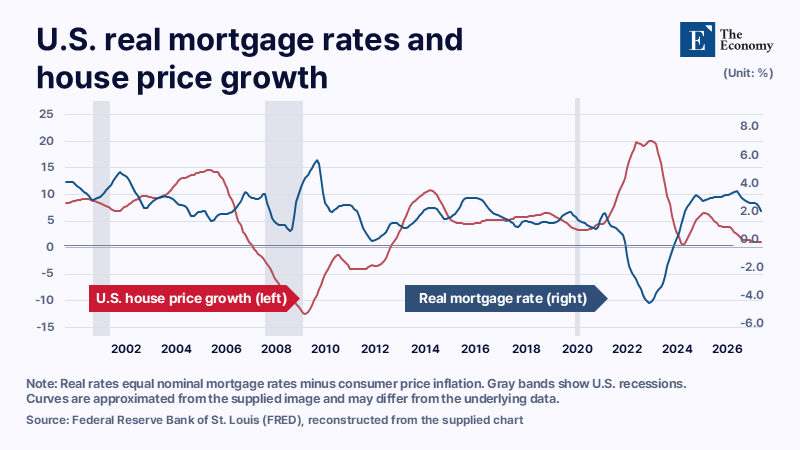
Housing market slows when real interest rates exceed 4%
The reduction in housing transactions and price cuts by sellers and builders correlate with real interest rates adjusted for inflation. Real interest rates are nominal loan rates minus inflation. Even if nominal rates remain constant, a slowdown in inflation raises real rates. With inflation less effectively eroding the real value of debt, borrowers experience a greater real repayment burden. This burden reduces home buying capacity, damping demand and prices. IMF analysis of data across countries shows that a 1 percentage point increase in real rates tends to slow home price growth by about 2 percentage points.
Rising real rates reduce not only the purchasing power of actual buyers but also impact housing demand for investment purposes. Housing investment value is assessed by converting expected rental income into present value, applying a discount rate that reflects interest rates. All other factors equal, a higher discount rate lowers the present value of future rental income, which can reduce the price investors are willing to pay for a home expecting the same rental returns. The U.S. Federal Reserve research team, analyzing the relationship between housing price and rents, identified real interest rates, expected rent growth, and required risk premiums for housing investment as key factors. They explained that interest rates, expected rent growth, and investment risk jointly influence housing valuation.
Concerns grow over prolonged high rates amid inflation and debt burdens
Although interest rates are dampening housing demand, the chance of rates falling soon is low. The prolonged war maintains inflation concerns, prompting the U.S. monetary policy to lean toward further tightening. Minutes from the Federal Open Market Committee (FOMC) meeting on September 7 indicated participants judged that inflation had not declined sufficiently toward the 2% target in recent months. Based on this, the Fed raised the benchmark interest rate by 0.25 percentage points in September, with most members expecting further hikes this year. While some advocated pausing to assess previous moves in October, persistent high inflation limits prospects for rate cuts.
U.S. fiscal burdens are also increasing upward pressure on long-term rates. With national debt surpassing US$40 trillion (approximately US$30.8 trillion), simultaneous Treasury issuance and tech giants’ borrowing for artificial intelligence investments intensify competition for funds. Without increased demand matching bond supply, higher yields are needed to attract investors. Long-term bonds require compensation for inflation and interest risks during their long holding periods via a 'term premium.' Rising term premiums lift long-term Treasury yields, causing the government’s interest costs on newly issued bonds to increase even if benchmark rates remain steady. Servicing maturing debt at higher rates further escalates fiscal pressures.
Oil supply instability complicates U.S. interest rate stabilization
If long-term rates rise further, losses among bond investors may trigger forced sales, raising financial market volatility risks. Dan Ivascyn, Chief Investment Officer at bond manager PIMCO, warned on September 9 that bond sales by leveraged investors could push the U.S. 10-year Treasury yield up to 6%. This process involves hedge funds and others reducing holdings due to mounting losses from price drops caused by rising yields. Large sales depress bond prices further, driving yields higher and causing more selling. Ivascyn anticipated that once 10-year yields exceed 5.5%, stock and corporate bond markets could face widespread damage. Firms and commercial real estate borrowers needing to refinance maturing debts may struggle to secure funds despite accepting higher interest costs.
Ending the Iran war and restoring energy supply remain key factors to ease upward rate pressures, yet these prospects are uncertain. Former U.S. President Donald Trump recently warned that if negotiations stall, attacks on Iran could resume after midterm elections. Delays in peace talks and risks of further military conflict heighten fears of prolonged oil supply disruption. Analysis by the Dallas Federal Reserve indicates that the longer oil supply issues persist, the greater their impact on U.S. inflation and household inflation expectations. Continued energy price volatility would hinder the Fed from cutting rates and exert upward pressure on long-term Treasury yields.
Anne-Marie Nicholson is a fearless reporter covering international markets and global economic shifts. With a background in international relations, she provides a nuanced perspective on trade policies, foreign investments, and macroeconomic developments. Quick-witted and always on the move, she delivers hard-hitting stories that connect the dots in an ever-changing global economy.
Similar Post