Private sector cuts consumption to repay debt, government borrows to stimulate economy, challenges as China tries to escape recession

Matthew Reuter is a senior economic correspondent at The Economy, where he covers global financial markets, emerging technologies, and cross-border trade dynamics. With over a decade of experience reporting from major financial hubs—including London, New York, and Hong Kong—Matthew has developed a reputation for breaking complex economic stories into sharp, accessible narratives. Before joining The Economy, he worked at a leading European financial daily, where his investigative reporting on post-crisis banking reforms earned him recognition from the European Press Association. A graduate of the London School of Economics, Matthew holds dual degrees in economics and international relations. He is particularly interested in how data science and AI are reshaping market analysis and policymaking, often blending quantitative insights into his articles. Outside journalism, Matthew frequently moderates panels at global finance summits and guest lectures on financial journalism at top universities.
Authored On
Modified
Private consumption and investment decline due to debt repayment
Additional borrowing inevitable despite stimulus to fill spending gap
Delayed debt resolution in China’s economy raises risk of prolonged recession
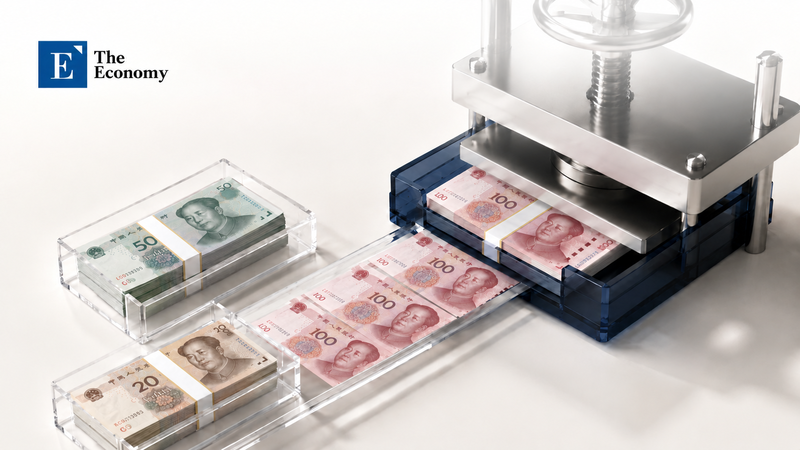
China's economy is increasingly burdened by real estate downturn and debt load, raising concerns about slower growth. The prolonged property slump is increasing banks' non-performing loans and suppressing household consumption, blocking domestic demand recovery. The government, which must fill the spending gap left by the private sector, faces reduced fiscal capacity due to rising debt, creating a dilemma where efforts to stimulate the economy only increase national debt burden. Market warnings suggest China could fall into a long-term recession similar to Japan's after its real estate bubble burst and prolonged debt adjustment period.
IMF lowers China’s growth forecast for this year to 4.5%
On the 12th (local time), the International Monetary Fund (IMF) lowered China's GDP growth forecast for this year from 4.6% in July to 4.5% in its World Economic Outlook (WEO) report. This aligns with the lower end of the Chinese government’s annual growth target range of 4.5–5.0% set in March. Considering last year's actual growth rate was 5.0%, this indicates a 0.5 percentage point slowdown this year. The growth forecast for next year was also cut from 4.1% in July to 4.0%, marking a downward revision for both years.
China’s growth forecast for this year has been repeatedly adjusted between the mid-4% range since the end of last year. In October last year, IMF’s WEO projected China’s 2026 growth rate at 4.2%, but after the annual consultation with China in December, it was raised to 4.5%. The January WEO update maintained 4.5%, then lowered it slightly to 4.4% in April. The July forecast was raised to 4.6%, an increase of 0.2 percentage points, but it has now been readjusted down to 4.5%. The sequence for this year’s WEO forecasts was: January 4.5%, April 4.4%, July 4.6%, October 4.5%, showing a fluctuation range of only 0.2 percentage points.
Domestic demand weakness not offset by export strength
This downward revision reflects sluggish consumption and investment within China. The IMF noted that under the real estate downturn, consumer recovery has been slow and investment weak, with export strength only partially offsetting the blow to domestic demand. Recent economic indicators confirm a slowdown in domestic recovery. According to the National Bureau of Statistics of China, retail sales increased only 0.4% year-on-year in August, down from 0.6% in July and just half the 0.8% market expectation. Fixed-asset investment also contracted, falling 7.2% year-on-year through August, deepening the 6.7% decline seen through July.
The real estate slump has been cited as a factor suppressing both investment and household consumption. A previous IMF report analyzing China’s economy diagnosed that the prolonged property downturn and fragile social safety net dampen household consumption motivation. Real estate development investment declined 19.9% year-on-year from January to August this year, while the value of new housing sales also shrank by 13.1%. Developers' liquidity worsened, with funding obtained from loans and sales proceeds dropping 21.0%. At construction sites, starts and completions shrank 24.8% and 23.7% respectively, reflecting ongoing project scalebacks.
Table 1. Key indicators of Chinese consumption, investment, and real estate
| Category | Retail Sales | Fixed Asset Investment | Real Estate Development Investment | New Housing Sales Value | Developer Funds Raised | Starts and Completions Area |
|---|---|---|---|---|---|---|
| Growth Rate | +0.4% | -7.2% | -19.9% | -13.1% | -21.0% | Starts -24.8% Completions -23.7% |
| Key Features | Slowed from +0.6% in July Half of expected +0.8% | Decline widened from -6.7% (January–July) Widening decline | Development investment shrinks amid real estate slump Development investment contraction | Housing sales Continued weakness | Loans and sale proceeds Decreased inflows | Simultaneous decline in starts and completions Construction project downsizing |
Chinese real estate losses put pressure on banks and households
Developers' liquidity shortage and construction cutbacks have also pressured lending banks. Fitch Ratings views real estate-related non-performing loans and weakened household mortgage repayment ability as threats to Chinese banks’ asset quality. There are concerns that both the collateral real estate values and borrowers’ repayment capacity could weaken. Aware of these risks, some banks have shifted loan screening to prioritize salary income over property holdings. For existing overdue loans, they are extending maturities or allowing borrowers time to sell properties to recover funds. These measures aim to strengthen loan screening for new loans while slowing down deterioration of existing loans.
As lending standards tighten, households are also reluctant to increase debt for consumption. The growing number of borrowers struggling with existing loans increases the burden of additional borrowing. According to Chinese consulting firm Gavekal Dragonomics, household non-performing loans reached 2,220 billion yuan (approximately US$342 billion) last year, rising over 20% year-on-year. In August this year, household loan balances declined by 202.9 billion yuan (approximately US$31.2 billion) from the previous month, marking six consecutive months of decreases. Gavekal Dragonomics attributes this to reduced mortgage demand and weakened willingness to borrow for consumption.
Dilemma between domestic stimulus and fiscal health
The government, tasked with resolving real estate losses and supporting the economy, is hampered by rising debt. With local governments reliant on land sale revenues, fiscal conditions have worsened amid the property downturn, increasing transfers required from the central government. The U.S.-based Conference Board estimates that in central government general public budgets this year, debt repayment accounts for 19.2% of expenditures, up 7.2 percentage points from 12% in 2014 over 12 years. Annual interest expenses for central and local governments are also projected to grow from 348 billion yuan (approximately US$53.5 billion) to 1.4 trillion yuan (approximately US$215 billion) over the same period.
While the cost of servicing national debt rises, additional borrowing for economic stimulus is still necessary. If households and companies repay debts by cutting spending, lowering income and sales, debt repayment becomes even harder. Increasing government spending through issuance of national bonds to support households reduces private sector burdens but accumulates as public debt. The IMF's annual report on China recommends additional fiscal expansion to support domestic demand and reduce the vicious cycle of debt and deflation. It also suggests increasing social security spending to encourage households to convert savings set aside for medical care and retirement into consumption.
Japan’s long-term recession shadows China's debt adjustment
The analysis suggesting prolonged fiscal support in China draws on Japan’s experience, which suffered a long recession after its real estate bubble burst. Nomura Institute’s chief economist Richard Koo described the sharp asset price collapse leading households to focus on debt repayment, suppressing overall economic demand, a phenomenon called "Balance Sheet Recession." According to his analysis, even with interest rates near zero, firms avoided borrowing and investment, weakening monetary easing effects. The government had to borrow to increase spending to fill the private demand gap, with recovery of private sector finances taking approximately 20 years. Koo says China’s debt adjustment is unlikely to conclude within 1–2 years and stresses careful selection of fiscal projects with multi-year impact.
Japan’s prolonged recession also warns that failure to timely resolve non-performing loans in troubled companies can delay recovery. Harvard professor Kenneth Rogoff and IMF economist Yin Xuancheng, in a joint study in March, explained that Japanese banks continued lending to troubled firms to avoid recognizing losses, distorting capital allocation and constraining corporate growth. Similarly, China must enhance banks' capacity to absorb losses while cleaning up bad debts. Recognizing uncollectible loans as losses shrinks bank capital, leading to reduced new lending. To maintain lending capacity, capital shortfalls must be filled, often with public funds, thereby burdening the government with costs for both stimulus and bank recapitalization.
Even after government financial support covers banks’ losses, it will take time for firms and households to restore repayment capacity. Professors Rogoff and Yin analyzed that Japanese regions with concentrated housing and infrastructure investments experienced deeper, longer recessions post-bubble. Declines in construction-related work and deteriorating income prospects reduced earnings needed for debt repayment. In China, capital and labor concentrated in real estate must shift to new industries, boosting corporate profits and household incomes to restore debt servicing ability. Given the need for the real economy to secure new income sources while banks resolve their non-performing loans, China’s debt adjustment is also likely to be prolonged.
Matthew Reuter is a senior economic correspondent at The Economy, where he covers global financial markets, emerging technologies, and cross-border trade dynamics. With over a decade of experience reporting from major financial hubs—including London, New York, and Hong Kong—Matthew has developed a reputation for breaking complex economic stories into sharp, accessible narratives. Before joining The Economy, he worked at a leading European financial daily, where his investigative reporting on post-crisis banking reforms earned him recognition from the European Press Association. A graduate of the London School of Economics, Matthew holds dual degrees in economics and international relations. He is particularly interested in how data science and AI are reshaping market analysis and policymaking, often blending quantitative insights into his articles. Outside journalism, Matthew frequently moderates panels at global finance summits and guest lectures on financial journalism at top universities.
Similar Post