“The Myth of Luxury’s Invincibility Is Faltering”: Hermès, LVMH and Kering Shares Plunge as Geopolitical Instability and Weakening U.S. and Chinese Spending Take a Toll

Aoife Brennan is a contributing writer for The Economy, with a focus on education, youth, and societal change. Based in Limerick, she holds a degree in political communication from Queen’s University Belfast. Aoife’s work draws connections between cultural narratives and public discourse in Europe and Asia.
Authored On
Modified
Slowing earnings growth at global luxury groups, including Hermès, LVMH and Kering, sends shares sharply lower
Prolonged Middle East war and social unrest in Europe dampen tourism demand, while luxury spending also declines in the United States
Property downturn and tighter taxation of overseas assets accelerate the retreat of China’s core consumers
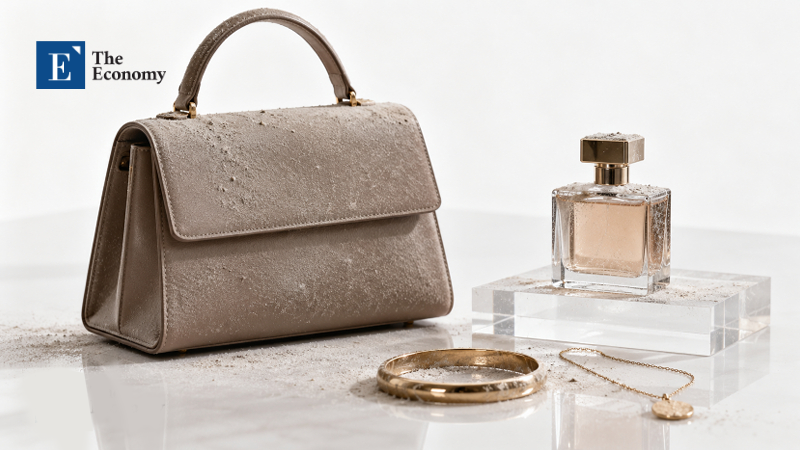
Shares in global luxury groups are plummeting. Market expectations are rapidly fading as earnings growth slows across major companies, including Hermès, LVMH and Kering. The industry’s worsening conditions are being attributed to weaker tourism and consumer demand amid the prolonged Middle East war and social and political instability in Europe. Meanwhile, adverse factors are also mounting in China, one of the largest markets for luxury goods, including deteriorating consumer sentiment caused by the property downturn and tighter taxation of wealthy individuals’ overseas trusts.
Hermès Shares Plummet
On the 22nd (all dates hereafter are local time), Hermès announced that revenue for this year’s third quarter (July–September) rose just 4.3% from a year earlier to EUR 4.1 billion (approximately USD 4.68 billion) at constant exchange rates. That was a slowdown of 2.4 percentage points from the preceding second quarter’s revenue growth rate of 6.7%, and below the market forecast of 5.2% compiled by financial data provider Visible Alpha. It was also the lowest quarterly growth rate in roughly six years, since early 2020, when stores worldwide closed simultaneously in the wake of the COVID-19 pandemic.
Immediately after the earnings release, Hermès shares plunged as much as 9% during trading in Paris, ultimately closing down 4.94% at EUR 1,289.5 (approximately USD 1,469) per share. The Financial Times (FT) also reported that Hermès shares were down about 40% from the beginning of the year. Its market capitalization has shed EUR 86 billion (approximately USD 98.1 billion) this year alone, falling to EUR 135 billion (approximately USD 154 billion). Its price-to-earnings ratio (P/E), which exceeded 54 times expected earnings for the following 12 months early last year, halved to around 27 times early this month.
Kering and LVMH Also Face Declines
Major French luxury groups Kering and LVMH have also faced falling share prices. LVMH, which owns leading luxury brands including Louis Vuitton, Dior and Tiffany, was down 39.9% from the beginning of the year as of the close on the 22nd. Kering also closed at EUR 178.12 (approximately USD 203) in Paris on the 23rd, down 16.6% from the previous trading session, marking the largest one-day share price decline in its history. Its year-to-date decline widened to approximately 41%.
Earnings growth is also slowing. LVMH’s third-quarter revenue this year totaled EUR 18.504 billion (approximately USD 21.1 billion), with organic growth of just 1% year on year. In particular, revenue in its fashion and leather goods division, which includes Louis Vuitton and Dior, fell 5% from the same period last year. Kering also announced on the 22nd that third-quarter revenue fell 1% year on year on a comparable basis to EUR 3.345 billion (approximately USD 3.82 billion). Sales at its flagship brand Gucci notably shrank 6% to EUR 1.291 billion (approximately USD 1.47 billion), far worse than the market forecast of a 2.8% decline.
Uncertainty Mounts Around the World
The broad weakness in luxury stocks has multiple causes. First, economic uncertainty stemming from the prolonged Middle East war has placed a considerable burden on the industry. Armed conflict between the United States and Israel on one side and Iran on the other has weakened tourism and shopping demand in the Middle East, while higher oil prices and flight disruptions have also reduced visits to Europe by big spenders. Indeed, when LVMH released its first-quarter results in April, it said the Middle East war had reduced the group’s overall revenue by approximately 1%. Hermès also saw its third-quarter revenue in the Middle East plunge 4.5% year on year.
Social and political instability within Europe has added to the headwinds. On the 17th, mass protests against rising living costs and cuts to public services turned violent in Paris, France. Louis Vuitton and Celine stores on Avenue Montaigne were attacked and their windows smashed, while Burberry, Dior perfume and Guerlain stores on Rue Saint-Honoré were looted. Luxury stores around Place Vendôme also suffered damage or suspended operations. In Milan, Italy, protests against rising living costs and other issues intensified on the 17th–18th, resulting in looting and property damage. On the 19th, shops on Via Montenapoleone, home to a concentration of luxury stores including Chanel, Tiffany and Dior, closed early or removed merchandise from display.
Table 1. Main Causes of Weakness in Global Luxury Stocks
| Category | Main Causes | Market Impact |
|---|---|---|
| Deteriorating Tourism and Business Conditions | · Weaker consumer and tourism demand due to the prolonged Middle East war · Fewer visitors to Europe due to higher oil prices and flight disruptions · Widespread damage, looting and business closures at luxury stores amid protests in France and Italy | Slower sales in the Middle East and Europe, greater pressure on physical store operations |
| Weakening U.S. Consumer Sentiment | · Heightened political uncertainty · Rising Treasury yields and mortgage rates | Continued decline in U.S. luxury spending |
| Weak Domestic Demand in China | · Deteriorating wealth effect due to falling property prices · Tighter taxation of overseas trust assets increases wealthy individuals’ need to raise cash and rebalance assets | Weak China sales at major brands |
U.S. and Chinese Consumers Tighten Their Purse Strings
U.S. consumers, once a major driver of growth in the luxury market, are also tightening their purse strings. An analysis of credit card transactions by U.S. bank Citibank showed that American consumers’ luxury purchases fell 6% year on year last month. This marked the third consecutive month of declines, following drops of 4% each in July and August. The contraction was particularly pronounced in spending on watches and fine jewelry. Market observers say heightened political uncertainty ahead of the midterm elections, along with rising U.S. Treasury yields and mortgage rates, is weighing on luxury purchases.
A similar situation has emerged in China, which accounts for approximately 20% of global luxury purchases. According to a Bloomberg report on the 23rd citing data from two luxury market research firms, sales at 25 major luxury brands in mainland China, including Louis Vuitton and Gucci, posted double-digit year-on-year declines in both August and September. Retail sales statistics released by China’s National Bureau of Statistics on the 20th also clearly showed slowing consumption. Retail sales of gold, silver and jewelry in China fell 9.6% year on year last month, while sales at department stores and specialty brand stores shrank 2.9% and 10.3%, respectively, in January–September this year.
Reasons Behind Weakening Consumption in China
China’s declining luxury consumption is attributed to the prolonged property market downturn and weak domestic demand. The Chinese property market entered a full-fledged correction following the liquidity crisis at major developer Evergrande Group in 2021. Conditions subsequently worsened as developer defaults, declining home transactions and falling home prices reinforced one another. Although the Chinese government has rolled out a series of stimulus measures, including easing home purchase restrictions and cutting lending rates, the recovery remains weak. Last month, new home prices in China fell 0.1% from the previous month and 2.8% from a year earlier. Falling property values undermine household consumer confidence and strengthen the tendency to save more, reducing demand for expensive consumer goods, including luxury products.
Adding to this, the Chinese government’s recent tightening of taxation on wealthy individuals’ overseas trust assets has intensified pressure on consumption. Chinese tax authorities are currently requiring high-net-worth individuals who have managed assets through overseas trusts to declare previously unreported income and are pursuing unpaid taxes. These measures follow regulations introduced in July by China’s Ministry of Finance and State Taxation Administration, applying a 20% tax rate to appreciation in the value of assets transferred to offshore trusts and income generated by those trusts. As tax oversight tightens, some wealthy individuals have reportedly begun restructuring their assets, including selling shares or terminating overseas trusts, to raise the cash needed to pay their taxes.
Aoife Brennan is a contributing writer for The Economy, with a focus on education, youth, and societal change. Based in Limerick, she holds a degree in political communication from Queen’s University Belfast. Aoife’s work draws connections between cultural narratives and public discourse in Europe and Asia.
Similar Post