Construction Labor Shortage Hampers Urgent AI Race With China: Will Robots Take the Jobs in Trump’s ‘Manufacturing Revival’?
Construction Labor Shortage Hampers Urgent AI Race With China: Will Robots Take the Jobs in Trump’s ‘Manufacturing Revival’?

Matthew Reuter is a senior economic correspondent at The Economy, where he covers global financial markets, emerging technologies, and cross-border trade dynamics. With over a decade of experience reporting from major financial hubs—including London, New York, and Hong Kong—Matthew has developed a reputation for breaking complex economic stories into sharp, accessible narratives. Before joining The Economy, he worked at a leading European financial daily, where his investigative reporting on post-crisis banking reforms earned him recognition from the European Press Association. A graduate of the London School of Economics, Matthew holds dual degrees in economics and international relations. He is particularly interested in how data science and AI are reshaping market analysis and policymaking, often blending quantitative insights into his articles. Outside journalism, Matthew frequently moderates panels at global finance summits and guest lectures on financial journalism at top universities.
Authored On
Modified
Aging workers and immigration crackdowns shrink the U.S. construction labor supply
Data center construction setbacks weigh on the AI race with China
Reliance on automation grows as manufacturing is rebuilt
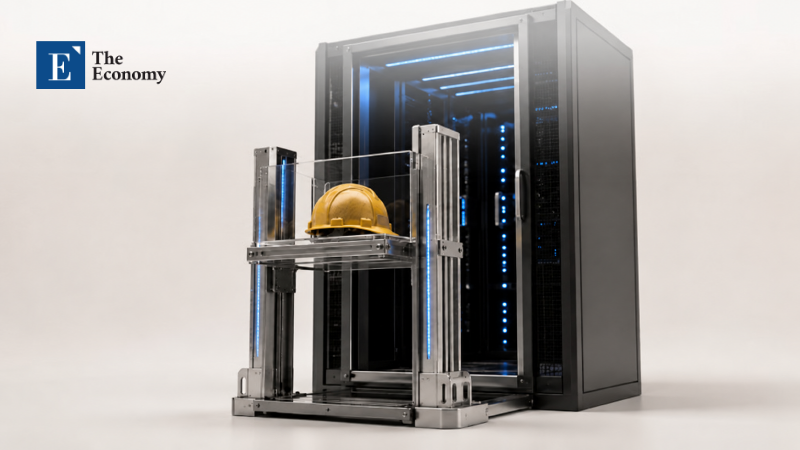
A construction labor shortage in the United States has emerged as an obstacle to expanding artificial intelligence (AI) infrastructure. An aging skilled workforce, slow generational replacement and intensified immigration enforcement have left too few workers to build data centers and power facilities. With infrastructure urgently needed to compete with China for AI supremacy, Big Tech companies have begun training skilled workers themselves, while robots are being deployed to construction sites. Although President Donald Trump has pledged to rebuild manufacturing and restore jobs, an irony is emerging on industrial sites: machines are filling the gaps left by people.
U.S. Construction Sites Need 500,000 More Workers
According to U.S.-based Holland Construction Services on the 18th local time, the U.S. construction industry needs about 500,000 additional workers this year to meet existing demand. Staffing is particularly difficult at construction sites for advanced facilities such as semiconductor and battery plants, where multiple trades must work in coordination. In a survey conducted in July and August this year by the Associated General Contractors of America (AGC) and the National Center for Construction Education and Research (NCCER), 87% of respondents reported unfilled craft positions. By trade, 81% of companies recruiting electricians reported difficulty finding workers, as did 77% of those seeking heating, ventilation and air conditioning technicians and 76% of those seeking concrete workers. There is also a shortage of managers to oversee construction. Among companies seeking site superintendents, 75% said they had difficulty finding suitable candidates.
Labor shortages are also delaying projects and driving up costs at a growing number of sites. In the same survey, 42% of respondents said their projects had been delayed by labor shortages at their own companies or subcontractors, making labor shortages the most frequently cited cause of delays. At some housing construction sites, foundations have been completed but subsequent work cannot begin because builders cannot find workers to erect the framing. Scott Brannock, president of Jacksonville, Florida-based homebuilder Tidewater Homes, said shortages of framing crews were causing large homebuilders to miss business targets and lose hundreds of thousands of USD. Adding to construction costs, a September survey by the National Association of Home Builders (NAHB) found that the median year-on-year increase in labor costs reached 4.2%.
AI data center construction projects are also facing an urgent struggle to secure skilled workers in numbers matching their scale. In the AGC–NCCER survey, 37% of companies that had worked on data center projects over the past year identified securing workers or subcontractors as the biggest challenge in winning and executing contracts. Of these companies, 58% said competition for skilled workers had intensified, while 49% reported upward pressure on wages. Many are offering high pay to secure electricians and construction managers. According to Jake Rathwell, senior vice president of the data center division at staffing company Kelly Services, workers moving into the data center sector often receive 25–30% more pay than before. Shortages of electricians and other skilled tradespeople persist in areas with extensive data center and power facility construction, including Virginia, Georgia, North Carolina and South Carolina.
Generational Replacement Stalls as Skilled Workers Near Retirement
An aging skilled workforce and slow generational replacement are cited as causes of the labor shortage. According to Anirban Basu, chief economist at Associated Builders and Contractors (ABC), about 20% of U.S. electricians are aged 55 or older, meaning a substantial number are approaching retirement. Too few young workers are entering the industry to replace them. Deloitte’s “2026 Engineering and Construction Industry Outlook” found that workers under 25 account for just 10% of the U.S. construction workforce. The time required for new entrants to become skilled workers also makes replenishing the workforce difficult. According to the U.S. Bureau of Labor Statistics (BLS), electricians typically complete a four- to five-year apprenticeship, receiving about 2,000 hours of on-the-job training each year along with separate technical instruction.
There is also a wide gap between the specialized skills required for advanced facilities and job applicants’ capabilities. Matt Wilson of Holland Construction Services explained that semiconductor and battery plants require skilled workers from multiple disciplines simultaneously because their mechanical systems, electrical systems, process piping and structures are intricately interconnected. Data centers likewise require expertise in power supply and cooling systems. The introduction of liquid cooling, in particular, means existing workers must also learn new skills. Matthew Hawkins, director of education at Uptime Institute, noted that introducing water-based cooling systems into spaces housing servers is changing both the skills workers must master and the requirements for managing equipment reliability. In the AGC–NCCER survey, half of respondents said applicants lacked the necessary skills, qualifications or licenses, identifying this as their biggest obstacle to hiring.
Table 1. Main Causes of the U.S. Construction Labor Shortage
| Category | Key details | Related indicators and conditions on site |
|---|---|---|
| Aging skilled workforce | Many workers approaching retirement; insufficient inflow of young workers | About 20% of electricians are aged 55 or older Workers under 25 account for 10% of the total construction workforce |
| Lengthy training process | New workers need considerable time to become proficient | Electrician apprenticeships typically last 4–5 years About 2,000 hours of on-the-job training each year, plus separate technical instruction |
| Demand for advanced facility skills | Skilled workers from multiple disciplines must be deployed simultaneously; training in new technologies is needed | Semiconductor and battery plants: interconnected mechanical systems, electrical systems, process piping and structures Data centers: expertise in power and cooling, plus the ability to work with liquid cooling, is required |
| Insufficient applicant capabilities | Lack of necessary skills, qualifications and licenses constrains hiring | Half of respondents to the AGC–NCCER survey identified applicants’ lack of skills, qualifications or licenses as the biggest obstacle to hiring |
| Intensified immigration enforcement | Growing pressure for workers to leave sites heavily dependent on immigrant labor | Foreign-born workers’ share in 2024 26.3% of the overall construction workforce; about one-third of on-site craft workers 57% of drywall and ceiling tile installers 53% each of roofers and painters 43% of construction laborers |
Immigrant Workers Who Sustained Construction Sites Are Also Leaving
While skilled worker training lags, the Trump administration’s intensified immigration enforcement is also encouraging existing workers to leave. Construction is an industry in which immigrants have long accounted for a substantial share of on-site labor. An NAHB analysis of U.S. Census Bureau data found that foreign-born workers made up 26.3% of construction workers in 2024 and about one-third of on-site craft workers. By occupation, immigrants accounted for 57% of drywall and ceiling tile installers and 53% each of roofers and painters. With foreign-born workers also representing 43% of construction laborers, enforcement-related departures directly hamper efforts to secure workers for individual trades.
At actual work sites, even rumors of enforcement raids are causing some workers to avoid reporting for work or leave their jobs. In the AGC–NCCER survey, about 29% of respondents said they had been directly or indirectly affected by immigration enforcement over the preceding six months. Of all respondents, 12% said workers had left sites or failed to report for work because of actual raids or rumors of raids, while 16% reported worker departures at subcontractors. Anxiety over enforcement has also grown among workers legally authorized to work. Last month, the NAHB conveyed concerns to the Department of Homeland Security and Immigration and Customs Enforcement (ICE) about enforcement practices at housing construction sites, saying that even workers legally authorized to work were reluctant to report to sites in some areas.
A decline in new immigrant arrivals also affects the future supply of workers entering construction sites. Riordan Frost, a senior research analyst at Harvard University’s Joint Center for Housing Studies, found that the entire net increase in U.S. construction craft workers from 2013 to 2024 came from growth in foreign-born workers. During that period, the construction craft workforce increased from 5.8 million to 6.2 million, while the increase of 236,000 construction laborers also consisted entirely of immigrants. However, net international migration to the United States, which had helped replenish the workforce, fell from 2.7 million in 2024 to 1.3 million last year. The U.S. Census Bureau projected that net migration would fall to 321,000 this year if current trends continue.
Infrastructure Expansion Challenges U.S. Plans to Secure AI Leadership
The shrinking construction labor supply is also weighing on the U.S. strategy to expand infrastructure and gain an edge in the AI race with China. Training AI models and expanding services require large-scale computing facilities and power grids to be ready on time, meaning on-site labor shortages could delay the expansion of infrastructure needed for technological development. Infrastructure construction was also identified as a key priority in “America’s AI Action Plan,” released by the White House in July last year. It included measures to shorten permitting procedures for data centers and semiconductor plants and train relevant workers, including electricians and heating, ventilation and air conditioning technicians. Industry leaders, however, continue to warn that there are not enough workers to execute national investment plans. Last September, Ford CEO Jim Farley noted that the United States lacked sufficient on-site workers to support its plans to expand factories, supply chains and data centers, emphasizing the need to invest in skilled trades.
As securing on-site workers emerges as a practical challenge in implementing AI infrastructure investments, Big Tech companies are also funding technical workforce training. Last year, Google concluded that a shortage of electrical workers could constrain the development of U.S. AI and advanced manufacturing infrastructure and announced plans to support training for 100,000 electrical workers and 30,000 new apprentices. The initiative funds the Electrical Training Alliance (etA), an electrical training organization, to expand apprenticeships and integrate AI skills into its curriculum. Meta also launched a construction craft workforce training program in June this year, committing USD 115 million (approximately USD 118 million) in its first year. Beginning in Louisiana, Ohio, Indiana and Texas, the program is designed to provide five weeks of free training and guarantee graduates jobs at Meta data center construction sites.
The Paradox of Restoring U.S. Manufacturing Jobs
Alongside workforce training, efforts to replace some on-site tasks with robots are gaining momentum. The approach assigns machines repetitive tasks previously performed by people, reducing staffing needs and construction time. U.S. data center design and construction company Align introduced robots from Dusty Robotics to mark the installation locations of server racks and other equipment on floors. This automated a process in which multiple workers consulted drawings and marked out locations individually. Align said using robots on a large data center project saved 784 work hours and reduced the workforce required for that process by 18 people.
Robots are also being deployed to build power generation facilities that will supply data centers. According to Noah Ready-Campbell, CEO of Built Robotics, about 10 robots handled pile installation at a solar power project in Louisiana that will supply Meta’s Hyperion data center. The work involves driving steel piles into the ground to erect structures supporting solar panels. These machines install about 1,000 piles a day and handle more than half of the installation work at the site. Ready-Campbell explained that completing the same volume of work using conventional methods would require three to four times the current workforce.
Inside data centers, robots are also handling repetitive tasks needed to install equipment. A drilling robot developed by DeWalt and August Robotics drills holes in concrete floors to anchor server racks, electrical equipment and piping systems. Multiple robots work simultaneously according to design drawings and also remove dust, reducing the preparation time needed for subsequent equipment installation. By replacing tasks affected by labor shortages with machinery first, companies are reducing the burden of additional hiring associated with data center expansion. A similar shift toward assigning robots tasks previously performed by people is also underway in manufacturing. At BMW’s plant in South Carolina, humanoid robots fed metal components into the welding process, supporting the production of more than 30,000 vehicles last year. Robots appear to be filling the jobs that President Trump has promised to bring back through his “manufacturing revival” before people do.
Matthew Reuter is a senior economic correspondent at The Economy, where he covers global financial markets, emerging technologies, and cross-border trade dynamics. With over a decade of experience reporting from major financial hubs—including London, New York, and Hong Kong—Matthew has developed a reputation for breaking complex economic stories into sharp, accessible narratives. Before joining The Economy, he worked at a leading European financial daily, where his investigative reporting on post-crisis banking reforms earned him recognition from the European Press Association. A graduate of the London School of Economics, Matthew holds dual degrees in economics and international relations. He is particularly interested in how data science and AI are reshaping market analysis and policymaking, often blending quantitative insights into his articles. Outside journalism, Matthew frequently moderates panels at global finance summits and guest lectures on financial journalism at top universities.
Similar Post