"Faster Localization Still Leaves Supply Short": China's AI Chip Shortage Sustains Reliance on Nvidia, Driving Smuggling and Overseas Cloud Use
"Faster Localization Still Leaves Supply Short": China's AI Chip Shortage Sustains Reliance on Nvidia, Driving Smuggling and Overseas Cloud Use

Aoife Brennan is a contributing writer for The Economy, with a focus on education, youth, and societal change. Based in Limerick, she holds a degree in political communication from Queen’s University Belfast. Aoife’s work draws connections between cultural narratives and public discourse in Europe and Asia.
Authored On
Modified
China buys Nvidia gaming and workstation GPUs in bulk
Supply remains woefully inadequate despite advances by domestic chipmakers such as Huawei
Smuggling of advanced chips and indirect access through overseas clouds spread amid U.S. export controls
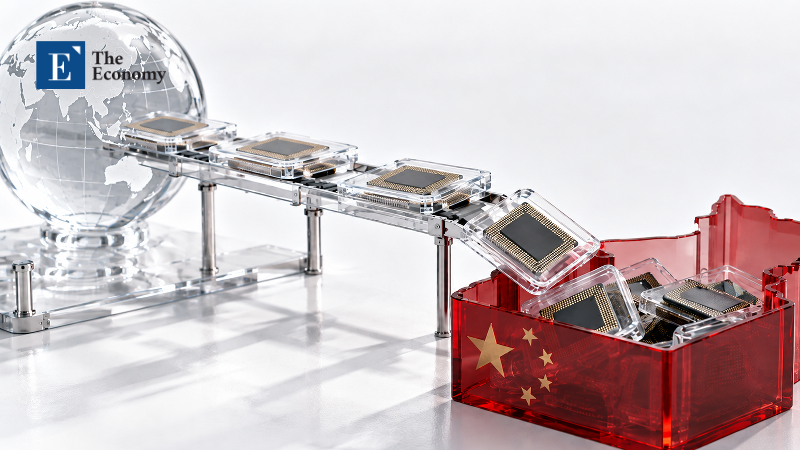
Chinese companies are buying Nvidia graphics processing units (GPUs) for gaming and workstations in large quantities. With U.S. export controls restricting access to advanced artificial intelligence (AI) chips, they are using some GPUs permitted for export for AI computations to make up for shortages of computing resources. Market observers attribute the trend to limits on China's domestic AI chip supply. They say local AI chipmakers, including Huawei, cannot expand production fast enough to meet surging demand, sustaining dependence on overseas computing resources.
China Snaps Up Nvidia Chips
On the 13th (all dates hereafter are local time), the Financial Times (FT) reported that Chinese companies had purchased more than 1 million Nvidia gaming and workstation chips this year to address their AI computing shortfall. Instead of data-center accelerators subject to U.S. export controls on advanced AI chips, they are acquiring some gaming and workstation GPUs permitted for export and using them for AI computations. The products purchased by Chinese companies include the RTX PRO 6000D, RTX PRO 5000 and RTX 5090. Although all three are slower than Huawei's Ascend 910C for most tasks, they can handle lighter AI workloads such as prefill—the stage in which an AI system reads a user's questions or documents before generating an answer.
Reports of actual bulk purchases by Chinese companies are also mounting. On the 13th, China's National Business Daily, citing a person familiar with the matter, reported that local IT company iSoftStone had secured 8,000 Nvidia RTX PRO 6000D GPUs. The products will reportedly be used in the production, testing and delivery of complete AI servers at a factory in Beijing's Tongzhou district. Based on local market prices, the purchase is estimated to be worth CNY 560 million (approximately USD 86.9 million). Earlier, on the 9th, Chinese financial IT company Tianyang Technology also announced that it had signed a contract with a supplier to purchase 20,000 RTX PRO 5500 Blackwell GPUs.
China's Efforts to Develop Its Own AI Chips
This trend is attributed to structural limitations in the local AI chip supply chain. China's semiconductor industry has recently accelerated efforts to achieve AI chip self-sufficiency. Huawei, for example, is working to commercialize its next-generation Ascend 950 series of AI accelerators, following the existing Ascend 910C, while Alibaba has also begun developing its Zhenwu series of AI accelerators through its chip-design subsidiary T-Head. Baidu's Kunlunxin and Cambricon have also joined the race to develop next-generation AI chips. In semiconductor manufacturing, Semiconductor Manufacturing International Corporation (SMIC) is strengthening production capacity on the back of AI-related demand. Memory maker ChangXin Memory Technologies (CXMT) is also raising substantial funding through an initial public offering (IPO), supporting the construction of new factories and expansion of production facilities.
These localization efforts have translated into changes in market share. According to a Reuters report on the 13th citing market research firm IDC, shipments of data-center AI accelerators in China totaled 2,008,000 units in the first half of this year. Huawei shipped nearly 572,000 units, accounting for 28% of the market. T-Head held a 7% share, Cambricon 5% and Kunlunxin 4%. Nvidia's shipments during the period, meanwhile, fell 44% year on year to just 678,000 units, and its market share dropped to 34% from approximately 55% for the whole of last year.
Table 1. Status of China's AI Chip Supply Chain
| Category | Key Details |
|---|---|
| Expanding Localization | Huawei, T-Head, Cambricon and Kunlunxin lead accelerated development of domestic AI chips |
| Supply Shortage | Domestic AI chip production capacity cannot keep pace with rapidly growing computing demand, leaving a persistent supply-demand gap |
| Production Constraints | Rising HBM prices and restricted access to advanced lithography equipment increase production costs and pressure on yields |
Computing Demand Outstrips Supply
The problem is that, despite these changes, China's domestic AI chip supply capacity cannot keep pace with surging computing demand. On the 13th, the FT reported that China's AI chip production this year was expected to reach approximately 3.5 million units, while total demand was projected to exceed 5 million. That would leave a gap of at least 1.5 million units between projected production and demand. Huawei, a key local supplier, has also acknowledged that it cannot adequately meet domestic demand. At the Huawei Connect 2026 event held in Shanghai on the 17th of last month, Huawei rotating chairman Xu Zhijun said, "We have not secured enough production capacity to meet even demand within China," adding that the company had no plans for a full-scale expansion into overseas markets.
Substantially increasing AI chip supply in the short term is also difficult. Rising procurement costs for high-bandwidth memory (HBM) have increased the production burden on Chinese chipmakers. According to a Reuters report last month, Chinese AI chip companies including Huawei and Cambricon have raised product prices in succession to reflect higher HBM prices. The quoted price for Huawei's next-generation Ascend 950DT card has exceeded CNY 250,000 (approximately USD 38,846), while the price of its existing Ascend 910C card has also jumped from around CNY 90,000 (approximately USD 14,000) at the beginning of the year to more than CNY 110,000 (approximately USD 17,077). Restricted access to advanced semiconductor manufacturing equipment is another factor limiting production efficiency. Unable to obtain extreme ultraviolet (EUV) lithography equipment because of U.S. restrictions, Chinese companies are manufacturing chips using existing deep ultraviolet (DUV) equipment and multipatterning techniques. Repeated lithography and etching processes inevitably raise production costs, while the additional process steps make it harder to achieve satisfactory yields.
Nvidia Product Smuggling Cases Mount
These supply shortages have increased Chinese industry's dependence on Nvidia chips. Cases of attempts to illegally export Nvidia's advanced AI chips to China have emerged one after another. On the 9th, Reuters reported that Taiwanese national Ting-Wei Willy Sun had pleaded guilty in federal court in Manhattan, New York, to four charges: conspiracy to violate U.S. export-control laws, conspiracy to smuggle goods, conspiracy to defraud the U.S. government, and obstruction of justice. U.S. prosecutors had previously indicted Sun, Supermicro co-founder Yih-Shyan Wally Liaw and Taiwan branch sales manager Ruei-Tsang Steven Chang in March on charges of conspiring to illegally export U.S.-made AI technology worth USD 2.5 billion (approximately USD 2.60 billion) to China. According to investigators, starting in October 2023, they used transactions routed through companies in third countries to send servers equipped with high-performance GPUs, including Nvidia's B200, H100 and H200, to China without export licenses. Sun allegedly brokered export orders and concealed the fact that the equipment's final destination was China. Investigators also found that, in December last year, he attempted to evade an on-site inspection by the U.S. Department of Commerce by substituting dummy servers for real ones.
A similar case occurred last year. In August last year, the U.S. Department of Justice arrested and charged California residents Chuan Geng and Shiwei Yang, both Chinese nationals, with illegally exporting advanced AI chips worth tens of millions of USD to China. They were found to have shipped AI chips to China without U.S. Department of Commerce export licenses through July last year, using ALX Solutions, a company they established in 2022. Between August 2023 and July 2024, they purchased more than 200 Nvidia H100 chips from Supermicro, declared that the end customers were in Singapore and Japan, and sent more than 20 shipments to freight companies in Singapore and Malaysia. However, local investigations found no evidence of the businesses at the listed addresses, and investigators also uncovered indications that the pair had received payments directly from Chinese companies.
Indirect Access Through Southeast Asian Infrastructure
A growing number of Chinese companies are renting computing resources at overseas data centers rather than smuggling advanced AI chips. They access Nvidia GPUs installed in Southeast Asian countries such as Singapore and Malaysia through cloud services. In November last year, the FT reported that Alibaba, ByteDance and others were training their latest large language models (LLMs) at Southeast Asian data centers equipped with advanced U.S.-made chips. On the 30th of last month, Tencent also signed a five-year lease agreement with U.S. cloud company Oracle to use approximately 100,000 advanced AI chips installed at several Southeast Asian data centers. The contract is estimated to be worth USD 7 billion (approximately USD 7.28 billion), with the initial payment reportedly amounting to around 30% of the total contract value.
The U.S. government is moving to block such Chinese access. Last year, The New York Times (NYT) reported that the Bureau of Industry and Security (BIS), part of the U.S. Department of Commerce, was investigating Chinese companies' channels for obtaining advanced chips and their use of overseas cloud infrastructure. The companies under investigation included Singapore-based Megaspeed International. Megaspeed reportedly purchased advanced Nvidia AI chips in large quantities and supplied them to data centers in Malaysia and Indonesia, which were believed to provide remote computing services to Chinese customers. Separately, U.S. authorities have also been examining whether Megaspeed illegally shipped some chips to mainland China.
Aoife Brennan is a contributing writer for The Economy, with a focus on education, youth, and societal change. Based in Limerick, she holds a degree in political communication from Queen’s University Belfast. Aoife’s work draws connections between cultural narratives and public discourse in Europe and Asia.
Similar Post