German Defense Industry Expands Naval Business on European Rearmament, Putting Non-European Firms' Foothold to the Test as Regional Defense Ecosystem Strengthens
German Defense Industry Expands Naval Business on European Rearmament, Putting Non-European Firms' Foothold to the Test as Regional Defense Ecosystem Strengthens

As one of the youngest members of the team, Tyler Hansbrough is a rising star in financial journalism. His fresh perspective and analytical approach bring a modern edge to business reporting. Whether he’s covering stock market trends or dissecting corporate earnings, his sharp insights resonate with the new generation of investors.
Authored On
Modified
German defense companies including Rheinmetall and TKMS accelerate expansion in naval shipbuilding
U.S. pressure to share defense costs accelerates European rearmament and increases defense spending
EU's stronger regional procurement strategy presents both challenges and opportunities for Asia's defense industry
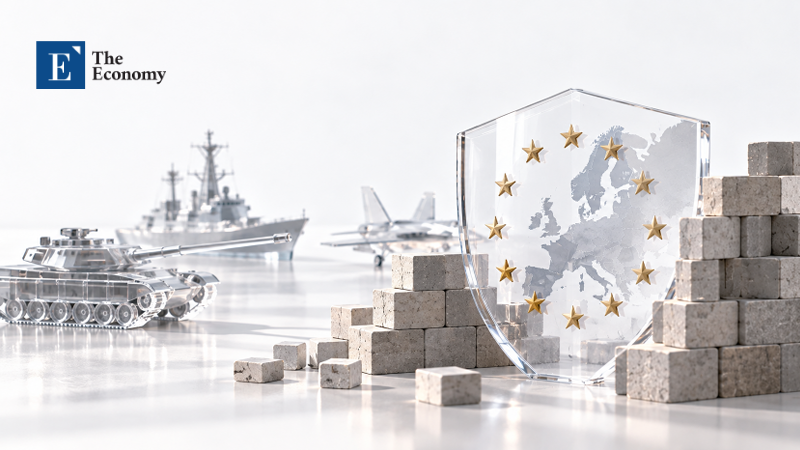
German defense company Rheinmetall is acquiring Romania's Mangalia shipyard. As European countries accelerate rearmament in response to U.S. pressure to share defense costs and security threats from Russia, Germany's defense industry is also rapidly expanding into naval capabilities. Market observers say Europe's push to strengthen its own defense capabilities and expand regional procurement could raise barriers to entry for defense contractors from outside the region, including South Korea.
Rheinmetall's Entry into Shipbuilding
On the 9th, local time, shipping and shipbuilding publication The Maritime Executive reported that Rheinmetall had agreed to acquire the Mangalia shipyard for EUR 138 million (approximately USD 159 million). This is about 75% of the original auction reserve price. Once one of Europe's largest shipyards, Mangalia had operated as a joint venture between Dutch shipbuilder Damen and the Romanian government since 2018. That arrangement began to unravel in 2023, however, when the Romanian government abruptly changed regulations governing the management of private companies. Damen called this a clear breach of contract and filed for insolvency proceedings in 2024, citing substantial loans extended to modernize and operate the shipyard. A local court declared the Mangalia shipyard bankrupt in April, and three subsequent auction rounds failed to attract a successful bid.
The deal is expected to accelerate Rheinmetall's business expansion. In March, Rheinmetall completed its acquisition of Naval Vessels Lürssen (NVL), the naval shipbuilding division of Germany's Lürssen Group, expanding beyond its traditional focus on land weapons, military vehicles and ammunition into naval defense. In May, it secured its first major local naval vessel order by signing a contract worth EUR 920 million (approximately USD 1.06 billion) to supply the Romanian Navy with two coastal patrol vessels and two diving support vessels. The contract requires hull construction, superstructure fabrication, and weapons and equipment installation to be carried out at shipyards in Romania. Rheinmetall thus had a clear incentive to secure a local production base.
Germany's Rapidly Growing Defense Industry
Another German defense company, thyssenkrupp Marine Systems (TKMS), is also accelerating its push into the large warship market, building on its existing submarine and surface vessel construction business. In particular, it is participating in the German Navy's next-generation F127 air-defense frigate program, focusing on developing large vessels with long-range air-defense and ballistic missile interception capabilities. The vessel is being developed based on TKMS's existing MEKO A400 design, with the aim of establishing a sea-based defense system capable of intercepting enemy ballistic missiles outside the atmosphere.
Established commercial shipbuilders are also expanding into defense. Germany's Meyer Werft, for example, has traditionally focused on building large cruise ships but has recently been placing greater emphasis on naval shipbuilding. In an interview with German business newspaper Handelsblatt in May last year, Meyer Werft's chief restructuring officer (CRO), Ralf Schmitz, expressed confidence, saying, "If we concentrate our capabilities on defense, we can build four to five frigates in succession." Meyer Werft has in fact gained experience building military vessels through its subsidiary Neptun Werft, which is participating in the German Navy's Type 707 replenishment ship program. It is reportedly pursuing expansion into defense while also working to restore orders in its core cruise ship business.
Table 1. German Defense Companies and Shipbuilders' Expansion into Naval Defense
| Company | Key Developments |
|---|---|
| Rheinmetall | Entered naval shipbuilding through the acquisition of NVL; pursuing the acquisition of Romania's Mangalia shipyard and local naval vessel production |
| TKMS | Targeting the large warship market, including the next-generation F127 air-defense frigate, drawing on submarine and surface vessel construction capabilities |
| Meyer Werft | Signaled expansion from cruise ships into naval vessels; gained experience building replenishment ships through a subsidiary |
Europe's Changing Security Landscape
Behind this broader trend of business expansion and stronger production capabilities across Germany's defense industry lies Europe's rapidly changing security landscape. Since returning to office last year, U.S. President Donald Trump has criticized North Atlantic Treaty Organization (NATO) allies for relying too heavily on U.S. military power and has consistently demanded that they shoulder a greater share of defense costs. In response, major members, including Germany, have begun adjusting their policies to expand their own forces, weapons systems and defense industrial bases while maintaining their military alliance with the United States.
At the NATO summit held in The Hague, the Netherlands, in June last year, these countries agreed to allocate 5% of gross domestic product (GDP) to defense- and security-related spending by 2035. At least 3.5% of GDP is to go toward core defense needs, such as operating military forces and acquiring weapons systems, while up to 1.5% is to be allocated to military infrastructure, cybersecurity and expansion of the defense industrial base. NATO also required members to submit annual spending plans for meeting the new targets and agreed to review progress and the spending breakdown in 2029.
European Countries Increase Defense Budgets
Germany has overhauled its fiscal framework to keep pace with these changes. It eased its "debt brake" (Schuldenbremse), a constitutional fiscal rule limiting government borrowing, to exempt defense- and security-related spending exceeding 1% of GDP from borrowing restrictions. On this basis, the German government is increasing investment in major military equipment procurement and force expansion. According to Germany's finance ministry, combined spending from the defense ministry budget and the special fund for the German armed forces totals EUR 108.2 billion (approximately USD 125 billion) this year. It is projected to rise to EUR 139.7 billion (approximately USD 161 billion) next year and EUR 153.9 billion (approximately USD 178 billion) in 2028.
Similar increases in defense spending are evident in numerous European countries beyond Germany. Poland, which borders Russia, is leading Europe's military buildup, allocating PLN 200.1 billion (approximately USD 52.7 billion), equivalent to 4.81% of GDP, to defense this year. France amended its Military Programming Law in August to increase its defense budget for 2026–2030 by EUR 36 billion (approximately USD 41.5 billion) above the previously planned level. Latvia, on the Baltic Sea, has also allocated EUR 2.16 billion (approximately USD 2.49 billion), or 4.73% of GDP, to defense this year and has set a goal of raising spending to around 5% of GDP in 2027.
What Lies Ahead for Asia's Defense Industry?
Europe's push to strengthen its own defense capabilities is also expected to affect access to the European market for defense companies from outside the region. As part of its ReArm Europe initiative announced last year, the European Commission introduced the Security Action for Europe (SAFE) program, which provides member states with up to EUR 150 billion (approximately USD 173 billion) in loans for defense industry investment. Joint procurement projects within the region receiving financial support under the program must source at least 65% of the final product's component costs from eligible areas, including the EU, Ukraine and the European Economic Area (EEA). Although participation by companies from outside the region is not categorically barred, local production capabilities and cooperation with European companies are decisive factors in their competitiveness for contracts.
European defense companies have also stood out in recent major naval procurement programs in the region. In August last year, Norway selected British company BAE Systems' Type 26 frigate as its next-generation anti-submarine warfare vessel. In November of the same year, Poland likewise selected Sweden's Saab A26 submarine as its preferred partner offering for the Orka program to acquire new submarines. French state-owned shipbuilder Naval Group is also capturing a substantial share of regional rearmament demand. According to a Reuters report on the 8th, the share of Naval Group's total revenue generated by European customers outside France has risen from 0% in 2019 to 20–25% recently.
Some observers, however, say there is still room for Asian companies to expand their presence in the region. They argue that European shipbuilders, whose production bases have been constrained by a prolonged slowdown in warship orders, will struggle to meet surging demand for warships in the short term. Indeed, the German Navy's F126 frigate program, awarded to Damen, was halted in June this year after setbacks caused by design delays and rising costs. The first delivery under the Belgian-Dutch next-generation anti-submarine warfare frigate program, in which Damen is also participating, has likewise been pushed back by three years to 2033 because of design changes. In these circumstances, cooperation with countries outside the region, such as South Korea and Japan, which have robust production infrastructure and experience in design and construction, could be a meaningful option for Europe.
As one of the youngest members of the team, Tyler Hansbrough is a rising star in financial journalism. His fresh perspective and analytical approach bring a modern edge to business reporting. Whether he’s covering stock market trends or dissecting corporate earnings, his sharp insights resonate with the new generation of investors.
Similar Post