Private Sector Cuts Spending to Repay Debt as Government Borrows to Spur Growth: China's Difficult Road Out of the Slump
Private Sector Cuts Spending to Repay Debt as Government Borrows to Spur Growth: China's Difficult Road Out of the Slump

Matthew Reuter is a senior economic correspondent at The Economy, where he covers global financial markets, emerging technologies, and cross-border trade dynamics. With over a decade of experience reporting from major financial hubs—including London, New York, and Hong Kong—Matthew has developed a reputation for breaking complex economic stories into sharp, accessible narratives. Before joining The Economy, he worked at a leading European financial daily, where his investigative reporting on post-crisis banking reforms earned him recognition from the European Press Association. A graduate of the London School of Economics, Matthew holds dual degrees in economics and international relations. He is particularly interested in how data science and AI are reshaping market analysis and policymaking, often blending quantitative insights into his articles. Outside journalism, Matthew frequently moderates panels at global finance summits and guest lectures on financial journalism at top universities.
Authored On
Modified
Private consumption and investment shrink as borrowers repay debt
Further borrowing inevitable even for stimulus to fill the spending gap
China faces risk of prolonged stagnation as debt resolution drags on
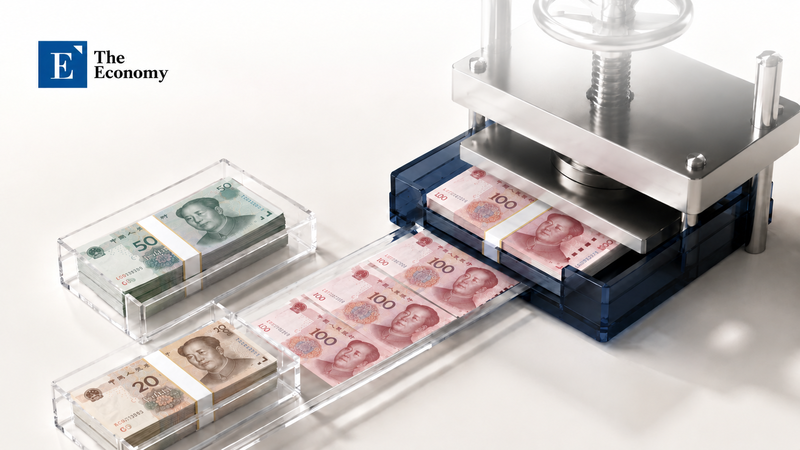
Concerns about slowing growth are mounting as China's economy struggles under a property slump and heavy debt burdens. The prolonged property downturn is increasing banks' exposure to bad loans and suppressing household consumption, obstructing a recovery in domestic demand. The government, which must fill the gap in private-sector spending, also faces shrinking fiscal room as its debt grows, leaving it in a dilemma: the more it stimulates the economy, the greater its public debt burden becomes. Market observers warn that China could fall into a prolonged slump like Japan, which spent years adjusting its debt after its property bubble burst.
IMF Cuts China's Growth Forecast for This Year to 4.5%
On the 12th (all dates hereafter are local time), the International Monetary Fund (IMF) lowered its forecast for China's gross domestic product (GDP) growth this year by 0.1 percentage point, from 4.6% in July to 4.5%, in its World Economic Outlook (WEO) report. That is the lower end of the Chinese government's growth target of 4.5–5.0% for this year, announced in March. Given China's actual growth of 5.0% last year, the forecast implies a slowdown of 0.5 percentage point this year. The IMF also lowered its growth forecast for next year from the 4.1% projected in July to 4.0%, cutting its projections for both this year and next.
China's growth forecast for this year has undergone repeated revisions in the mid-4% range since late last year. After projecting China's 2026 growth at 4.2% in its WEO last October, the IMF raised the forecast to 4.5% when it announced the results of its annual consultation with China in December of the same year. It maintained the 4.5% forecast in its January WEO update this year, then lowered it by 0.1 percentage point to 4.4% in April. It subsequently raised the forecast by a larger 0.2 percentage point to 4.6% in July, before adjusting it back to 4.5% this time. In the order of this year's WEO releases, the forecasts were 4.5% in January, 4.4% in April, 4.6% in July and 4.5% in October, a range of 0.2 percentage point.
Strong Exports Fail to Offset Weak Domestic Demand
The latest downgrade reflects weak consumption and investment in China. The IMF assessed that, with consumption recovering slowly and investment weakening amid the property downturn, strong exports had only partially cushioned the impact of contracting domestic demand. Recent economic indicators also confirm that the recovery in domestic demand is losing momentum. According to China's National Bureau of Statistics, retail sales rose just 0.4% year on year in August, slowing from 0.6% in July. That was only half the market forecast of 0.8%. Investment also contracted: fixed-asset investment fell 7.2% year on year in January–August, a steeper decline than the 6.7% drop in January–July.
The property slump, in particular, is cited as a factor weighing on both investment and household consumption. In an earlier report analyzing China's economy, the IMF also found that the prolonged property downturn and a weak social safety net were dampening households' willingness to spend. Property development investment fell 19.9% year on year in January–August this year, while the value of new home sales declined 13.1% over the same period. Developers' finances also deteriorated, with funding raised through loans, proceeds from presales and other sources falling 21.0%. Construction activity continued to contract, with the floor areas of new starts and completions dropping 24.8% and 23.7%, respectively.
Table 1. Key Indicators of China's Consumption, Investment and Property Market
| Category | Retail sales | Fixed-asset investment | Property development investment | New home sales value | Developers' funds raised | Starts and completions Floor area |
|---|---|---|---|---|---|---|
| Percentage change | +0.4% | -7.2% | -19.9% | -13.1% | -21.0% | Starts -24.8% Completions -23.7% |
| Key features | Slowed from +0.6% in July Half the forecast of +0.8% | From -6.7% in January–July Decline deepens | Amid the property slump Development investment contracts | Home sales Weakness persists | Loans, presale proceeds and other sources Funding inflows decline | Both starts and completions decline Construction activity contracts |
China's Property Distress Squeezes Banks and Households Alike
Developers' funding difficulties and construction cutbacks have also burdened the banks that lent them money. International credit rating agency Fitch expects property-related nonperforming loans and households' weakening ability to repay mortgages to put pressure on Chinese banks' asset quality. The concern is that both the value of property pledged as collateral and borrowers' repayment capacity could deteriorate. Mindful of these risks, some banks have changed their personal-loan screening criteria to place greater weight on salary income than on property ownership. For existing overdue loans, they are pursuing recovery by extending maturities or giving borrowers time to sell properties. The approach is seen as an effort to tighten screening for new loans while delaying the deterioration of existing loans into entrenched bad debts.
As banks raise lending barriers, households are also reluctant to borrow more to finance consumption. With more borrowers struggling to repay existing loans, taking on additional debt has become a greater burden. According to China-focused consultancy Gavekal Dragonomics, China's outstanding nonperforming household loans reached CNY 2.22 trillion (about USD 342 billion) last year, up more than 20% from the previous year. In August this year, outstanding household loans fell by CNY 202.9 billion (about USD 31.2 billion) from the previous month, marking a sixth consecutive monthly decline. Gavekal Dragonomics attributed the drop in lending to reduced mortgage demand and a weakening willingness to borrow to spend.
A Dilemma Between Stimulating Domestic Demand and Maintaining Fiscal Health
The government, tasked with resolving property-sector distress and supporting the economy, is also constrained by a growing debt burden. As the property slump weakens the finances of local governments that have relied on land-sale revenue, the central government is having to transfer more funds to them. The Conference Board, a US economic research organization, estimated that debt repayment expenditure would account for 19.2% of China's central government general public budget this year. That is an increase of 7.2 percentage points over 12 years from 12% in 2014. Annual interest expenditure by central and local governments is also projected to rise over the same period from CNY 348 billion (about USD 53.5 billion) to CNY 1.4 trillion (about USD 215 billion).
Even as the cost of servicing public debt rises, the government needs to borrow more to stimulate the economy. If the government also withdraws money from the economy while households and businesses are cutting spending to repay debt, incomes and sales could fall, making repayment even harder. If the government issues bonds to expand household support, the cost of easing the private sector's burden accumulates as public debt. In its annual consultation report on China's economy this year, the IMF also recommended further fiscal expansion to support domestic demand and reduce the risk of a debt-deflation spiral—falling prices amid an economic slump. It also proposed increasing social security spending so that households could redirect savings set aside for healthcare, retirement and other needs toward consumption.
The Shadow of Japan's Prolonged Slump Hangs Over China's Debt Adjustment
Japan's prolonged slump after the collapse of its property bubble is cited as evidence that fiscal support may be needed for an extended period. Richard Koo, chief economist at the Nomura Research Institute, described the phenomenon in which economy-wide demand contracts as the private sector focuses on repaying debt after a sharp fall in asset prices as a “balance sheet recession.” According to his analysis, monetary easing became less effective in Japan because businesses were reluctant to borrow and invest even after interest rates fell to near zero. The government had to borrow and increase spending to fill the gap in private demand, and it took about 20 years for private-sector balance sheets to recover, he assessed. Koo said China's debt adjustment was likewise unlikely to be resolved within 1–2 years, stressing the need to carefully select fiscal projects capable of delivering results over multiple years.
Japan's prolonged slump also left a warning that recovery can be delayed further if funds tied up in distressed companies are not dealt with promptly. In a joint study published in March, Harvard professor Kenneth Rogoff and IMF economist Yuanchen Yang explained that Japanese banks' continued lending to distressed companies to avoid recognizing losses had distorted capital allocation and constrained corporate growth. Observers argue that China, too, must strengthen banks' capacity to absorb losses as it resolves nonperforming loans. Recognizing unrecoverable loans as losses reduces bank capital, potentially curtailing new lending as well. Maintaining banks' lending capacity requires replenishing depleted capital, and if public funds are used, the government will have to bear the cost of cleaning up troubled banks as well as stimulating the economy.
Even after the government uses fiscal resources to cover banks' losses, businesses and households will likely need time to regain their ability to repay debt. Rogoff and Yang found that areas in Japan with greater concentrations of housing and infrastructure investment experienced deeper and longer downturns after the bubble burst. They explained that declining work in construction and related industries, together with worsening income prospects, had also hit the earnings needed to repay debt. In China, the capacity to service debt can recover only if capital and workers previously concentrated in property shift to new industries, boosting corporate profits and household incomes. China's debt adjustment could therefore also be prolonged, as the real economy must secure new sources of income while banks' bad debts are being resolved.
Matthew Reuter is a senior economic correspondent at The Economy, where he covers global financial markets, emerging technologies, and cross-border trade dynamics. With over a decade of experience reporting from major financial hubs—including London, New York, and Hong Kong—Matthew has developed a reputation for breaking complex economic stories into sharp, accessible narratives. Before joining The Economy, he worked at a leading European financial daily, where his investigative reporting on post-crisis banking reforms earned him recognition from the European Press Association. A graduate of the London School of Economics, Matthew holds dual degrees in economics and international relations. He is particularly interested in how data science and AI are reshaping market analysis and policymaking, often blending quantitative insights into his articles. Outside journalism, Matthew frequently moderates panels at global finance summits and guest lectures on financial journalism at top universities.
Similar Post