"From Bond Issuance to Equity Raises": Alphabet Goes All-In on AI Infrastructure Investment as Big Tech's Spending Race Endures Despite Chipflation

Aoife Brennan is a contributing writer for The Economy, with a focus on education, youth, and societal change. Based in Limerick, she holds a degree in political communication from Queen’s University Belfast. Aoife’s work draws connections between cultural narratives and public discourse in Europe and Asia.
Authored On
Modified
Alphabet seeks an $80 billion equity raise to fund AI infrastructure investments
Aggressively tapping bond markets while sharing investment costs with outside investors
Escalating AI arms race drives Big Tech to absorb mounting chipflation-related costs

Google parent Alphabet is pursuing a massive capital raise. As investment requirements for artificial intelligence (AI) infrastructure continue to expand, the company is accelerating external fundraising efforts to secure the resources needed to sustain its aggressive spending plans. This investment-heavy approach is not unique to Alphabet. Across the broader Big Tech sector, companies are increasingly willing to shoulder short-term financial burdens in pursuit of long-term market dominance, as AI has emerged as the central battleground in the next generation of platform competition.
Alphabet's Massive Equity Offering Plan
According to a Wall Street Journal report published on Sept. 1 (local time), Alphabet unveiled an equity financing plan consisting of a $30 billion public offering, a $40 billion at-the-market (ATM) share sale program, and a $10 billion private placement. Berkshire Hathaway, led by Warren Buffett, will participate as the lead investor in the private placement. Berkshire agreed to purchase $5 billion worth of Class A common shares at $351.81 per share and another $5 billion worth of Class C capital stock at $348.20 per share.
Alphabet's decision to pursue such a large-scale equity offering reflects its determination to fund an aggressive AI investment strategy. Demand for AI services has expanded faster than anticipated, triggering intense competition among major technology firms to secure computing infrastructure. During the company's first-quarter earnings call in April, Google Chief Executive Officer Sundar Pichai stated that "demand for AI remains strong across our products" and pledged to continue investing to ensure sufficient computing capacity to support future growth opportunities.
Alphabet's capital expenditure commitments have continued to rise. In April, the company revised its projected 2026 annual capital expenditures to between $180 billion and $190 billion, up from its previous forecast of $175 billion to $185 billion issued in February. The company said most of the incremental spending would be directed toward servers, data centers, and other technology infrastructure. Alphabet's actual capital expenditures reached nearly $35.7 billion in the first quarter alone, the highest quarterly figure in the company's history and more than double the $17.2 billion invested during the same period a year earlier.
Aggressive Fundraising in Bond Markets
Alphabet has also been actively raising capital through bond markets. In November of last year, the company issued approximately $17.5 billion of bonds in the United States and raised roughly $7.6 billion through European bond offerings. In February, it launched another bond sale initially valued at $15 billion. Investor demand exceeded $100 billion, prompting the company to increase the final issuance size to $20 billion while securing lower borrowing costs than initially expected. Alphabet subsequently issued sterling- and Swiss franc-denominated bonds as well. One 100-year sterling bond offering equivalent to approximately $2.7 billion attracted nearly $26 billion in orders.
The company disclosed on Aug. 5 that it had raised roughly $17 billion through bond offerings denominated in euros and Canadian dollars. Reuters and Nikkei also reported that Alphabet is preparing a yen-denominated corporate bond issuance, commonly known as a Samurai bond. Bank of America, Mizuho Securities USA, and Morgan Stanley are serving as lead underwriters. While the exact issuance size has not yet been disclosed, market participants expect it to amount to several billion dollars, with detailed pricing terms likely to be finalized soon.
In addition, Google has established mechanisms to share part of its AI infrastructure investment burden with outside investors. The company recently partnered with private equity giant Blackstone to form a large-scale joint venture. Under the agreement announced last month, Blackstone will provide an initial $5 billion equity investment and support up to $25 billion in computing infrastructure investments through a combination of equity and debt financing. Google will contribute its Tensor Processing Unit (TPU) hardware, software, and cloud services. The two companies aim to secure approximately 500 megawatts (MW) of data center power capacity by 2027 through the partnership.
Big Tech's Capital Spending War Continues
This wave of investment expansion is also evident across the broader Big Tech sector. Amazon has projected that its capital expenditures could reach $200 billion in 2026. Chief Executive Officer Andy Jassy has identified AI, proprietary chips, robotics, and low-Earth-orbit satellite businesses as major growth opportunities and stated that the majority of spending will be directed toward Amazon Web Services (AWS) and generative AI infrastructure. Meta likewise raised its capital expenditure outlook for this year by $10 billion, projecting spending of between $125 billion and $145 billion. Microsoft has not disclosed a specific annual capital expenditure target, but its quarterly spending continues to climb rapidly. The company's most recent quarterly capital expenditure reportedly reached approximately $37.5 billion.
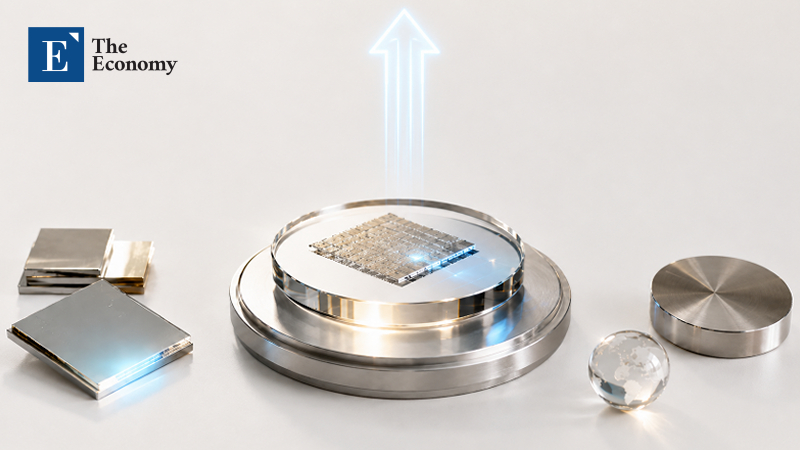
As competition among Big Tech firms intensifies, demand for memory semiconductors essential to AI infrastructure is surging. The phenomenon known as "chipflation"—a combination of semiconductor demand pressure and inflationary pricing—has become increasingly visible. According to Counterpoint Research, prices for DRAM, NAND flash memory, and high-bandwidth memory (HBM) rose 80% to 90% quarter-over-quarter during the first quarter of this year, reaching record highs. Fixed contract prices for 64GB server RDIMM modules climbed from approximately $450 in the fourth quarter of last year to more than $900 in the first quarter of this year, effectively doubling within a matter of months. Another market research firm, SemiAnalysis, projects that memory expenditures will account for roughly 30% of hyperscaler capital spending this year. The figure stood at just 8% in 2024.
Despite mounting cost pressures, the race to build AI infrastructure is expected to continue. Big Tech firms increasingly view AI as a next-generation platform rather than merely a new business segment. The competitiveness of core businesses—including search, cloud computing, productivity software, and e-commerce—is becoming increasingly dependent on AI capabilities. In this regard, one market analyst noted, "Companies that establish an early lead in AI are likely to retain control over the surrounding ecosystem and revenue streams for an extended period. That explains why many Big Tech firms remain unwilling to retreat from the race for computing infrastructure, even at the expense of short-term profitability."
Aoife Brennan is a contributing writer for The Economy, with a focus on education, youth, and societal change. Based in Limerick, she holds a degree in political communication from Queen’s University Belfast. Aoife’s work draws connections between cultural narratives and public discourse in Europe and Asia.
- Previous “Extinction Shock Hits Japan”: Population Shrinks 2.5% in Five Years, Vacant-Home Crisis Threatens Regional Finance
- Next "After Spending Hundreds of Billions of Dollars" AUKUS Shaken by Australia’s Humiliating Turn to Second-Hand Nuclear Submarines, as Questions Over U.S. Alliance Credibility Elevate the Strategic Role of South Korea and Japan
Similar Post