Europe’s Carbon Budget Debt Cannot Be Paid with a Border Tax

Working across research, policy, and data-driven analysis, the Editorial Board ensures that published pieces reflect a consistent institutional perspective grounded in quantitative reasoning and long-term structural assessment.
Authored On
Modified
Europe has exceeded its fair carbon share
China now leads key green-technology markets
CBAM needs climate finance to become fair

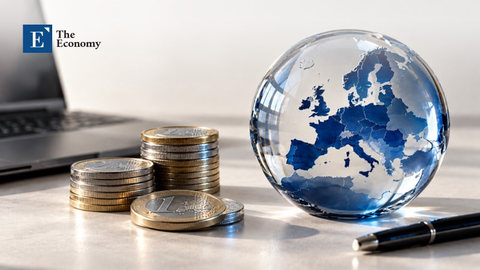
By the beginning of 2025, there are just over 235 billion tonnes of carbon dioxide in the total worldwide carbon budget to give a 50-50 chance of limiting heating to 1.5°C. At 2024 emission rates, that is around six years. This is the tough context of Europe’s carbon budget debate. The atmosphere doesn’t clear when annual emissions fall. Carbon hangs around, so earlier emissions still influence current heating. Europe and the United States accumulated wealth during the most carbon-intensive phase of industrial development. China and India entered that phase much later. That history does not entitle any country to excessive pollution. It does imply that equal cuts from unequal starting points are unjust. Europe’s burden is therefore greater than cutting its own emissions. However, the traditional proposed answer, transfer of clean tech, now faces a tough market reality. China already produces much of the world’s cheapest green equipment. Europe must settle its carbon debt without pretending that it still monopolizes the green industrial prize.
Europe’s Carbon Budget Is Already Overdrawn
A carbon budget is a physical value that precedes a political conception. Because global warming is inherently linked to the cumulative emissions of carbon dioxide, the remaining budget, which is the remaining possible input of carbon dioxide in the time frame, predicts in advance a high-probability limit of the temperature. For equitable distribution of that limit among states, the science can give only the grand total; it cannot say what is fair by a normative, moral concept. The single principle that emerges is policy for an equal cumulative amount per capita. In this case, all people are equal; they can all claim the atmosphere equally. Countries that used more than their fair population share at the expense of the rest are in “carbon debt,” while the remaining ones still have room for growth. Recent estimates based on emissions data and population numbers from 1870 up to 2022 show that most European nations are in debt. India and Egypt, as well as several other developing economies, still have positive claims. China, at the upper end, also has some room, although less so than India.
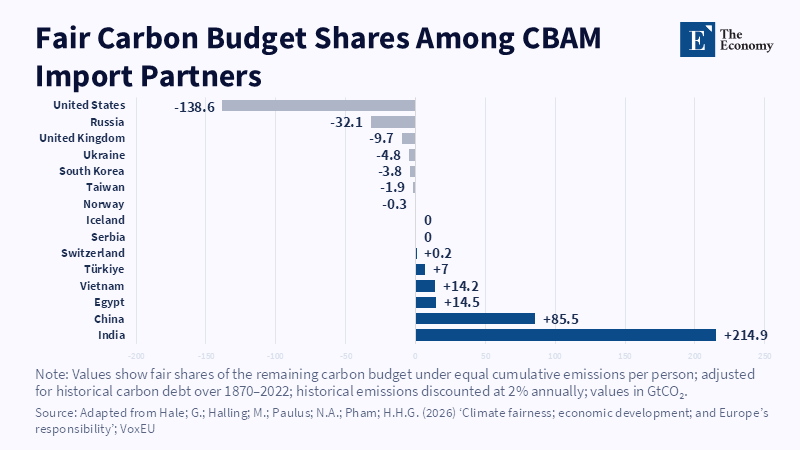
Europe’s carbon debt is not only a matter of the past. It redefines the responsibilities today. After Europe exploited coal, oil and gas to develop its towns, factories, clinics and roads, it cannot require poorer nations to follow the same track, at the same pace, at the same cost. However, fairness must sit alongside the need for speed. The 500-gigatonne limit figure cited in the recent UN climate assessment was calculated from 2020. Many years of large emissions subsequent to this point have passed. The revised figure is now much lower. A positive national carbon allocation is therefore better seen as a proposal for finance, technology and pace, rather than as a green light to take on further coal needs. Europe has a greater obligation to provide support. Developing nations have a greater obligation to exercise restraint. Both responsibilities are now pressed into the confines of a swiftly diminishing world limit.
Carbon Budget Fairness Does Not Excuse Today’s Emissions
Perhaps the biggest challenge to carbon equity is simple. China is now the world’s largest emitter and India the third. In 2023, China was responsible for an estimated 35 percent of all energy-related carbon dioxide emissions in the world. India overtook Europe in total annual emissions and remained below half the world average for domestic per-capita emissions. These are not trivial numbers. Historical responsibility cannot justify scale. A tonne emitted in Shanghai, Mumbai, Berlin or Texas exerts the same influence on warming. Europe has consumed more than its fair share; China cannot use that debt to justify unlimited future emissions. Nevertheless, India has a compelling fairness claim, but again it cannot afford a development future built on perpetually high-carbon power and industrial facilities that can actively operate for decades.
Climate policy therefore has to have two books. One documents past consumption of the atmosphere. The other documents the current ability to reduce emissions. On the first, Europe is heavily in arrears but has high financial and technological capacity. On the second, China has a far lower per capita historic debt, but a huge current scale of emissions, deep industrial capacity and a very powerful state. India, meanwhile, has per capita emissions and a per capita historic share that are far lower, but is also constructing the infrastructure upon which its future will depend. These three mean that justice should be reason for greater burden sharing, not for watering down the objective. Europe should cut faster: it is in debt and can do so. China should cut faster: its large-scale today is crucial and its ready-made green industries will be ready to go. India should be given more policy room and climate finance, but that room should be maintained for green growth, not for copying Europe's outdated growth path. A carbon budget can underlie many types of actions, but not delay.
China’s Green-Tech Lead Changes Europe’s Bargain
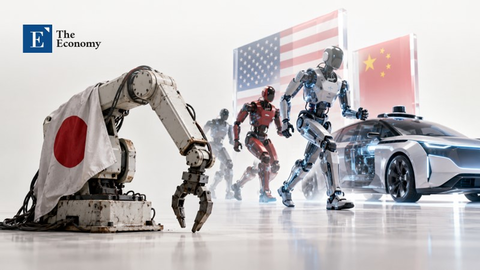
The normal reply to climate inequality is the transfer of technology. In principle, that’s correct. More efficient devices, power infrastructure, production methods and financial flows can allow developing countries to grow more cleanly. In practice, the phrase often evokes the old model: invention in Europe, adoption in Asia. This model is no longer credible. About 100 percent of growth in solar module manufacturing capacity over the last two years was supplied by China, which also accounted for some 80 percent of world battery-cell production in 2024. A similar story of dominance applies for electric-car production, with Chinese firms responsible for close to 70 percent of global sales in 2023. The basis of this lead was long-term industrial policies, cost-effective financial conditions, huge home markets, extensive supply chains and decades of experience in manufacturing. Though Europe remains home to advanced research centers, grid-infrastructure expertise and specialized engineering, it does not dominate mass markets for green innovations. In certain complementary technologies, fabricating equipment in the EU costs a multiple of that in China.
This presents a difficult reality for Europe’s carbon budget policy. Green technology transfer cannot mean giving poor countries European manufactured products at European prices. That would turn climate justice into an export strategy. Many developing countries now require the cheapest, most reliable solar panels, batteries, electric buses and trucks, heat pumps and grid equipment on the market; in most cases they are Chinese. Shutting them out to protect European industry may bolster a trade bloc’s industrial security, but it can also hinder the planet’s decarbonization. Cheap Chinese supplies have been critical to delivering infrastructure projects in countries with limited fiscal capacity. An overreliance on a single country poses risks of trade conflicts, wide-ranging export controls, limited due diligence and abrupt supply shortfalls. The intention should be not to globalize Chinese dominance, but rather to expand manufacturing, skill-sharing and ownership opportunities across India, North Africa, Southeast Asia, Latin America and parts of sub-Saharan Africa.
Europe still has a valuable contribution to make, but it will be different from the ones often aspired to. Its comparative advantage perhaps lies in finance, standards, project design, grid integration, industrial demand and state strategic patience. Public banks can lower the cost of capital for lowest-income nations’ clean plants. Joint ventures can bring production nearer demand centers. Licensing and research partnerships can accelerate technological diffusion. Training can support needed engineers, auditors, installers and factory managers to sustain clean infrastructure for years to come. Europe should also defend a narrow set of industries where domestic capacity is important to national security or where industrial pressure can deliver sharp technological advantage. Grids, power electronics, industrial heat, low-carbon materials, recycling and long-duration storage are naturally important too. Basic deployment should continue to shift at low cost toward affordable products from the global market. Some projects will combine Chinese hardware, European finance and local labor. That tapestry may drive tighter emissions reduction than a smaller plan centered only on Europe’s share of the market. Carbon debt should be addressed through verified emissions cuts, not equipment flags.
CBAM Must Serve Europe’s Carbon Budget
The Carbon Border Adjustment Mechanism can be seen as the bridge between Europe’s climate ambitions and the world trading system. From 1 January 2026, it has entered its definitive phase. EU importers of covered cement, iron and steel, aluminum, fertilizers, electricity and hydrogen will have to reflect in their accounts the emissions embodied in those imports. They will have to surrender certificates associated with the EU carbon price, with deduction of the price paid elsewhere or in the EU. This is no traditional trading of another country’s carbon budget. Europe is not purchasing India’s or Egypt’s excess atmospheric allowance. The CBAM essentially acts as a border tax, aimed at minimizing carbon leakage and forcing imported products into the same carbon charge as EU-based production.
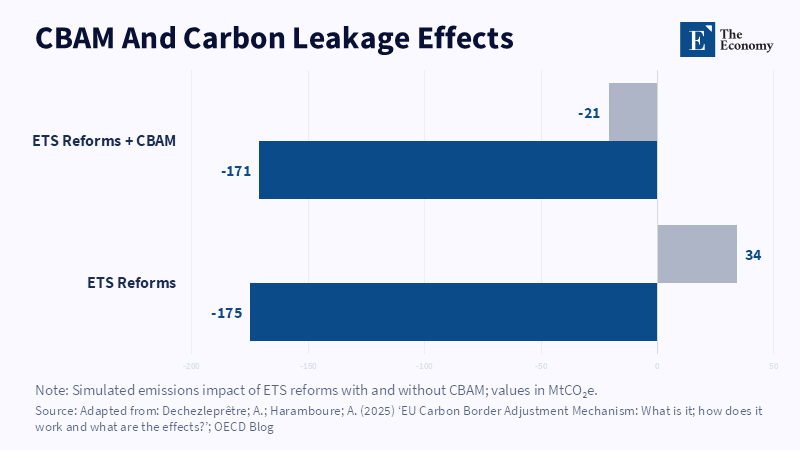
That makes a difference. If one considers CBAM a trading of national emissions allowance, it would turn a moral statement into a tradable financial instrument without leading to cleaner factories. CBAM can still achieve carbon fairness but only if it transcends collection in its design. The first set of affected goods represents just a modest proportion of EU imports and modeling of the mechanism only shows the global effect of Europe’s climate policy on emissions improving marginally. Uneven effects appear as well. Producers with cleaner plants might gain market share, in general, while carbon-intensive exporters could lose sales. Not all firms will be able to send the right data, pay for verification and acquire new machinery. Countries do not choose to join CBAM like signing up for a treaty. The border tariff is automatically imposed when the goods arrive from outside the EU. In practice, the question is whether those exporters have the institutions and capital to invest. Applying a carbon price at the border in the absence of transition financing could harm countries lacking capacity more than those lacking effort. This would be a considerably distorted cross-subsidy.
A fairer arrangement would recycle a portion of CBAM revenue into verified decarbonization projects across the supply chains requiring the border adjustment. Steel plants could be helped with cleaner furnaces, power procurement deals and emissions monitoring. Fertilizer producers could get access to low-carbon hydrogen projects. Small producers could share data and verification systems. The EU could provide further transition periods to the hardest-hit countries while maintaining tight reporting rules. It could also acknowledge robust, non-price-based climate policies when they result in verifiable reductions. These steps would not reverse China’s green-tech dominance, but they could help other regions become producers, not just consumers. Europe’s carbon budget is now an acid test of political integrity. The 1.5°C margin is measured in years, not generations. Europe cannot write off its carbon debt with greener home power nor a tariff at the border. It has to cut its own emissions, keep cheap clean goods available, safeguard a targeted set of strategic sectors and use finance and trade policy to develop low-carbon capacity externally. Without revenue sharing and genuine partnership, CBAM will be a tollbooth erected by a debtor. With them, it can help turn carbon debt into measurable worldwide cuts.
The views expressed in this article are those of the author(s) and do not necessarily reflect the official position of The Economy or its affiliates.
References
Amundi Asset Management (2024) ‘The green tech series: China’s green tech dominance’, OCBC, July.
Canadell, J.G., Monteiro, P.M.S., Costa, M.H. et al. (2021) ‘Global carbon and other biogeochemical cycles and feedbacks’, in Masson-Delmotte, V. et al. (eds.) Climate Change 2021: The Physical Science Basis. Cambridge: Cambridge University Press, pp. 673–816.
Dechezleprêtre, A. and Haramboure, A. (2025) ‘EU Carbon Border Adjustment Mechanism: What is it, how does it work and what are the effects?’, OECD, 21 March.
Dechezleprêtre, A., Haramboure, A., Kögel, C., Lalanne, G. and Yamano, N. (2025) Carbon Border Adjustments: The Potential Effects of the EU CBAM along the Supply Chain. OECD Science, Technology and Industry Working Papers, No. 2025/02. Paris: OECD Publishing.
European Parliament and Council of the European Union (2023) ‘Regulation (EU) 2023/956 of 10 May 2023 establishing a carbon border adjustment mechanism’, Official Journal of the European Union, L130, pp. 52–104.
Forster, P.M., Smith, C., Walsh, T. et al. (2025) ‘Indicators of Global Climate Change 2024: Annual update of key indicators of the state of the climate system and human influence’, Earth System Science Data, 17, pp. 2641–2680.
Friedlingstein, P., O’Sullivan, M., Jones, M.W. et al. (2025) ‘Global Carbon Budget 2024’, Earth System Science Data, 17, pp. 965–1039.
Friedlingstein, P., O’Sullivan, M., Jones, M.W. et al. (2026) ‘Global Carbon Budget 2025’, Earth System Science Data, 18, pp. 3211–3305.
Hale, G., Halling, M., Paulus, N.A. and Pham, H.H.G. (2026a) Climate Fairness and Growth: Allocating the Remaining Carbon Budget. NBER Working Paper No. 34978. Cambridge, MA: National Bureau of Economic Research.
Hale, G., Halling, M., Paulus, N.A. and Pham, H.H.G. (2026b) ‘Climate fairness, economic development, and Europe’s responsibility’, VoxEU, 14 July.
Halldén, E. (n.d.) ‘China’s global green tech leadership: What’s behind it and will it last?’, SEB Transition Reflections.
International Energy Agency (2024a) Advancing Clean Technology Manufacturing. Paris: IEA.
International Energy Agency (2024b) CO₂ Emissions in 2023. Paris: IEA.
International Energy Agency (2024c) Global EV Outlook 2024. Paris: IEA.
International Energy Agency (2025) Global EV Outlook 2025. Paris: IEA.
Matthews, H.D., Tokarska, K.B., Nicholls, Z.R.J. et al. (2020) ‘Opportunities and challenges in using remaining carbon budgets to guide climate policy’, Nature Geoscience, 13, pp. 769–779.
Working across research, policy, and data-driven analysis, the Editorial Board ensures that published pieces reflect a consistent institutional perspective grounded in quantitative reasoning and long-term structural assessment.