[Europe’s Fiscal Turn] From Bailouts to the RRF - Fiscal Evolution

Working across research, policy, and data-driven analysis, the Editorial Board ensures that published pieces reflect a consistent institutional perspective grounded in quantitative reasoning and long-term structural assessment.
Authored On
Modified
The debt crisis exposed the euro’s missing fiscal shock absorber
COVID-19 transformed common borrowing into practical policy
Europe now needs a limited and accountable shared capacity

In June 2010, euro area governments established a temporary euro-area rescue fund. It borrowed against national guarantees and then used the proceeds to lend to governments locked out of capital markets. Eleven years later, the Recovery and Resilience Facility set aside up to €672.5 billion in 2018 prices. It included €312.5 billion in grants and €360 billion in loans, financed through EU borrowing. That stark difference illustrates how much the policy had already shifted. It does not imply that EU fiscal integration started with the RRF. The common budget, cohesion funds and common rescue tools had preceded it. The true break was narrower. The RRF became the Union's first major test of shared debt, combining grants, loans, national plans, public investment and reform steps linked to payment. It happened because the euro-area debt crisis exposed a currency union without a coherent shared cushion for crises. Then, COVID-19 revealed that national action alone could transform a common shock into deep, persistent gaps among member states.
A Currency Built Without a Common Shock Absorber
The euro centralized monetary policy to the European level. Tax, public spending, state debt and most forms of support in recession remained a national matter. It was a conscious compromise: member states were prepared to have one central bank, restrictions on borrowing and a ban on direct central bank financing for government, but not a federal treasury with the power of taxation, borrowing and spending. The system still retained fiscal links: the EU Budget funded joint programs and cohesion policy channeled money to less developed states and regions. Those tools were designed to foster long-term growth and catch-up, not to provide rapid support in recession; and fiscal rules were devised to constrain weak national policies rather than generate joint budgets capable of providing demand or shielding a state from a run on its debt.
The global crash revealed the chasm. Bank write-downs damaged public finances as national governments guaranteed debts or injected additional capital into lenders. Falling public bond prices then harmed banks holding vast amounts of home-country bonds. This downward spiral linking banks and governments became the essential threat. A government subjected to market assault could not devalue its own currency or determine its own level of interest rates. It did not receive any federal fiscal transfer when tax revenues fell. Deflationary fiscal contraction often deepened the recession. Funds also flowed between countries within the euro region. The cost of credit diverged across nations despite the ECB setting a single policy rate. The euro had abolished currency risks within its countries. It had not dissolved sovereign default risks nor devised a collective tool to eradicate them.
Nevertheless, national failings remained. The less disciplined budgets, the weaker bank supervision, the private debt bubbles and sluggish reform all played out in different ways in each country. The euro’s design allowed local fragility to become a hazard for the entire union. The old rules - which monitored debt and deficits while ignoring banks, private borrowings and the fiscal stance of the euro area - proved inadequate in the crisis. Stronger oversight, banking union and a new safety net sought to manage once-national risks. All this made the eurozone safer but their primary purpose was to prevent collapse, not to build an all-encompassing system for shared investment and demand support.
Bailouts Created Discipline, Not Shared Investment
The first emergency bridge was the European Financial Stability Facility. It was established by euro-area countries in 2010 as a temporary company. It issued bonds supported by a package of national guarantees and used the proceeds for loans to Ireland, Portugal and Greece. The permanent European Stability Mechanism was created in 2012 under a treaty among euro-member countries. It has subscribed capital, raises funds and provides financial assistance in the form of loans to countries experiencing extremely difficult funding circumstances when euro-area stability would be at risk. In total, the EFSF and ESM disbursed around €295 billion. This was genuine risk-sharing but confined within closely circumscribed limits. The aid satisfied a demand once other channels of market access had failed or become prohibitively expensive. It took the form of loans not grants and while policy conditions were comparatively generous, national ministers kept most of the power on either side.
The ECB had its own role to play. It supplied banks with cash via its normal procedures. Very occasionally, a national central bank could provide emergency liquidity assistance (ELA) to a solvent bank facing severe short-term liquidity problems; this was support for the bank, not for the state. The ECB bought bonds in the secondary market under the Securities Markets Programme. It later introduced Outright Monetary Transactions, with tough conditions attached, to protect the transmission mechanism of monetary policy and the integrity of the euro. These measures repaired broken markets and reduced fears that a state might leave the currency. They did not allow the ECB to fund normal public expenditure. EU law prevents it from purchasing new government debt directly from the issuer. Central-bank money can help a bank run, but it cannot turn an insolvent government into a sound one or plug a bank's capital shortfall without fiscal support.
The rescue system prevented destructive defaults and saved the euro. Its conditions also met a legitimate concern. Easy euro-area support could weaken incentives for credible budgets, sound bank oversight and reforms. But the bailout plan had high costs. The conditions were set during a crisis, when governments had little bargaining room and output was in free fall. Most adjustment was borne by the recipient country. It was not designed to finance a joint macroeconomic recovery across the Union nor shield public investments. It was a firewall, not a growth strategy. That constraint pushed EU fiscal integration into a new frame at the next crisis.
COVID-19 Turned EU Fiscal Integration Into Policy
COVID-19 strengthened the case for coordinated action because it was an external shock. The pandemic was not caused by unsound budgets. Nonetheless, countries started the crisis with very different debt levels, public health provision, labor markets and economic structures. Economies dependent on inbound tourism and high-contact services suffered greater declines. Countries with lower debt burdens could support wages, firms and investment through easier borrowing. Highly indebted countries were constrained. A response based only on national budgets risked reinforcing previous disparities. Stronger countries might sustain business and employment protection much longer, giving rise to premature cutbacks in weaker states. The pain would not end at country borders.
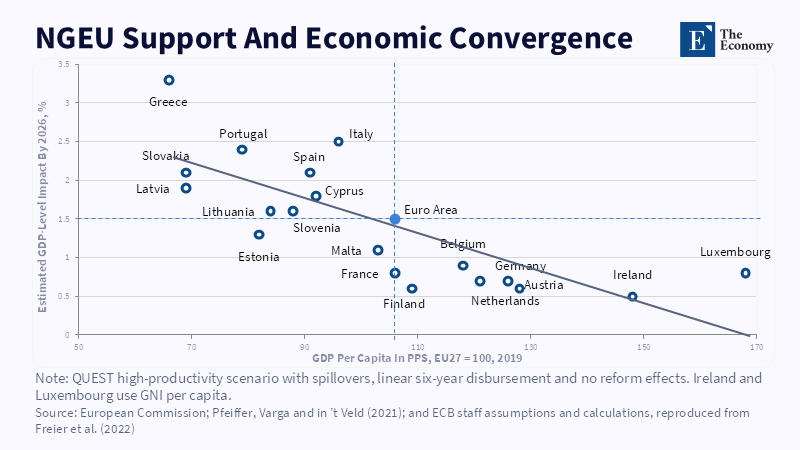
Disrupted supply chains, lenders and consumer demand interconnected the single market. Weak demand in one economy depressed sales and investment in the others. In the July 2020 NextGenerationEU deal, it was agreed that the availability of a country's fiscal space should not determine the quality of its shared recovery. Under that agreement, the Commission could borrow up to 750 billion in 2018 prices for the Union. The RRF accounted for €672.5 billion. Grants offered support without incrementally increasing the sum in each nation's debt account at full value and loans provided future funding. To determine the share, grants used population size, income, prior average unemployment and the COVID-19 shock magnitude, not pure equality. Each member state then created a recovery and resilience plan involving reforms and investments. This wasn't the EU's first shared loan or linked budget. This was the deal and its total sum that was new. That was a major leap in EU fiscal integration.
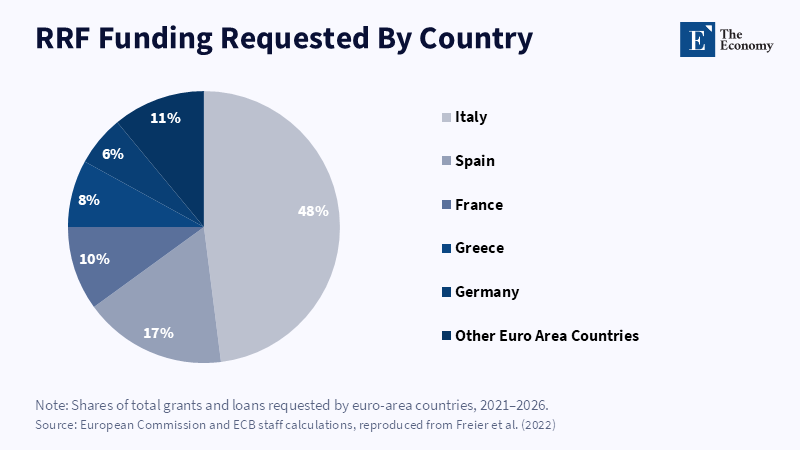
Payment terms have also changed. Conditions linked to bailouts have involved crisis loans designed for restoring market access and sound public finances. RRF funds are released once reform and investment milestones and targets as defined in agreed plans are met. This links payment to progress, rather than reimbursing individual project costs as in the usual approach. Its central bargain consists of support for reform in a growth strategy, rather than austerity in exchange for rescue. National ownership is therefore stronger than a rescue programme planned to cope with market stress. Likewise, spillovers count. A rail link, electricity grid or digitization reform in one country can boost demand and growth prospects. EU fiscal integration was easier to justify because the aid pursued common goals and carried visible obligations.
A Limited Capacity Beyond the RRF
The RRF should not be copied verbatim or institutionalized as the default. Its end dates-final milestones and targets due August 2026 and final payments due year-end-show that it remains an emergency instrument. Debt financing grants can outlast the emergency. States repay their own RRF loans. Debt financing grants and other EU expenditures must be repaid through the EU budget until 2058. That makes the revenue side crucial for credible EU fiscal integration. New EU revenue sources have been suggested, but any durable debt instrument requires a well-defined basis of payments. It must not rely on constant battles over larger national contributions. Shared debt not backed by transparent income can conceal who pays. Voters need to see who approves the spending, which account faces the debt and what revenue will reduce it.
The RRF can also illustrate why detailed steps are not sufficient. The European Court of Auditors has said that several targets monitor process or output more effectively than defined public benefit and missing full cost data prevents assessment of value for money. A similar future instrument should tie payment to significant outcomes, while maintaining cost records, effective auditing and sanctions against fraud or policy reversal. Rules should exclude moral hazard, be restrictive and limited in access, with a defined time horizon and external criteria of the shock. National responsibility remains essential: states must bear part of the cost and keep healthy budgets when no crisis looms. But national responsibility reaches its limits. Power interconnections, mutual defense acquisitions, climate safeguards and important research often create efficient public benefits that do not flow to the paying state. If left at national budgets alone, these may be under-supplied.
The next step of fiscal integration in Europe should be modest, rules-based and transparent. A standing framework could remain inert in normal years, then be activated for a specific European public good or specific European crisis. Debt should be subject to a hard ceiling, a predetermined repayment profile and approval by both EU and national democratic institutions. Common funds should supplement strong European and national budgets, not displace them. The initial contrast still motivates the move. Europe moved from rescue loans backed by state guarantees in 2010 to shared debt for grants, loans, investment and reform in 2021 because two crises identified two gaps. The first required a firewall to avoid default. The second required a mechanism to prevent disparate fiscal capacity from undermining a common recovery. The RRF is not a completed fiscal union. It demonstrates that a common currency and market may sometimes require a coherent common fiscal instrument, with responsibility and solidarity intertwined.
The views expressed in this article are those of the author(s) and do not necessarily reflect the official position of The Economy or its affiliates.
References
Council of the European Union (n.d.) A recovery plan for Europe. Brussels: Council of the European Union.
European Central Bank (2012) ‘Technical features of Outright Monetary Transactions’, press release, 6 September. Frankfurt am Main: European Central Bank.
European Central Bank (2019) What is a lender of last resort? Frankfurt am Main: European Central Bank.
European Commission (2020) Europe’s moment: Repair and prepare for the next generation. COM(2020) 456 final. Brussels: European Commission.
European Commission (n.d.-a) Cohesion policy. Brussels: European Commission.
European Commission (n.d.-b) Recovery plan for Europe. Brussels: European Commission.
European Council (2020) Special meeting of the European Council, 17–21 July 2020: Conclusions. EUCO 10/20. Brussels: European Council.
European Court of Auditors (2025) Performance-orientation, accountability and transparency: Lessons to be learned from the weaknesses of the RRF. Review 02/2025. Luxembourg: Publications Office of the European Union.
European Parliament and Council of the European Union (2021) ‘Regulation (EU) 2021/241 of 12 February 2021 establishing the Recovery and Resilience Facility’, Official Journal of the European Union, L57, pp. 17–75.
European Stability Mechanism (2022) ESM at a glance. Luxembourg: European Stability Mechanism.
European Stability Mechanism (n.d.-a) History. Luxembourg: European Stability Mechanism.
European Stability Mechanism (n.d.-b) Who we are. Luxembourg: European Stability Mechanism.
European Union (2016) ‘Consolidated version of the Treaty on the Functioning of the European Union’, Official Journal of the European Union, C202, pp. 47–200.
Freier, M., Grynberg, C., O’Connell, M., Rodríguez-Vives, M. and Zorell, N. (2022) ‘Next Generation EU: A euro area perspective’, ECB Economic Bulletin, Issue 1/2022.
Pfeiffer, P., Varga, J. and in ’t Veld, J. (2021) Quantifying spillovers of Next Generation EU investment. European Economy Discussion Paper No. 144. Luxembourg: Publications Office of the European Union.
Praet, P. (2016) The ECB and its role as lender of last resort during the crisis. Speech at the Committee on Capital Markets Regulation Conference, Washington, DC, 10 February. Frankfurt am Main: European Central Bank.
Schang, C. and Vinci, F. (2024) Marrying fiscal rules and investment: A central fiscal capacity for Europe. Working Paper Series No. 2962. Frankfurt am Main: European Central Bank.
Working across research, policy, and data-driven analysis, the Editorial Board ensures that published pieces reflect a consistent institutional perspective grounded in quantitative reasoning and long-term structural assessment.