[Europe’s Fiscal Turn] Southern Europe’s Gains - Southern Convergence

Working across research, policy, and data-driven analysis, the Editorial Board ensures that published pieces reflect a consistent institutional perspective grounded in quantitative reasoning and long-term structural assessment.
Authored On
Modified
The RRF delivered strong early gains in fiscally constrained economies
Greece led broad catch-up, Spain employment and Italy capital formation
Lasting convergence still requires reform, productivity and private investment

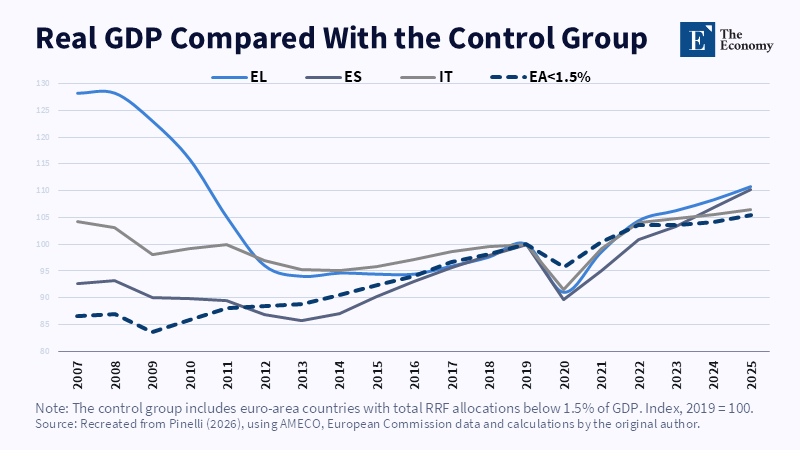
Greece’s economy in 2025 was 10.8 percent larger than in 2019 - a much better return than the low-allocation euro-area benchmark. That is notable for a country still recovering from a 'lost decade.' However, the RRF impact in Southern Europe can only be fully assessed beyond the available evidence of a strong bounce-back. Recovery measures how far GDP, employment and investment have increased following a shock. Convergence measures whether production per worker, wages and capacity to produce are closing longstanding gaps with Europe. Clearly, the facility has aided the former and might have prompted the latter. The early evidence is clearest in Greece, Italy and Spain, where the pandemic arrived with limited fiscal space, weak investment and deep structural weaknesses. Still, the snapshot shows very different stories: broad catch-up in Greece, robust employment increases in Spain and more workers given capital without a clear productivity or hours break in Italy. Occasional European financing has secured a significant start; long-lasting convergence largely depends on its subsequent use.
Why Southern Europe’s RRF Recovery Was Intentionally Large
The three large allocations were not an unintended transfer to the south. The formula for grants rewarded the relative size of each country, with the absolute level of income, level of employment, and level of COVID losses in the formula; total RRF support amounted, relative to 2023 nominal GDP, at around 16.1 percent in Greece, 9.1 percent in Italy, and 6.8 percent in Spain. Grants represented 8.1 percent, 3.4 percent, and 5.3 percent, respectively, and Greece and Italy used long-term loans extensively. Those numbers refer to commitments, not expenditure, and they combine grants and loans, which have different effects on budgets and on costs of funding, and ultimately on future debt. Payments were conditional on agreed reforms, programs, milestones and targets, and were released in tranches after milestones were met.
The two modern yardsticks use quite different benchmarks. Performance since 2019 is compared with lightly funded euro-area countries and with each country’s projected pre-pandemic trend. Both benchmarks compare recent performance with lightly funded peers and earlier national trends. Both reveal a pattern; neither establishes causation. Post-pandemic demand was supported by national fiscal support, ECB policy, and a fall in energy prices which changed both supply and demand, with old reforms delivering. Pandemic measures also varied. Nonetheless, real GDP, the number of hours worked and investment rose in these three countries with the largest aid. There was also an early fall in sovereign spreads before much money was spent.
This evidence shows why the fund was not just a transfer to rescue the south. Disorderly first-deficit adjustment in Greece, Italy or Spain would have hampered northern exporters, cross-border banks and investment, tourism networks, industrial suppliers and the euro itself. Joint spending also generates import demand abroad, and safer sovereign debt can boost cross-border bank assets. Empirical analysis suggests that cross-border benefits then add to the direct impact in the single market and euro area. By providing common insurance, the RRF impact on the southern periphery also helped less advanced members sustain investment and reduce default risk, and support economic resilience, as well as prevent potential financial market fragmentation arising from renewed two-speed economic recoveries.
Greece: a broad fresh start from a damaged starting point
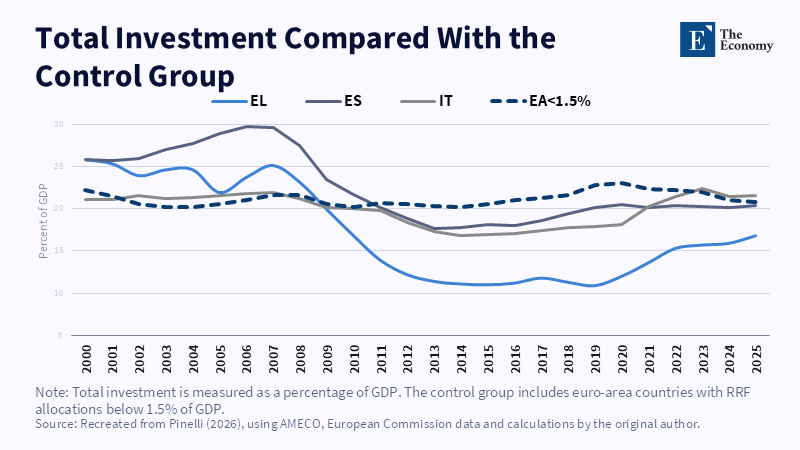
Greece provides the most vivid example of broad-based recovery. By 2025, real GDP was 10.8 percent higher in Greece, also above the trajectory for the pre-COVID period. Hours worked were 7.5 percent higher. The investment share rose by 5.9 percentage points, the strongest increase of the three, albeit from a very low starting point. A higher share does not necessarily imply an increase in investment in monetary values, nor does either measure guarantee that all projects are productive. Greece, however, escaped the typical post-crisis experience, when subdued demand, impaired banking systems and fiscal austerity repeatedly checked the rate of new investments in plant and equipment. Meanwhile, its loan facility aimed to attract private projects through banks and co-financing, whilst reforms tackled taxation, the public sector, rule of law, the labor market, digital services, energy and the vocational system.
The strongest case for RRF impact on Southern Europe is Greece: output, new capital and total factor productivity all moved together. Growth figures reflect increases in output per hour rather than merely more work and machinery. The Commission estimates that the support could boost Greek GDP by nearly 4.5 percent in 2026, compared with a no-new-policy scenario, driven largely by project demand early on, with later contributions from new capital and reforms. This is a model estimate, not current output. Tourism, earlier reforms, stronger banks, and fiscal backing at the national level also mattered. Yet the plan provided Greece with scale and continuity where its public finances alone could not be trusted to do so. R&D, spending on ideas, skills and capacity, still also remain underfunded, and the large current account deficit shows how escalating spending also increases other imports and has not decreased the need to rely on foreign supply.
Spain’s Jobs and Italy’s Capital Tell Different Stories
Spain's greatest achievement has been its record on jobs. By 2025, real GDP was 10.2 percent above 2019 levels and hours worked 7.4 percent higher. It is not headcount that matters here but total hours worked, as more workers can work fewer hours and still have more total work done. Spain relied on investments to achieve a profound shake-up in employment while implementing the landmark work reform, skills strategies and mechanisms for supporting job search. Since 2022, fixed-term and temporary employment fell significantly, signaling a break with the old two-tier labor market. Strong migration expanded labor supply, while tourism, reopening and domestic demand also supported the upswing. However, among the three countries, labor made the largest contribution to potential growth in Spain, while total factor productivity benefited as well. The effect of the NGEU on Southern European countries is thus apparent in Spain not in a large rise of the investment ratio, but through greater employment stability.
Spain's share of investment rose by a modest 0.3 percentage points from its pre-COVID level. However, investment was neither static nor falling. The comparison of investment and output implies a rapid growth in output per capita. Fixed investment, including construction work and software, increased. Yet Spain continues to suffer from long-term unemployment, depressed output per hour in numerous service subsectors, and large disparities in productivity across stronger urban centers versus weaker regions. Fixed-term employment declined, but tenure insecurity was still high. In 2025, the unemployment rate equaled 10.5 percent, and it was projected to decline below 10 percent in 2026, a rate that had not been reached since 2008. It is time that more secure jobs should give rise to better training, more fluid transitions, higher value-added work and more output per hour.
Italy is almost the opposite. Real GDP was 6.4 percent above 2019 in 2025, the least of the three but still above the marginally funded peer group. Hours worked increased by 8.1 percent and the investment share increased by 3.7 percentage points. Private investment outside of housing remained robust as the Superbonus program was phased out. Capital expenditure increased and exceeded the scope of residential refurbishment.
RRF financing supported roads, railways, digital systems, machinery, equipment and business investment. Facility reforms in the judiciary, public administration, procurement and schools removed longstanding barriers to investment. The impact of RRF on Southern Europe is large in Italy, but its clearest channel is the accumulation of capital rather than the wider increase in labor productivity. Italy’s main constraint remains total factor productivity. Growth accounting continues to indicate a drag on growth to potential, and even the Commission expects a modest 0.5 increase to 2026 and 0.6 to 2027. More capital can indeed increase output, but there will only be durable convergence if productivity is improved, quicker diffusion of innovation, and institutions are enabled. The benefits of reforms may have a lag, which has been compounded by court delays, weak administrations, low employment and weak education outcomes which have accumulated over many years. The benign interpretation is that investment has laid down a platform for subsequent benefits; the less benign is that this base may prove to be insufficient without focused delivery and change within firms. Italy has not recovered faster than Greece or Spain, though it has broken a long period of sluggish investment and still-deficient output per hour.
Recovery Is Not Convergence, and the Fiscal Cliff Is Near
The best outcomes do not undo the deep gaps. Public debt in Greece was still some 146 percent of GDP in 2025, and 137 percent in Italy and 101 percent in Spain. Greece’s ratio is falling, but in Italy it was expected to rise to 139.2 percent in 2027. Populations are aging fast in Greece and Italy, but in Spain migration is needed to keep the workforce expanding. Skill shortages often sit alongside high unemployment. Local disparities reduce access to new resources. State capacity is limited as governments work towards milestones in August 2026-a circumstance that raises the stakes on time, quality and robust checks. By then, the RRF’s contribution to Southern Europe may be reduced if reforms are merely cosmetic or funds end up in the deepest pockets.
A post-RRF fiscal cliff is a real problem. Greek growth in 2027 is forecast to slow to 1.6 percent because RRF investment is slowing down. Italy will also see its capital spending dip after the fund closes, while Spain's budget stance will tighten. Not the imperative to hold all spending forever, but to shield growth-raising projects, ensure maintenance, complete reforms and attract private money. Better procurement rules, quicker permits, credible tests and forward-looking rules would make public funds more attractive to private investors. A future European fund should also prevent common shocks from triggering sharp and uneven cuts to national investment.
The bigger lesson is that common fiscal spending can close gaps without becoming a new permanent lifeboat. The RRF intervention in Southern Europe demonstrates that joint debt, grants and reform contracts can lift countries with little room for maneuver, while safeguarding the single market. It also warns of the limits of temporary funding. Greece's 10.8 percent in real GDP since 2019 is a genuine recovery, not full convergence. Spain has built more resilient employment but its productivity and regional gaps remain. Italy has reestablished capital investment; yet efficiency still requires a long haul. The fund averted another lost recovery and lent reform agendas teeth. Its success will be judged long after its last payments: in firms borrowing without subsidy, in fulfillment by local authorities without crisis rules, in productivity and in sustainable debt stability. Europe has set the stepping stones. Now each must construct the road beyond them.
The views expressed in this article are those of the author(s) and do not necessarily reflect the official position of The Economy or its affiliates.
References
Bańkowski, K., Benalal, N., Bouabdallah, O., De Stefani, R., Dorrucci, E., Huber, C., Jacquinot, P., Modery, W., Nerlich, C., Rodríguez-Vives, M., Szörfi, B., Zorell, N. and Zwick, C. (2024) Four years into NextGenerationEU: What impact on the euro area economy? ECB Occasional Paper Series No. 362. Frankfurt am Main: European Central Bank.
Busse, M., Caselli, F. and Fotiou, A. (2026) The EU’s Recovery and Resilience Facility: Experience and lessons for the next multiannual financial framework. IMF Working Paper WP/26/114. Washington, DC: International Monetary Fund.
European Commission (2024) Mid-Term Evaluation of the Recovery and Resilience Facility. European Economy Institutional Paper 269. Luxembourg: Publications Office of the European Union.
European Commission (2026a) AMECO Database: Spring 2026 Vintage. Brussels: Directorate-General for Economic and Financial Affairs.
European Commission (2026b) European Economic Forecast: Spring 2026. European Economy Institutional Paper 341. Luxembourg: Publications Office of the European Union.
European Commission (2026c) 2026 Country Report: Greece. Brussels: Directorate-General for Economic and Financial Affairs.
European Commission (2026d) 2026 Country Report: Italy. Brussels: Directorate-General for Economic and Financial Affairs.
European Commission (2026e) 2026 Country Report: Spain. Brussels: Directorate-General for Economic and Financial Affairs.
European Commission (2026f) Greece’s Recovery and Resilience Plan. Brussels: European Commission.
European Commission (2026g) Italy’s Recovery and Resilience Plan. Brussels: European Commission.
European Commission (2026h) Spain’s Recovery and Resilience Plan. Brussels: European Commission.
European Parliament and Council of the European Union (2021) ‘Regulation (EU) 2021/241 of 12 February 2021 establishing the Recovery and Resilience Facility’, Official Journal of the European Union, L57, pp. 17–75.
López Molina, G., Martínez Turégano, D., Pedrero Bohnet, V. and Salvado Garcia, J. (2026) Spain’s Recovery and Resilience Plan: Addressing structural challenges in the labour market. European Economy Discussion Paper 245. Brussels: European Commission.
Pfeiffer, P., Varga, J. and in ’t Veld, J. (2023) ‘Quantifying spillovers of coordinated investment stimulus in the EU’, Macroeconomic Dynamics, 27(7), pp. 1843–1865.
Pinelli, D. (2026) ‘The macroeconomic impact of the Recovery and Resilience Facility: An analysis for Italy, Spain, and Greece’, VoxEU, 14 July. Centre for Economic Policy Research.
Zorell, N. and Zwick, C. (2026) Assessing the impact of the EU’s Recovery and Resilience Facility on institutional quality: A Bayesian synthetic control approach. ECB Working Paper No. 3212. Frankfurt am Main: European Central Bank.
Working across research, policy, and data-driven analysis, the Editorial Board ensures that published pieces reflect a consistent institutional perspective grounded in quantitative reasoning and long-term structural assessment.