Japan’s AI Adoption Gap Is Not a Technology Problem

Working across research, policy, and data-driven analysis, the Editorial Board ensures that published pieces reflect a consistent institutional perspective grounded in quantitative reasoning and long-term structural assessment.
Authored On
Modified
Japan’s AI problem is not access to technology, but weak pressure to adopt it
Corporate inertia reduces demand for AI skills across schools and universities
Japan and parts of Europe risk missing the productivity gains of AI unless delay becomes costly

Only one in five adults in Japan who used the internet had tried tools like ChatGPT, Copilot, or Gemini in the last year, whereas a government survey in fiscal 2024 found Japan's generative AI usage stands at 26.7 percent. That is not a modest consumer eccentricity. It is a sign of how advanced economies can miss a wave of productivity while maintaining a sophisticated, urbane, highly technical appearance. But the larger lesson is that the difference in AI usage is not mainly a software problem. The tools are cheap, freely available and simple to trial. The difference is in pressure. Firms compete aggressively where they must explore all possibilities, managers go looking for open-ended methods, workers learn to meet measures of value and education is influenced by demand. Where firms are protected with dense supplier networks, long-established routines and low exit pressure, slow adoption is sensible. Japan illustrates this challenge in its starkest form, but a handful of other European economies may be on the same track to some degree.
The AI Adoption Gap Starts Inside The Firm
Japan’s AI adoption gap starts with a business system that often perceives new technology as a risk to be managed, rather than a contest to win. This is not to say that Japanese corporations are deficient. The country retains formidable capabilities in robotics, quality manufacturing, materials, precision instruments and the discipline of process. But generative AI is different from factory automation. It is intervening in every business routine, office work, sales, design, legal review, customer support, translation, coding and even management itself. It favors corporate cultures willing to allow fast experiments, abundant trial-and-error and rapid task redesign. That clashes with hierarchy, consensus, lifelong bonds and internal disruption fears. It grows even harder if top managers see no peers among their competitors winning with faster methods. When competitors also stumble, inaction no longer hurts. It just becomes the norm.
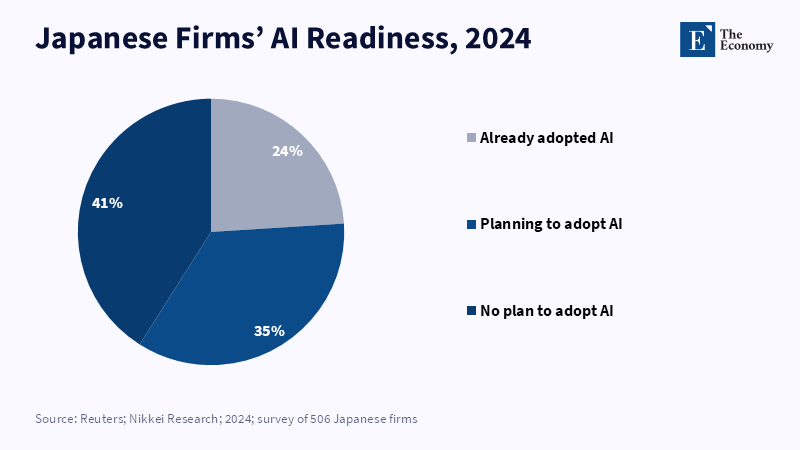
The evidence points that way. In OECD workplace evidence, only 8.4 percent of Japanese workers report using AI at work and only 6.4 percent report using generative AI. Japan has the lowest usage of workplace AI among comparable countries in the survey (finance and manufacturing workers). Reuters and Nikkei Research (2024) also found that about 24 percent of Japanese businesses had adopted AI, 35 percent planned to do so and more than 40 percent had no plan to do so. These should not be interpreted as a failure of awareness alone. There is a deeper adoption trap. Many firms are aware that this is a tool that exists. They just do not see enough reason to reconfigure jobs around it, quantify and measure the gains from doing so and change who has authority over decisions.
That is why “culture” explains only part of the story. Culture becomes decisive when weak competition protects it. A formal cartel is not necessary. A cartel-like equilibrium can emerge when large firms copy one another’s caution, suppliers avoid offending long-term customers, workers avoid standing out, and foreign entrants struggle to gain scale. In that setting, firms can under-adopt advanced foreign technology without any explicit agreement. No one needs to ban AI. The system only needs to make delay safe. The cost is a quiet loss of learning. It is less visible than a factory closure, but over time it can destroy just as much value.
Slow Firms Create Slow AI Adoption Gap In Skills
The education effect emerges from the labor market. Firms are not rushing to train and recruit workers to do things that the labor market does not care about. Employers are not reorienting their recruitment search very quickly to the labor market in which new hires will be doing most of their work. Schools are not feeling overwhelming pressure to switch from leading-edge courses when employers continue to recruit on old criteria. Not leading-edge curricula are emerging as a weak signal that an area of the schoolroom remains important. When the labor market does not demand, for the time being, any new competences in general and particularly not AI, then pedagogies keep offering digital skills as a small part of the curriculum, while the rest of the population is busy learning that having the right little certificate is a better assurance of future security than digital proficiency.
Japan is not ignoring AI education. There have been guidelines, university trials and data science programs. Some universities are providing some basic education for all students on AI and focused applied courses in specific fields. These are positive moves. However, they will be hollow if there are no examples of AI applications in internships, handling entry-level roles, in public administration and in small firms. The fundamental issue is less whether a school emphasizes prompt writing and model risk, than if young people are taught to handle autonomous tools in real work: comparing sources across tools, analyzing premises, reviewing program output, reading and analyzing data, designing pipelines, translating with judgment and learning when an answer should be ignored. These are practical skills and they improve through use: they decline if treatment is high policy and just another future-themed lecture.
The lesson is painful for educators. Curriculum reform cannot solely bear the burden of the AI shift. A school can teach AI literacy, it cannot build an AI labor market on its own. Schools, then, should build programs with some external pressure woven in. Employers should define tasks, rather than delivering speeches. Universities should require non-technical students to deliver AI-enabled projects with verification and boundaries. Public agencies should leverage procurement to incentivize firms that deploy workers trained by AI and report productivity improvements. If there is no such pressure, students will rationally do what makes the most sense for them. They will learn enough to get through the class, but not enough to change how work is done. The problem of output will then persist for each new graduating class.
Europe's AI Adoption Gap Looks Familiar
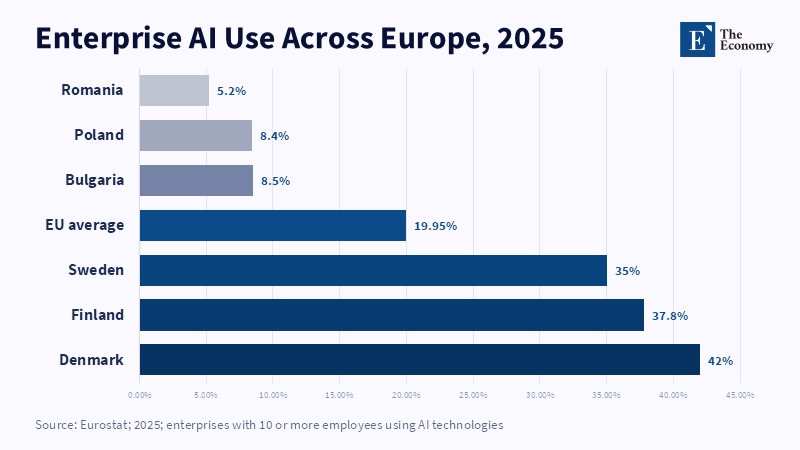
Europe should not treat Japan as an exotic case. The European Union has a big and unbalanced gap in the use and implementation of AI. Eurostat data show, 19.95% of EU enterprises (with 10 employees or more) used at least 1 AI technology and here the big firms far exceeded (55.03%), while small firms remained much lower (17%). And the division within the single market was more visible: Denmark (42%), Finland (38%) and Sweden (35%) in 2025. And as for the new members (Romania, Poland and Bulgaria), the average was lower than 9%. Europe is not one AI economy. It is a set of fast and slow regimes of total change in the same legal and economic space.
The similarities with Japan are not about the fact that Europe has the same corporate culture. It does not. The similarity is that most European economies also do a lot to protect incumbents more than they will admit. The complex regulation, small domestic markets, bank-based finance, cautious public procurement, fragmented data systems and slow university-industry links all can be used to lessen the pressure to change. In some areas, firms can go on for years doing well by complying well, lobbying well and serving stable clients even if there's no job re-design in sight. The European risk is not a shortage of talent. It is the risk of talent fleeing to the few firms and nations where AI is normal, while the rest of the economy waits for safe templates and imported examples.
What is true for Japan may be more extreme still, as demography leaves no room for delay. Recruit Works Institute has put forward a projection of a shortfall of more than 11 million workers by 2040, even in a scenario of maintaining constant demand for labor. OECD analysis also indicates that the country's annual growth in hourly productivity declined from 1.2 percent in 2000-08 to 0.3 percent in 2019-24. In that setting, slow adoption of AI is not merely a story of technology. It's a story of living standards. If a shrinking labor force is combined with weak productivity growth, public services, wages, care systems and regional economies, the care economy and regional economies all come under pressure. AI is not going to solve that by itself, but if you choose not to spread it, the numbers are only going to get worse. And the country would age faster than its working systems could cope with.
Closing The AI Adoption Gap Needs Competition Policy
The policy response should take a neutral starting point that competition policy is AI policy. Firms are demanding to know if there are grants for chips, labs and national models, but they will not lift productivity if they keep old work and business systems. Japan should condition any SME-related support on clear, quantifiable process redesign, training for workers and vendors and leeway for open vendor access. Subsidies should not safeguard low-productivity firms with no intention of reform. Public guarantees of loans and safeguard instruments should be refashioned in a manner where viable firms are able to integrate, transform and operate at a larger scale and non-viable firms require no labor and capital in perpetuity. Creative destruction is painful, but permanent stagnation is not humane. It just hides the toll and drives talented workers in firms with bleak outlooks.
This need not be to imitate Silicon Valley's tempo or to see every delay as an indicator of failure. The main argument against rapid proliferation is that many new instruments are not reliable, unbiased, legally well-defined, or affordable after AI regulation. Valid argument. Look at studies of AI impact on productivity, with broad variables: findings range from great improvements in customer support, especially for less skilled workers, to more modest increments in macroeconomics. Blind acceleration is not the answer; wise is a steady proliferation. Companies should examine the AI needs, where goals are explicit, oversight is clear and employees can oppose poor results. Regulation must impose safe protocols, not indulgence incentives. Confidence should develop in practice, not be a prerequisite for it.
The same should be applied to education. AI literacy should be a fundamental skill in economics, not just hype. Students should learn how to verify, how to judge data, how to plan workflow, how to be aware of copyright and the limitations of automation. Teachers should be given time and training, not just best practice instructions. Universities should stop categorizing AI as only a cheating problem or a computer science topic in computer science. Because it is quite obviously becoming the new paradigm in writing, research, design, management, health, law, finance, logistics and public administration. It is definitely not about creating prompt engineers in all disciplines. The objective is to create graduates who are able to operate in companies that are truly innovative. And that the faculty should demand and schools should measure and firms should risk, as in any other innovation.
The more profound lesson is that the AI adoption gap will never close by giving longer speeches about innovation. It will close only when waiting becomes an increasingly costly choice. Japan's issue is not that its residents are incapable of learning about AI. Its issue is that it still enables its institutions to shield it from doing so. And the same piece of advice applies to Europe's laggard economies. A nation can have some of the world's top research institutions, overwhelmingly large firms and cutting-edge infrastructure. But it may still fail to realize the productivity boost if too many companies remain inside risk-averse incumbents. The challenge that policymakers face is to normalize prudent experimentation and make safe stagnation more painful. This involves, among other things, reducing entry barriers and increasing exit rates, opening up procurement contracts, and providing more training opportunities for workers, and establishing more frank and open relationships between educational and professional training. AI isn't a solution to population aging, weak competition, or sluggish productivity. But its advent provides a benchmark for whether these advanced nations can transform in time to avoid a slow productivity crisis.
The views expressed in this article are those of the author(s) and do not necessarily reflect the official position of The Economy or its affiliates.
References
Acemoglu, D. (2024) ‘The Simple Macroeconomics of AI’, NBER Working Paper, No. 32487. Cambridge, MA: National Bureau of Economic Research.
Brynjolfsson, E., Li, D. and Raymond, L.R. (2025) ‘Generative AI at Work’, The Quarterly Journal of Economics, 140(2), pp. 889–942.
Eurostat (2026) ‘Use of Artificial Intelligence in Enterprises’, Statistics Explained. Luxembourg: European Commission.
Goh, L., Haridas, G. and Kaul, A. (2025) Bridging the AI Gap: Advancing Adoption and Governance in Japan. Singapore: Access Partnership.
Inument (2025) ‘From Resistance to Revolution: Japan’s Path to AI Adoption’, Inument Insights, 29 April.
ITBT StaffWriter (2026) ‘AI Adoption in Japan: Opportunities, Challenges, and the Future of the Tech Industry’, IT Business Today, 5 March.
Kohsaka, A. (2026) ‘Japan’s AI Transition Faces Stumbling Blocks’, East Asia Forum, 3 June.
Kyodo News (2025) ‘Japan Lagging in Generative AI Use with 26.7% Adoption in FY 2024’, Kyodo News, 8 July.
OECD (2025) Artificial Intelligence and the Labour Market in Japan. Paris: OECD Publishing.
OECD (2026) OECD Economic Surveys: Japan 2026. Paris: OECD Publishing.
Recruit Works Institute (2023) Future Predictions 2040 in Japan: The Dawn of the Limited Labor Supply Society. Tokyo: Recruit Works Institute.
Reuters Staff (2024) ‘More Than 40% of Japanese Companies Have No Plan to Make Use of AI’, Reuters, 18 July.
Sicari, P. (2026) ‘Reviving Business Dynamism in Japan’, OECD Ecoscope, 18 May.
Thorbecke, C. (2026) ‘Japan’s an AI Laggard. That Could Be Its Edge’, The Japan Times, 28 May.
Working across research, policy, and data-driven analysis, the Editorial Board ensures that published pieces reflect a consistent institutional perspective grounded in quantitative reasoning and long-term structural assessment.