Europe’s Fiscal Turn Needs a Clearer Debt Compass

Working across research, policy, and data-driven analysis, the Editorial Board ensures that published pieces reflect a consistent institutional perspective grounded in quantitative reasoning and long-term structural assessment.
Authored On
Modified
The 2024 EU fiscal rules promised simpler budget surveillance
Early evidence shows spending plans still react to growth surprises
A clearer debt anchor would make adjustment more transparent

The euro area opened the new fiscal era with public debt equal to 87.4 percent of GDP in 2024. That average, however, masked huge differences. Greece was at 153.6 percent; Italy was at 135.3 percent; France was at 113.0 percent; Estonia was at 23.6 percent. A common rule was required. A uniform numerical path could not be fair. Thus, the 2024 EU fiscal rules attempted to address this issue with national plans and individual debt trajectories. The policy was correct. The implementation was not. Europe substituted one conspicuous rule for another: a visible expenditure constraint based on a concealed mass of projections, safeguards, shocks and model structures. On the surface, the framework is simpler; the rationale remains unclear; and the targets are difficult to test. The real choice is not between rigid uniform constraints and sovereign discretion. It is between opaque complexity and a transparent debt anchor permitting national differences but not concealing the scale of the fiscal task.
What the 2024 EU Fiscal Rules Changed
The reform shifted fiscal control away from annual disputes over several indicators. Instead, each member state prepares a medium-term fiscal-structural plan, usually spanning four or five years. It defines a trajectory for net expenditure and ties that trajectory to reforms and investment. The country can extend the four-year adjustment period to up to seven years in exchange for commitments to reforms and investments that foster economic growth, resilience and the sustainability of public debt. The Commission assesses whether the country’s debt exceeds 60 percent of GDP or the country’s deficit exceeds 3 percent. In both cases, it calculates a reference path based on a debt sustainability analysis. The government submits the plan, the Commission reviews it and the Council approves a binding net expenditure path. Through this measure, the reform attempts to replace the emphasis on annual goals of the Stability and Growth Pact with an emphasis on a negotiated national plan with greater national ownership. The reform aimed to strengthen ownership and prevent piecemeal action.
Net expenditure alone is used as the operational indicator to monitor the plan. The assessment begins with gross government expenditure, then deducts items that are not directly under government control and could distort the indicator, including interest costs, spending associated with cyclical unemployment, temporary measures, EU-funded programmes and national co-financing. Discretionary revenue measures are also deducted. The Commission maintains a control account of deviations from the agreed path. If net expenditure is above the path, a debit is incurred; if below, a credit. This is more transparent than the previous complex mix of headline deficits, structural balances, expenditure benchmarks, debt rules and medium-term objectives. However, the spending ceiling is only the final step. The ceiling itself derives from a sophisticated debt model. The reform simplified monitoring once the target was set. It did not, however, simplify the process of determining how tight a target should be.
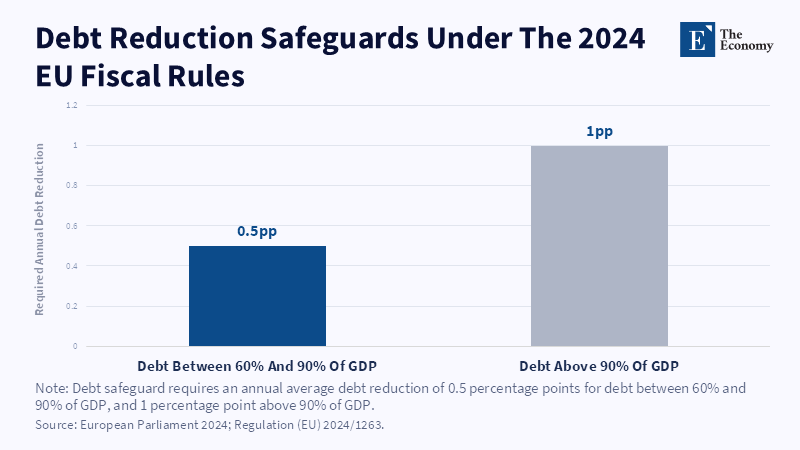
During the negotiations, several safeguards were introduced. Countries with debt above 90 percent of GDP are required to bring down their debt ratio by an annual average of at least 1 percentage point, while the minimum is a 0.5 percentage point reduction in the debt-to-GDP ratio for countries whose debt ratio stands between 60 percent and 90 percent. Countries with a deficit exceeding 3 percent are also required to undertake a minimum annual structural adjustment of 0.5 percent of GDP. The deficit resilience safeguard aims to generate a margin below the 3 percent ceiling. It requires an annual improvement of 0.4 percent of GDP in the structural primary balance or 0.25 percent if the time to undertake the adjustment is extended. Back-loading is also limited, so governments cannot place the bulk of the strain at the far end of the plan. Each safeguard has a distinct purpose. Together, the safeguards create multiple tests. Debt analysis, minimum debt reduction, deficit correction, the resilience margin, reform commitments and the expenditure rule all shape the eventual pathway. A plan devised to replace a cluttered rulebook instead created a new layer of conditions around a single leading indicator.
Why the EU Fiscal Rules Still Create Budget Pressure
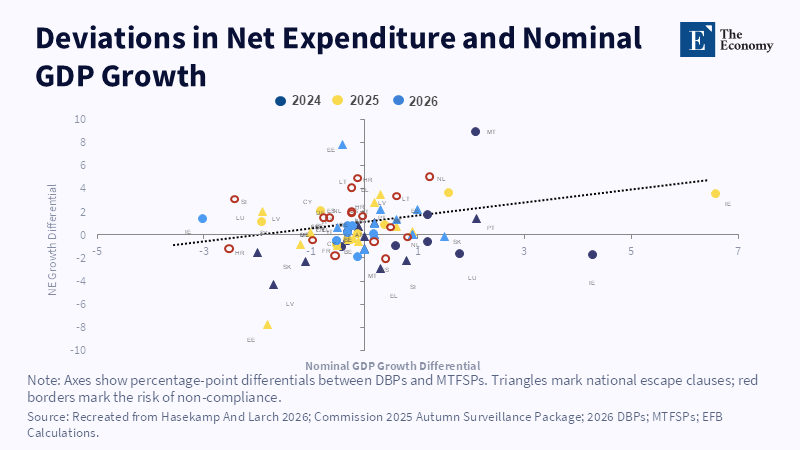
The first implementation round illustrates why the design remains problematic. An appropriate medium-term expenditure path should be resilient to cycles: it should prevent temporary booms from producing permanent spending increases, without instituting a permanent spending squeeze in response to periods of weak growth. Early evidence points in the opposite direction. Looking at 2024–2026, the majority of euro-area observations fell into procyclical quadrants during the framework’s first implementation. Countries expanded spending beyond recommended limits when nominal growth exceeded expectations or cut spending below the recommended path when growth disappointed. In 2025, Italy alone planned to keep its overall expenditure growth in line with its Council recommendation for 2025. Looking at 2026, only Austria, Italy and Slovakia set their expenditure plans in a way consistent with the recommended expenditure growth rate. Moving to the medium-term setting was meant to minimize the impact of cyclical forces on medium-term developments. In reality, cyclical forces continue to shape national choices. The rule remains medium-term on paper, while political short-termism prevails.
The labels associated with compliance are also problematic. A country can be at risk of material non-compliance even when its debt and deficit are below Treaty limits. Another can meet the expenditure test while at the same time being subject to an excessive deficit procedure. Conversely, a high-debt country can appear to be compliant through adhering to an approved path, even as its initial assumptions have eroded and political delivery has weakened. This does not mean that the architecture is defective, but merely illustrates that any narrow label cannot capture the full picture. The label indicates whether expenditure is following a given path. It does not show whether this path remains credible, whether actions announced in the budget are being taken or whether the risks on debt have dramatically changed. In this way, it weakens public understanding and invites challenge to enforcement. A government can state it is complying while critics argue that debt risks are worsening. Both assertions are correct because each is asking a different question.
Flexibility has created an additional future source of pressure. Seventeen member states received temporary flexibility for higher defense spending, with deviations of up to 1.5 percent of GDP during 2025–2028. The political argument is powerful, as Europe has a clear need for security. The fiscal risk lies in the exit. The initial implementation assessment suggested that with the end of this flexibility, average additional consolidation of around 0.4 percent of GDP per year might be needed after 2028, with even greater implications for some individual countries. Temporary flexibility can shift adjustment pressure into the future. The same holds true for seven-year planning. Slower adjustment may insulate investment now, but only if the reforms push up future growth or reduce future costs; if those assumptions fail, slower adjustment becomes a weak promise, rather than an improved method. Complexity then becomes cover for delay. The architecture provides explanations for why a path remains adequate, but fewer ways for the public to judge whether it remains adequate.
A Simpler Debt Anchor for the EU Fiscal Rules
A better way might be to keep the existing national plans and the net expenditure instrument, but to put a public debt anchor at its heart. The anchor begins with the basic arithmetic of debt. The core rule is that a government should maintain a primary balance that offsets the effect of the difference between the effective interest rate on its debt and the growth rate of its economy. When the interest rate exceeds the growth rate, a primary surplus is needed to stabilize the debt ratio. The new framework already employs this principle in its debt sustainability analysis. Its weakness is that the result is obscured by thousands of lines of computer code, linked assumptions and multiple iterations. A more transparent rule would be to determine the needed primary balance directly: use the largest debt-stabilizing primary balance projected over ten years after the end of adjustment, then add a buffer of about 1 percent for every 100 percent of debt. In short, the buffer is roughly 1 percent of the debt ratio.
The point of this rule is predictability. For a country with debt at 140 percent of GDP and a worst expected interest-growth gap of just one percentage point, the basic debt-stabilizing primary surplus is 1.4 percent of GDP. A further 1.4 percent of GDP as a buffer would deliver a target close to 2.8 percent. The government, parliament, fiscal council and public could see the scale of the target at once. A change in borrowing costs, expected growth or debt ratio would have a tangible and clearly visible consequence. The path would still vary by country, but the source of that variation would be obvious. This would be a better form of national adaptation. It would steer clear of both a fixed debt rule for all countries and a model so complex as only experts could replicate it; it would also lessen the impact of random market shocks, selected historical periods and technical decisions about how to interpret extreme shocks. The standard stochastic test requires debt to decline in at least 70 percent of 10,000 simulated paths. Such analysis lends itself to stress testing. It is a poor main language for democratic fiscal control. The result hinges on the selection, trimming and distribution of past shocks. Removing extreme observations makes the test less demanding. Retaining them can make it the binding constraint. That can alter the adjustment required of elected governments. A deterministic anchor does not eliminate uncertainty; it makes its treatment visible.
The rule can use a stated adverse interest-growth differential and the worst year in a ten-year window. Parliament can discuss this assumption. Independent fiscal councils can evaluate it. Markets can understand it. Citizens can understand why a target changed. A fiscal rule is strengthened when the public can see the link from economic conditions to the required balance. A simple anchor would also improve investment policy. Today, governments often debate whether a project can earn flexibility within a complicated plan. A sharper debt target would refocus the debate on project quality. Investment that raises potential growth would improve the future interest-growth balance and make debt easier to sustain over time. Reforms that lower pension costs or increase employment would strengthen the primary balance. A weak project would improve neither. This does not give a blank cheque for investment. It sets a higher bar. The test is whether a measure alters a country's growth, interest, revenue or lasting expenditure. A transparent link is easier to assess than an opaque promise made in a seven-year plan. Transparency may safeguard important investment better than discretionary flexibility.
Simpler EU Fiscal Rules Still Need Sound Judgement
A deterministic debt anchor cannot become a new inflexible ceiling. Forecasts can be wrong. Recessions, banking crises, war, energy shocks and climate disasters can alter the balance of spending and growth in months. A straightforward formula cannot cover all risks and should not try. A better design is a two-layer system. The first layer should be a public anchor drawn from debt, the forecast interest-growth differential and a properly calculated safety margin. It should set a sustainable fiscal profile. The second layer should be an open and visible stress test used to challenge that profile, rather than hide it. When the technical model shows the need for a much heavier adjustment than the public rule, the Commission should set out, in plain language, the size of the shock, its presumed duration and its fiscal weight. Exceptions should be visible and their rationale scrutinized. Then complexity would inform rather than replace judgment.
Some will say that a simpler rule will invite political manipulation. Growth projections can be inflated, interest costs understated and reform effects overstated. That risk exists under the current arrangements, too. Opacity is no barrier to gaming; it just makes the gaming less obvious. The solution is independent projections, comparable assumptions on interest rates, predetermined review dates and published sensitivity analysis. National fiscal councils would verify the projections; the European Fiscal Board would check for distortions between countries; the Commission would publish a short bridge from the simple rule to the final projection. Monitoring would concentrate on the cumulative deviations from the path and on the failure to implement adopted reforms. These measures would not eliminate contested decisions, but they would at least make them transparent.
Europe's fiscal problem is not a lack of models. It is a lack of a common means of understanding what each country has to do and why. The EU's 2024 fiscal rules recognized that Greece, Italy, France and Estonia cannot be on the same track. That was the right turn. Country-specific policy, however, does not have to mean country-specific secrecy. A deterministic debt anchor can stabilize different countries and give every plan a common public language. Debt, growth, interest costs and the primary balance would stand at the centre. Stress tests would remain, but only as checks. Flexibility would stay, but with a clear price and a clear destination. The starting point of 87.4 percent of GDP should not produce a single fiscal rule for the entire euro area. It should produce a clear calculation for each country. Europe needs to complete the reform it has begun: keep differentiated paths open the black box and make sound public money understandable.
The views expressed in this article are those of the author(s) and do not necessarily reflect the official position of The Economy or its affiliates.
References
Darvas, Z., Welslau, L. and Zettelmeyer, J. (2024) The Implications of the European Union’s New Fiscal Rules. Bruegel Policy Brief 10/2024. Brussels: Bruegel.
de Lemos Peixoto, S. and Loi, G. (2024) The New EU Fiscal Governance Framework. In-Depth Analysis PE 760.231. Brussels: European Parliament, Directorate-General for Internal Policies.
European Commission (2024) Debt Sustainability Monitor 2023. Institutional Paper 271. Luxembourg: Publications Office of the European Union.
European Fiscal Board (2026) The Implementation of National Medium-Term Fiscal-Structural Plans: Recent Fiscal Developments and Draft Budgetary Plans for 2026. Brussels: European Commission.
European Union (2024) Regulation (EU) 2024/1263 of the European Parliament and of the Council of 29 April 2024 on the Effective Coordination of Economic Policies and on Multilateral Budgetary Surveillance. Official Journal of the European Union.
Eurostat (2025) Government Debt At 87.4% Of GDP In The Euro Area. Luxembourg: Statistical Office of the European Union.
Gros, D. and Hofer, S.M. (2026) ‘Opening The Black Box Of Europe’s New Fiscal Rules’, VoxEU, 15 July.
Hasekamp, P. and Larch, M. (2026) ‘The EU’s New Fiscal Rules: First Gaps Between Hopes And Outcomes’, VoxEU, 18 March.
Pench, L. (2024) Three Risks That Must Be Addressed For New European Union Fiscal Rules To Succeed. Bruegel Policy Brief.
Working across research, policy, and data-driven analysis, the Editorial Board ensures that published pieces reflect a consistent institutional perspective grounded in quantitative reasoning and long-term structural assessment.