Japan Stakes Its National Future on Semiconductors, Accelerates Revival by Attracting U.S. Investment

Oliver Griffin is a policy and tech reporter at The Economy, focusing on the intersection of artificial intelligence, government regulation, and macroeconomic strategy. Based in Dublin, Oliver has reported extensively on European Union policy shifts and their ripple effects across global markets. Prior to joining The Economy, he covered technology policy for an international think tank, producing research cited by major institutions, including the OECD and IMF. Oliver studied political economy at Trinity College Dublin and later completed a master’s in data journalism at Columbia University. His reporting blends field interviews with rigorous statistical analysis, offering readers a nuanced understanding of how policy decisions shape industries and everyday lives. Beyond his newsroom work, Oliver contributes op-eds on ethics in AI and has been a guest commentator on BBC World and CNBC Europe.
Authored On
Modified
Government pours funding into semiconductor resurgence
Growing wave of investment centered on HBM and foundry manufacturing
Production-line realignment targeting Samsung Electronics and TSMC gathers momentum
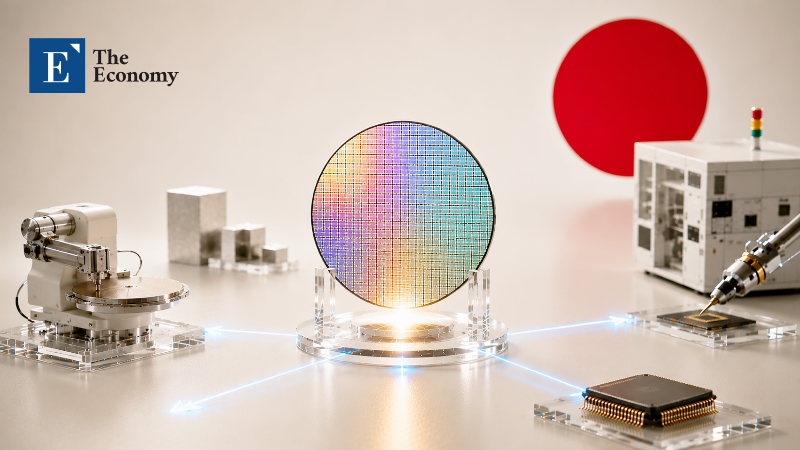
The Japanese government is continuing its full-scale support campaign to revive the domestic semiconductor industry. As additional capital injections into Rapidus and investments in advanced manufacturing facilities move forward, U.S. companies including Micron and Intel are also strengthening their operational footprints in Japan. The combination of massive government backing and growing investment from global corporations is accelerating the reconstruction of Japan’s semiconductor sector.
Japan Conducts Second Capital Injection Into Rapidus
According to Nikkei Asia on June 9, Economy, Trade and Industry Minister Ryosei Akazawa announced during a press conference following a Cabinet meeting on June 5 that the government had completed an additional capital injection of approximately $1 billion into Rapidus. The investment was executed earlier this month through the Information-technology Promotion Agency (IPA). The Japanese government acquired a class of shares that grants voting rights in the event of management deterioration, raising its ownership stake in Rapidus to roughly 60% of total capital. However, its voting rights were capped at 11.5%, the minimum level required to secure the position of largest shareholder. The arrangement reflects the government's intention to provide substantial funding while maintaining a private-sector-led management structure.
Rapidus aims to begin mass production of 2-nanometer semiconductors during fiscal year 2027. The newly injected capital will be used to build advanced production facilities, including extreme ultraviolet (EUV) lithography systems. The funds will also support research and development expenses and personnel costs associated with a 1.4-nanometer semiconductor program targeted for production launch in 2029. The Japanese government incorporated the latest capital injection into its fiscal 2026 budget. Following a previous investment of approximately $670 million executed in February this year, cumulative government capital contributions have reached roughly $1.67 billion. The government plans to provide a combined total of approximately $19.3 billion in subsidies and capital support for 2-nanometer semiconductor development through fiscal year 2027. Meanwhile, 32 private-sector companies have already invested approximately $1.12 billion in the project.
Japan is pursuing domestic production of advanced semiconductors as a national strategy in response to the U.S.-China technology rivalry and the restructuring of global supply chains. Rapidus is widely viewed as the centerpiece of Japan’s effort to reclaim leadership in the semiconductor industry, and the success or failure of its mass-production ambitions is regarded as a critical test of the country’s industrial policy. During the press conference, Akazawa stated, “Rapidus is advancing at a pace rarely seen anywhere in the world,” adding that “the government will fully support its success in the national interest as a core growth-investment project.”
Micron Expands Hiroshima Facility, Targets Next-Generation HBM Shipments by 2028
Japanese semiconductors dominated global markets in the early 1990s, but their market share fell below 10% during the 2010s, marking a prolonged decline. External pressure came largely from the United States. Beginning in the mid-1980s, Washington imposed retaliatory tariffs on Japanese products over alleged dumping practices and weakened Japan’s price competitiveness through the Plaza Accord. As a result, Japanese semiconductor revenue peaked in 1992 before entering a steep decline.
Internal shortcomings also played a role. Japanese companies failed to adapt to changing market conditions. As personal computers became widespread, demand shifted toward smaller and lower-cost DRAM products, yet Japanese manufacturers remained focused on high-performance DRAM used in large-scale computing systems. The decline culminated in the 2012 bankruptcy of Elpida, while Toshiba spun off its flash-memory semiconductor division in 2017 amid financial distress.
As the semiconductor sector—once a pillar of Japan’s manufacturing competitiveness—fell into a prolonged slump, the Japanese government began deploying large-scale subsidies in 2021. The effort formed part of the “Semiconductor and Digital Industry Strategy” unveiled by the Ministry of Economy, Trade and Industry in June of that year. Japan provided approximately $3.2 billion, equivalent to roughly 40% of TSMC’s investment, for the construction of the company’s first Kumamoto fabrication plant. Rapidus likewise represents a national strategic project directly designed by the Japanese government to restore semiconductor sovereignty. Through Rapidus, Tokyo is pursuing next-generation semiconductor development and advances in high-performance memory technologies.
Micron’s investment in Hiroshima represents another key pillar of Japan’s semiconductor revival. After acquiring bankrupt Japanese chipmaker Elpida in 2013, Micron maintained its Hiroshima operations for more than a decade. The company is now seeking to transform the site into a next-generation HBM production hub. The project involves constructing a new manufacturing building at the existing Hiroshima facility in Higashihiroshima. Total investment is estimated at approximately $10 billion, with the Japanese government expected to provide subsidies of up to $3.3 billion.

Intel Joins the Push as Japan’s Semiconductor Ecosystem Expands
The inflow of capital and expansion of manufacturing capacity into Japan are also influencing supply-chain strategies across the global semiconductor industry. On June 5, Intel announced a strategic partnership with Japanese IT and infrastructure company Hitachi. The two firms will pursue joint projects across five areas: semiconductor manufacturing equipment, factory automation, energy optimization, customized silicon development, and related technologies. A central objective is to integrate Hitachi’s measurement and inspection equipment data and process-optimization expertise into Intel’s foundry operations to improve yields and productivity.
Semiconductor foundry equipment represents the core area of collaboration. Hitachi collects high-precision data generated by metrology systems, critical-dimension scanning electron microscopes (CD-SEMs), etching equipment, and other tools through its integrated ExTOPE platform. The company plans to apply physical artificial intelligence to diagnose equipment abnormalities in advance and optimize maintenance operations. Hitachi expects the initiative to improve semiconductor yields, shorten development and production cycles, and enhance product quality.
The partnership comes as Intel seeks to restore competitiveness in its foundry business. The company is attempting to reestablish itself in the foundry market through advanced manufacturing processes and AI semiconductor infrastructure, though many industry observers believe a significant gap remains between Intel and rivals Samsung Electronics and TSMC. As semiconductor manufacturing nodes continue to shrink, equipment utilization rates, defect management, and maintenance timing are becoming increasingly critical determinants of productivity and yield, elevating the importance of AI-driven factory operations.
At Computex 2026, Intel also highlighted its partnership with Hitachi as part of its broader strategy for industry-specific AI solutions. Intel said it would collaborate with companies including Foxconn, Siemens, and Hitachi to develop customized AI solutions tailored to specific industries. With Hitachi, the company plans to expand cooperation in foundry equipment and quantum-computing technologies.
Intel’s move also reflects Japan’s changing position within the semiconductor industry. Japanese companies, long viewed primarily as suppliers of materials and manufacturing equipment, are once again emerging as indispensable partners in advanced process development. Following substantial government support for Rapidus, TSMC’s investment in Kumamoto, Micron’s development of an HBM manufacturing hub in Hiroshima, and Intel’s expanding partnerships with Japanese firms, Japan is strengthening its role as a key node in the restructuring of the global semiconductor supply chain. Some industry observers argue that Japan’s semiconductor sector has entered a new investment cycle for the first time in 15 years. The country’s strategic wager on semiconductors is increasingly taking shape through the rebuilding of advanced manufacturing capabilities.
Oliver Griffin is a policy and tech reporter at The Economy, focusing on the intersection of artificial intelligence, government regulation, and macroeconomic strategy. Based in Dublin, Oliver has reported extensively on European Union policy shifts and their ripple effects across global markets. Prior to joining The Economy, he covered technology policy for an international think tank, producing research cited by major institutions, including the OECD and IMF. Oliver studied political economy at Trinity College Dublin and later completed a master’s in data journalism at Columbia University. His reporting blends field interviews with rigorous statistical analysis, offering readers a nuanced understanding of how policy decisions shape industries and everyday lives. Beyond his newsroom work, Oliver contributes op-eds on ethics in AI and has been a guest commentator on BBC World and CNBC Europe.
- Previous “Monetization Remains Elusive Despite Astronomical Spending” The Dark Side of the AI Investment Boom, as Redemption Shockwaves Spread Through Private Credit Markets
- Next "Seeking Differentiation Through a Triple Mechanism" Eli Lilly’s Retatrutide Again Proves Efficacy in Trials, Raising Question of Whether It Can Overcome Side-Effect Limits and Reshape the Market
Similar Post