"Astute-Class Operational Readiness at 0%": Britain’s Nuclear Submarine Fleet Hits Structural Limits, Raising Deeper Doubts Over Core Operating Capacity

Matthew Reuter is a senior economic correspondent at The Economy, where he covers global financial markets, emerging technologies, and cross-border trade dynamics. With over a decade of experience reporting from major financial hubs—including London, New York, and Hong Kong—Matthew has developed a reputation for breaking complex economic stories into sharp, accessible narratives. Before joining The Economy, he worked at a leading European financial daily, where his investigative reporting on post-crisis banking reforms earned him recognition from the European Press Association. A graduate of the London School of Economics, Matthew holds dual degrees in economics and international relations. He is particularly interested in how data science and AI are reshaping market analysis and policymaking, often blending quantitative insights into his articles. Outside journalism, Matthew frequently moderates panels at global finance summits and guest lectures on financial journalism at top universities.
Authored On
Modified
Britain’s Core Astute-Class Nuclear Submarine Force Enters Port Simultaneously, Creating a Capability Gap
Structural Constraints Continue to Generate Friction, Clouding the Future of the AUKUS Alliance
Budget Pressures and Shortage of Available Vessels Disrupt Nuclear Submarine Operations and Decommissioning
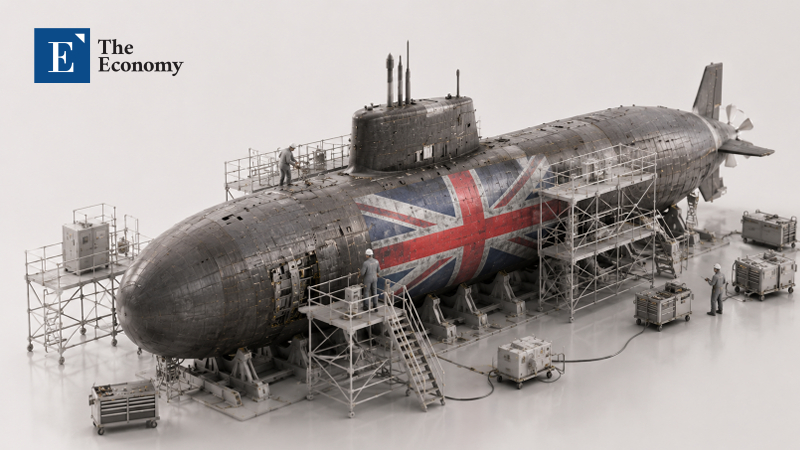
The Royal Navy’s most advanced nuclear-powered attack submarine force has been tied up in maintenance docks all at once. With the operational availability rate of deployable assets falling to 0%, structural problems within Britain’s naval system are again coming into sharp relief. The episode is fueling doubts that extend beyond a temporary capability gap, raising broader questions over Britain’s underlying ability to operate nuclear submarines and the future viability of AUKUS, the nuclear submarine security partnership among the United States, Britain and Australia.
Major Gap Opens in Britain’s Cutting-Edge Nuclear Submarine Force
According to The Telegraph on June 7, local time, all five of the Astute-class nuclear submarines that form the core of the Royal Navy’s undersea capability are currently in port because of technical problems and maintenance delays. After defects were discovered on HMS Anson following its return from a recent joint exercise with Australia, every commissioned vessel became immobilized in maintenance docks, effectively paralyzing a central pillar of Britain’s security architecture.
The roots of the crisis lie in structural weaknesses across Britain’s defense industrial infrastructure. Years of defense budget cuts, austerity and industrial base contraction have steadily eroded British military capability. Submarine forces have remained a relatively high priority and therefore suffered less damage than other areas, but they too have been operating under severe constraints and steadily losing international standing. The Astute-class program in particular has long suffered schedule delays and cost overruns. Each Astute-class boat costs about $2 billion to build, while production takes far longer than comparable top-tier submarines in other major naval powers.
Infrastructure bottlenecks are also a critical problem. Britain can conduct nuclear submarine maintenance only at docks equipped with radiological safety facilities, including Devonport, while skilled personnel remain in acute shortage. If maintenance is delayed at a single site, the entire fleet is forced into a queue, inevitably creating a capability gap. Criticism of this situation has persisted inside Britain. In December, retired Rear Adm. Philip Mathias, former head of nuclear policy at the UK Ministry of Defence, said, “Britain no longer has the capability to manage a nuclear submarine program,” adding that “performance across the program continues to deteriorate in every area, an unprecedented situation in the nuclear submarine era and a catastrophic failure of succession development and leadership planning.” The assessment is that long-running management failures have severely damaged fleet availability and other key performance indicators.
Precarious British Submarine Technology
This instability in Britain’s submarine system has translated into tangible operational problems. A representative case came in 2024, when Britain’s submarine-launched ballistic missile Trident II failed in its first test launch in eight years. The missile was fired from the British strategic nuclear submarine HMS Vanguard, but the missile carrying a dummy warhead fell into the sea just meters from the submarine rather than reaching its planned impact zone in the Atlantic between Brazil and West Africa. A malfunction in the ignition of the first-stage motor among the three-stage solid-fuel rockets caused the missile to lose thrust immediately after launch. HMS Vanguard, the first of four Vanguard-class strategic nuclear submarines, had undergone a full refit costing about $670 million over the three years before the launch.
AUKUS is also facing difficulties because of Britain’s technology and capability shortfalls. Launched in 2021, AUKUS is an alliance among the United States, Britain and Australia designed to counter China’s military buildup by strengthening nuclear submarine capabilities needed to deter China in the Indo-Pacific. Under the plan, the United States agreed to sell Australia as many as five Virginia-class nuclear submarines from the early 2030s, while Britain and Australia would jointly develop conventionally armed nuclear-powered submarines using advanced U.S. technology and build them in their respective domestic shipyards.
In a January interview with the Brisbane Times, Mathias said, “Nuclear submarines are built by people, not policy and money,” adding that “Britain does not have enough personnel with the right skills and experience.” He continued, “The United States may be able to sell nuclear submarines to Australia, but the UK-led program is highly likely to fail,” adding that “if that happens, Australia’s plan to build nuclear submarines could be cancelled.” He also said it was “extremely naive” for Australia to join the alliance without sufficient due diligence on the precarious state of Britain’s nuclear submarine program, noting that “there have been countless announcements, international visits, forums and discussions over the past four years, but no substantive progress in building the industrial base needed to construct and support nuclear submarines.”
Strains in Decommissioning and Available-Force Management
Infrastructure constraints have also created major disruption across Britain’s submarine operating system itself. Delays in dismantling nuclear submarines are a prime example. According to the UK Ministry of Defence, more than 20 retired nuclear submarines are currently moored at Rosyth and Devonport awaiting dismantling. Many of these vessels were retired decades ago. Britain’s first nuclear submarine, HMS Dreadnought, was retired in 1980 but has still not been fully dismantled, while many Cold War-era submarines are also awaiting disposal. Parliament and audit bodies have criticized the Ministry of Defence for postponing dismantling work because of cost pressures and facility shortages. In 2019, the UK National Audit Office estimated that the cost of storing retired nuclear submarines had already exceeded about $670 million, while the long-term liability stood at roughly $10.1 billion.
The core problem is a shortage of dismantling infrastructure. Because facilities and personnel capable of removing nuclear fuel, handling reactors and managing radioactive waste remain insufficient, submarines stay moored for long periods even after retirement. The British government has designated the issue as a long-term challenge and only this year announced a plan to resume defueling retired nuclear submarines for the first time in more than two decades. Yet because dismantling HMS Swiftsure alone, the first vessel selected for the pilot program, is expected to take several years, disposing of the more than 20 retired submarines now in the backlog is projected to take decades.
The burden on available vessels and crews is also intensifying. Recently, a Vanguard-class nuclear submarine returned after a 205-day uninterrupted patrol, setting the longest submerged deployment record in Royal Navy history. A Vanguard-class submarine designed for a standard three- to four-month deployment carried more than 200 days’ worth of supplies, while crews repeated a two-watch system with shifts every six hours for more than half a year. The case is cited as a clear illustration of the Royal Navy’s capability gap. As the replacement program for aging Vanguard-class submarines faces delays and the number of available vessels continues to shrink, individual submarines are being forced into ever-longer deployments to sustain Britain’s nuclear deterrent.
Matthew Reuter is a senior economic correspondent at The Economy, where he covers global financial markets, emerging technologies, and cross-border trade dynamics. With over a decade of experience reporting from major financial hubs—including London, New York, and Hong Kong—Matthew has developed a reputation for breaking complex economic stories into sharp, accessible narratives. Before joining The Economy, he worked at a leading European financial daily, where his investigative reporting on post-crisis banking reforms earned him recognition from the European Press Association. A graduate of the London School of Economics, Matthew holds dual degrees in economics and international relations. He is particularly interested in how data science and AI are reshaping market analysis and policymaking, often blending quantitative insights into his articles. Outside journalism, Matthew frequently moderates panels at global finance summits and guest lectures on financial journalism at top universities.
Similar Post