‘Doosan Bobcat vs. Caterpillar’ Second Front Opens as Patent Barriers Rise Amid China’s Competitive Push

Anne-Marie Nicholson is a fearless reporter covering international markets and global economic shifts. With a background in international relations, she provides a nuanced perspective on trade policies, foreign investments, and macroeconomic developments. Quick-witted and always on the move, she delivers hard-hitting stories that connect the dots in an ever-changing global economy.
Authored On
Modified
Doosan Bobcat-Caterpillar patent battle enters formal U.S. ITC investigation
Dispute over core control technologies could reshape technological benchmarks in the U.S. construction equipment market
Stronger patent defenses amid China's advance, pivotal moment in the global battle for industry leadership
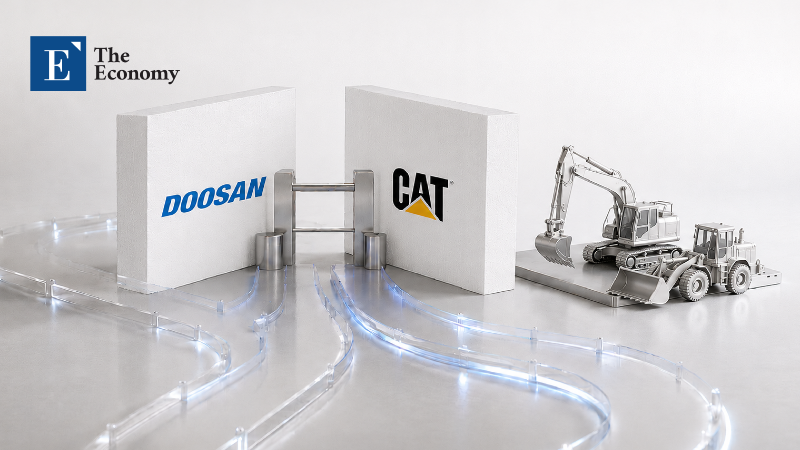
The patent dispute between Doosan Bobcat and Caterpillar has entered the formal investigation stage at the U.S. International Trade Commission (ITC). The two companies are now confronting each other simultaneously before U.S. federal courts and the ITC over core control technologies, hydraulic systems, and fuel-efficiency technologies, escalating into a full-scale battle over the boundaries of patent protection in the North American construction equipment market. As China's construction machinery manufacturers disrupt the market with aggressive low-cost competition and the rapid expansion of electrified equipment, the litigation is widely expected to become a watershed that determines the scope of technologies protected in the U.S. market and the extent to which latecomers can gain entry.
Caterpillar Strikes Back Over Four Excavator and Loader Patents
According to Bloomberg Law on June 29 (local time), the ITC has initiated an investigation after accepting Caterpillar's patent infringement complaint filed on May 26. On the same day, Caterpillar also filed a separate patent lawsuit with the U.S. District Court for the District of Delaware, adopting a "two-track strategy" that combines an administrative investigation with civil litigation. Unlike ordinary courts, the ITC has the authority not to award monetary damages but to restrict imports into the United States. If patent infringement is confirmed through the investigation, the commission may issue exclusion orders barring imports of the relevant equipment into the U.S., as well as sales restriction orders.
At the center of Caterpillar's complaint are four of its patents related to machine control systems, hydraulic performance, fuel efficiency, and smooth drive technologies. The machine control system patent covers methods enabling heavy equipment to independently assess current operating conditions and dynamically adjust machine performance to improve efficiency. Heavy machinery experiences enormous instantaneous loads when digging deeply with a bucket or lifting heavy materials, and abrupt demands for high output can place excessive strain on the engine. Caterpillar's patented technology continuously monitors engine conditions and torque in real time, automatically adjusting hydraulic pressure and transmission output requirements so that the machine operates only within the engine's sustainable performance range. Caterpillar alleges that Doosan Bobcat's "ECO Mode" and "Horsepower Management" functions operate based on this same principle.
Caterpillar's hydraulic control patent simultaneously calculates engine output and hydraulic pump loads, adjusting pump torque in real time. The technology supplies only the hydraulic pressure necessary for excavation or heavy lifting operations while minimizing unnecessary power losses and preventing engine overload. Caterpillar claims that the "Smart Power Control" function and pump torque control system used in Doosan Bobcat's large excavators incorporate its patented technology. The company also identified as infringing its fuel-efficiency technology, which optimizes engine speed and hydraulic usage to perform identical workloads with lower fuel consumption.
Smooth drive technology has likewise emerged as a key point of contention. The patent electronically controls torque and acceleration in hydrostatic drive systems, minimizing shocks and vibrations during starts, stops, and directional changes. The technology reduces equipment instability when operators transport materials or traverse rough terrain, improving both operational stability and operator comfort. Caterpillar argues that the "Smooth Drive Mode" featured in Doosan Bobcat telehandlers operates on the same principle as its patented technology and has therefore included it in the ITC investigation. Caterpillar maintains that these technologies represent core control innovations that simultaneously enhance engine protection, equipment durability, and operational efficiency, making robust patent protection essential.
Doosan Bobcat's Offensive Opens Simultaneous Fronts Across Four U.S. and European Courts
The latest dispute forms part of a broader intellectual property (IP) conflict that began in December last year, when Doosan Bobcat simultaneously filed lawsuits involving 14 patents before U.S. federal courts, the ITC, the Unified Patent Court (UPC) in Europe, and German federal courts. The patents Doosan Bobcat alleges were infringed include skid-steer remote joystick control technology, E-Fence geofencing safety software, automatic hydraulic transmission systems, lift-arm safety zone configuration technology, and variable engine speed control.
In its court filings, Doosan Bobcat asserted that "rather than innovating independently after entering the skid-steer loader market as a latecomer in 1999, Caterpillar appropriated Bobcat's technology and engaged in unfair competition." The complaint argues that Caterpillar entered the market approximately four decades after Bobcat pioneered the world's first compact loader in 1957 and subsequently copied the technology by dismantling and reverse-engineering competing equipment.
In response, Caterpillar argued in a public interest statement submitted to the ITC in January that granting Doosan Bobcat's request for an import ban would inflict significant damage on the U.S. economy and infrastructure projects. As the world's largest construction equipment company, having ranked No. 1 globally in construction equipment financing sales for three consecutive years from 2023 through 2025, Caterpillar emphasized that disruptions to its supply chain could have broad repercussions across nationwide infrastructure construction and equipment rental businesses.
Building Technological Defenses Amid China's Competitive Offensive
The dispute has attracted particular attention because competitive dynamics in the construction equipment industry are shifting away from pricing and distribution networks toward patents, software, and trade barriers. The U.S. construction equipment market has long been dominated by North American and European manufacturers led by Caterpillar. Extensive dealer networks, equipment financing capabilities, after-sales services, and rental infrastructures have historically served as formidable barriers to entry, making it difficult for newcomers to disrupt the existing market structure.
However, that landscape has begun to fracture as Chinese manufacturers expand their offensive. Chinese construction equipment companies have offset domestic market weakness and overcapacity by aggressively expanding overseas sales, strengthening their presence across North America, Europe, and emerging markets. Companies including SANY, XCMG, and Zoomlion have established strong price competitiveness through excavators, cranes, electrified equipment, and specialized machinery, while also benefiting from domestic supply chains for batteries and electronic components. Moreover, Chinese products once viewed solely as low-cost alternatives are increasingly narrowing the technological gap by incorporating electrification and automation capabilities.
Against this backdrop, the patent litigation between Caterpillar and Doosan Bobcat takes on greater strategic significance. Although Doosan Bobcat is not generally classified alongside Caterpillar among the very top tier of global construction equipment manufacturers, it has already established itself as a leading player with substantial brand equity and a robust technology portfolio in North America's compact equipment segment. Caterpillar's decision to aggressively escalate rather than dismiss Doosan Bobcat's lawsuit underscores that the dispute extends well beyond competition with a single rival. Once technological boundaries are legally defined, they will also establish benchmarks that Chinese manufacturers must avoid if they seek to introduce similar functions into the U.S. market in the future. Both Caterpillar and Doosan Bobcat therefore have strong incentives to broaden the scope of legal protection for their respective technologies through this litigation.
Doosan Bobcat's decision to file suit first is closely tied to this broader strategic context. Bobcat carries symbolic significance as the brand that pioneered the compact loader market, while Doosan secured a U.S.-based manufacturing and sales platform through its acquisition of Bobcat in 2007. Today, Doosan Bobcat has firmly established itself as a participant capable of asserting technological rights within the U.S. equipment ecosystem. Its allegations of reverse engineering and patent infringement against Caterpillar represent not only a defensive effort to protect technological leadership but also an offensive move aimed at gaining recognition as a higher-tier competitor in the North American market. Caterpillar, by contrast, has long maintained its position as the undisputed global leader in construction equipment, with its technologies widely regarded as industry benchmarks. If Doosan Bobcat's claims gain traction and the ITC investigation proceeds, Caterpillar's technological leadership and market credibility could come under pressure. From this perspective, Caterpillar's countersuit and ITC complaint can be interpreted not merely as defensive measures but as an effort to redraw the boundaries of future technological standards.
Some industry observers believe the dispute is evolving into a broader contest for leadership in the global construction equipment market. If Doosan Bobcat succeeds in securing recognition of its technological rights against Caterpillar, its standing in the North American compact equipment market could strengthen considerably. Conversely, if Caterpillar prevails, it would reinforce the existing market order and prevailing technological standards. Regardless of which company gains the upper hand, the ruling is expected to send a powerful signal to Chinese manufacturers regarding their strategies for entering the North American market. One IP attorney commented, "It is difficult to view this simply as a patent dispute between two companies," adding, "The ITC's ruling is likely to become a precedent that determines which technologies receive protection in the U.S. market and which technologies become benchmarks for market entry." The attorney further noted, "Given that the case coincides with Chinese manufacturers' push to expand in North America, the ruling could become a turning point that reshapes the competitive landscape of technological innovation across the global construction equipment industry."
Anne-Marie Nicholson is a fearless reporter covering international markets and global economic shifts. With a background in international relations, she provides a nuanced perspective on trade policies, foreign investments, and macroeconomic developments. Quick-witted and always on the move, she delivers hard-hitting stories that connect the dots in an ever-changing global economy.
Similar Post