“Turnkey Competitiveness Takes Hold” Samsung Electronics Forms $200 Billion AI Alliance with Broadcom, Gains Ground in Chase of TSMC

Anne-Marie Nicholson is a fearless reporter covering international markets and global economic shifts. With a background in international relations, she provides a nuanced perspective on trade policies, foreign investments, and macroeconomic developments. Quick-witted and always on the move, she delivers hard-hitting stories that connect the dots in an ever-changing global economy.
Authored On
Modified
Samsung Secures Tesla, Anthropic and Broadcom in Succession
End-to-End Integration from Memory to Foundry
New Global Customer Wins Signal Foundry Rebound
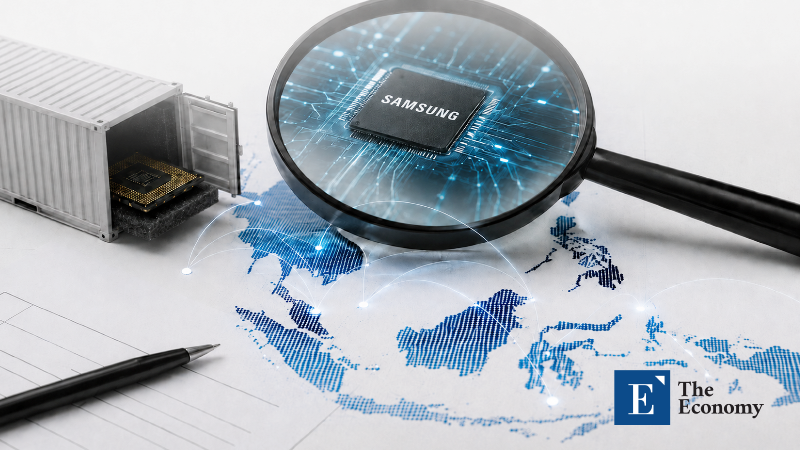
Taiwan’s TSMC is raising foundry prices as capacity at leading-edge nodes tightens, creating an opening for Samsung Electronics’ 2-nanometer foundry business to reverse course. As major technology companies, including Broadcom—the world’s leading application-specific integrated circuit (ASIC) designer—successively adopt Samsung’s 2nm process, the timetable for the loss-making foundry division’s return to profitability is expected to move forward substantially.
Samsung Partners with Broadcom on Turnkey AI Infrastructure
According to Reuters and other foreign media outlets on the 28th, Samsung Electronics will pursue cooperation valued at more than $200 billion with Broadcom over the next five years under a memorandum of understanding signed at the AI Summit held in San Francisco on the 24th. The arrangement entails supplying Broadcom with at least roughly $208 billion in semiconductors, including long-term agreements for high-bandwidth memory (HBM). It reflects closer collaboration between global Big Tech companies and Samsung Electronics, which possesses the world’s largest advanced manufacturing capacity, at a time when semiconductor supply shortages are worsening as demand outstrips available production. Samsung is currently discussing similar cooperative arrangements with other global technology companies.
The notable aspect is that the partnership extends beyond memory. Its scope encompasses advanced memory, including HBM, sub-2nm foundry manufacturing and advanced packaging. As investment in AI infrastructure accelerates sharply, leading technology companies such as Google and Tesla, alongside established semiconductor firms, are racing to develop their own AI accelerators, or ASICs. Against this backdrop, Broadcom, a leader in custom semiconductor design, and Samsung Electronics, which possesses capabilities across the full semiconductor manufacturing chain, have agreed to combine their respective strengths.
Samsung Electronics plans to supply Broadcom’s AI accelerators with next-generation memory products, including HBM4, its sixth-generation HBM product that entered mass production in February, and HBM4E, the seventh-generation product for which samples were delivered to customers in May. In foundry manufacturing, Samsung will apply sub-2nm leading-edge processes to key Broadcom products, including next-generation high-speed data-communications chips. It also plans to provide advanced packaging technology to improve the performance and power efficiency of AI semiconductors. “This partnership goes beyond a simple HBM supply arrangement, representing a strategic collaboration spanning the entire semiconductor value chain—from memory and sub-2nm foundry manufacturing to advanced packaging,” an industry source said. “It is a case in which Samsung’s competitive strengths are being deployed in earnest.”
TSMC to Raise Prices by 10% in 2027
Broadcom’s decision to turn to Samsung after previously relying exclusively on TSMC for leading-edge manufacturing reflects Samsung’s integrated production capabilities. Samsung is the only company capable of offering a one-stop turnkey solution because it possesses capabilities in memory, foundry manufacturing and packaging. By linking the entire process from chip design and development through packaging and mass production, it can shorten development cycles and enhance price competitiveness. It can also alleviate, to some extent, concerns over supply delays as demand for AI semiconductors surges.
TSMC’s move to raise prices has also generated spillover benefits for Samsung. TSMC recently informed major customers that it would increase foundry prices by up to 10% beginning in 2027. As a result, the price of TSMC’s 2nm wafers, currently around $30,000 per wafer, is expected to exceed $33,000 in 2027. Samsung Electronics’ 2nm wafer price, by contrast, is reportedly about $20,000, or roughly two-thirds of TSMC’s level.
Table 1. Samsung Electronics’ Advanced Foundry Processes and AI Semiconductor Order History
| Period | Key Development | Process/Product | Achievements and Limitations |
|---|---|---|---|
| June 2022 | Began mass production of the industry’s first 3nm gate-all-around (GAA) process technology | 3nm GAA | Recorded its highest-ever foundry revenue and profit in the second quarter of the year, though the size of initial customer contracts was not disclosed. |
| 2023 | Secured AI semiconductor orders from Groq and Tenstorrent | High-performance 4nm SF4X | Despite a record backlog of new design orders in the third quarter and the acquisition of external AI customers, utilization rates and profitability remained weak. |
| July 2024 | Won a turnkey order for an AI accelerator from Japan’s Preferred Networks | 2nm GAA and 2.5D packaging | Secured its first publicly disclosed order for a 2nm AI accelerator, while the number of AI and high-performance computing customers doubled from the previous year. |
| Q4 2024 | Profitability deteriorated amid low yields and utilization rates | Advanced processes centered on 3nm | Revenue fell 1.4% quarter on quarter to $3.26 billion, while market share stood at just 8.1%, far below TSMC’s 67%. |
| Q2 2025 | Started mass production of Nvidia processors for the Nintendo Switch 2 | Nvidia processors | Foundry revenue rose 9.2% quarter on quarter to $3.16 billion. |
| July 2025 | Signed a $16.5 billion long-term supply agreement with Tesla | Next-generation AI6 chips | The agreement, extending through 2033, secured key production volume for the Taylor plant. |
| August 2025 | Selected as a supplier of U.S.-made chips for Apple | Production at the Austin plant | Product types, process nodes, volumes, and contract value were not disclosed, but the deal expanded Samsung’s U.S. customer base. |
| Q4 2025 | Began mass production of first-generation 2nm products and shipments of HBM4 base dies | 2nm products and 4nm HBM base dies | The foundry business returned to profitability; market share rose from 6.8% to 7.1%, and HBM base-die shipments began to ramp up. |
| 2026 | Secured a 2nm yield above 60% and began production of Groq’s LP30 | 2nm and 4nm LP30 | Improved advanced-process stability positioned Samsung as a supply-chain diversification option for U.S. fabless companies. LP30 shipments are scheduled for the second half of the year. |
Yield Above 60% Validates Cost Advantage
Samsung recently raised the yield of its 2nm process above 60%, demonstrating its technological stability and becoming a supply-chain diversification option for U.S. fabless semiconductor companies facing mounting cost pressures. In June 2022, Samsung began initial mass production of the industry’s first 3nm process incorporating gate-all-around architecture. Its foundry business recorded its highest-ever second-quarter revenue and profit that year, although the scale of the contract with its first 3nm customer was not disclosed.
External AI semiconductor orders with publicly identified customers began emerging successively in 2023. U.S. semiconductor company Groq selected Samsung Electronics for its next-generation language processing unit (LPU), while Tenstorrent selected the company for AI chiplet production. Both products were to use the high-performance 4nm SF4X process. Contract values and production volumes were not disclosed. Although the backlog of new design orders reached a quarterly record in the third quarter of that year, utilization and profitability remained weak as the recovery in mobile demand lagged.
In July 2024, Samsung secured a turnkey order to manufacture Japanese company Preferred Networks’ (PFN) AI accelerator using its 2nm GAA process and provide 2.5D packaging. It was Samsung’s first publicly disclosed order for a 2nm AI accelerator. The number of AI and high-performance-computing customers also doubled year on year in the second quarter. At the time, Samsung said, “This order is highly significant because it demonstrates that Samsung’s 2nm GAA process technology and advanced packaging technology represent an ideal solution for next-generation AI accelerators.”
However, yields became a limiting factor. Reuters reported in October of that year that Samsung Electronics was experiencing low yields for 3nm chips on domestic production lines. Profitability also deteriorated in the fourth quarter amid low utilization rates and the burden of research-and-development costs for advanced processes. According to market research firm TrendForce, Samsung Foundry’s revenue in the fourth quarter of 2024 fell 1.4% from the preceding quarter to $3.26 billion, while its market share stood at 8.1%, far behind TSMC’s 67%.
Secures 2nm Customers After Tesla and Groq
The momentum began to shift last year. Buoyed by mass production of Nvidia processors for Nintendo Switch 2, Samsung Electronics lifted foundry revenue in the second quarter of last year by 9.2% from the previous quarter to $3.16 billion. Its decisive order win came from Tesla. Beginning in July last year, Samsung entered into a contract to supply $16.5 billion worth of semiconductors through the end of 2033. Elon Musk, Tesla’s chief executive, said the company would manufacture next-generation AI6 chips at Samsung Electronics’ Taylor plant. The market viewed Tesla’s order as having established an operating foundation for the Taylor plant, which had struggled to secure major customers.
Apple also announced in August last year that it would source chips for products including the iPhone from Samsung Electronics’ Austin plant. However, it did not disclose the chip types, process nodes, volumes or contract value. Samsung Electronics said it had secured a record volume of customer orders centered on advanced processes in the third quarter of that year. In the fourth quarter, it began mass production of first-generation 2nm products and shipments of 4nm HBM base dies. TrendForce estimated that Samsung Foundry returned to profitability during that period, with its market share rising from 6.8% to 7.1%.
This year’s most visible achievement may be Groq LP30, an AI inference chip based on Groq technology that Nvidia has disclosed. Nvidia Chief Executive Jensen Huang said Samsung Electronics is producing the 4nm LP30 AI inference chip based on Groq technology and will begin shipments in the second half of this year. “I would like to thank Samsung, which is producing Groq LP30 chips for us,” Huang said. “Samsung is ramping output as much as possible.”
Mass Production and Profitability Face a Crucial Test Amid Signs of Revival
Experts caution that it is still too early to declare Samsung Foundry fully revived. TrendForce found that Samsung Foundry’s first-quarter revenue this year fell 5.8% from the previous quarter and estimated that its market share declined to 6.5%, while TSMC’s share reached 72%. Samsung Electronics also said foundry profitability deteriorated due to the seasonal slowdown.
Nevertheless, signs of recovery are emerging. Samsung Foundry is gradually expanding its customer base as it works to overcome the absence of major customers and yield-related challenges. Tesla’s mass production is not scheduled until the second half of next year, while Broadcom remains only at the memorandum-of-understanding stage. It is still premature to declare a revival, but Samsung has unmistakably reached a critical test: converting orders into stable mass production and profits to prove that revival.
Anne-Marie Nicholson is a fearless reporter covering international markets and global economic shifts. With a background in international relations, she provides a nuanced perspective on trade policies, foreign investments, and macroeconomic developments. Quick-witted and always on the move, she delivers hard-hitting stories that connect the dots in an ever-changing global economy.
Similar Post