Trump Revives Court-Blocked Reciprocal Tariffs as ‘Forced Labor Tariffs,’ China Warns of Retaliation With ‘All Necessary Measures’

Siobhán Delaney is a Dublin-based writer for The Economy, focusing on culture, education, and international affairs. With a background in media and communication from University College Dublin, she contributes to cross-regional coverage and translation-based commentary. Her work emphasizes clarity and balance, especially in contexts shaped by cultural difference and policy translation.
Authored On
Modified
U.S. imposes 10–12.5% tariffs on 60 economies under forced-labor rationale
China maintains existing countermeasures against U.S. while signaling further retaliation
Escalating reprisals could blunt tariff impact by weighing on U.S. exports and raising supply-chain costs

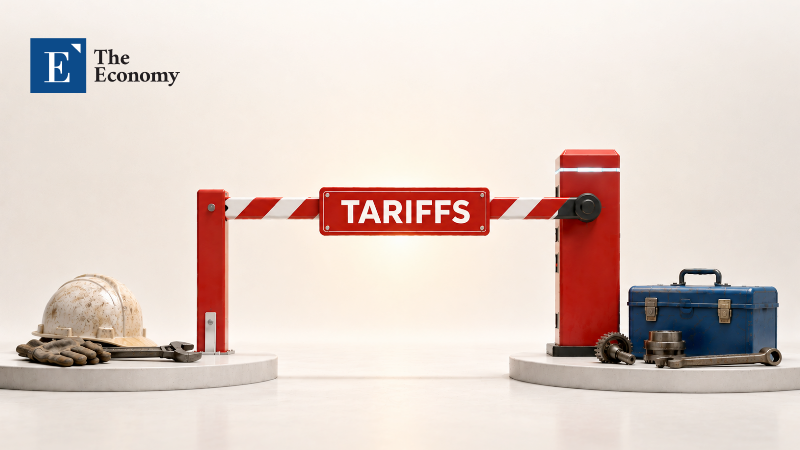
China has warned of retaliation against the United States’ “Forced Labor Tariffs.” After Washington imposed additional tariffs of 10–12.5% on 60 economies, including China, on the grounds that they had failed to block imports of goods produced with forced labor, Beijing reaffirmed that its existing countermeasures against the U.S. remain in force and left the door open to further retaliation. Faced with massive tariff refunds and a widening fiscal deficit following the Supreme Court’s invalidation of its reciprocal tariffs, the Donald Trump administration is rebuilding its tariff architecture around Section 301 of the Trade Act. Although publicly framed as a response to forced labor, the policy is widely viewed as a trade strategy designed to resurrect the reciprocal tariff regime halted by the courts and restore tariff revenue.
China Poised to Retaliate Against U.S. Forced-Labor Tariffs
According to the South China Morning Post (SCMP) on July 29, China’s Ministry of Commerce issued a series of statements through a spokesperson on July 27, expressing strong regret over Washington’s plan to impose forced-labor tariffs under Section 301. Addressing the additional tariffs imposed on 60 economies, including South Korea and China, the ministry stated, “China has consistently opposed forced labor and has established relevant laws and institutions to strictly prevent and crack down on such practices.” It added, “The United States has long politicized the issue of forced labor. Imposing unilateral tariffs under this pretext is a textbook act of unilateralism and protectionism, which China firmly opposes.”
The ministry continued, “The United States has repeatedly stated that it intends to replace tariffs imposed under the now-invalid International Emergency Economic Powers Act (IEEPA), as well as import surcharges under Section 122 of the Trade Expansion Act, with Section 301 tariffs.” It argued that the U.S. had “explicitly pledged during China-U.S. economic and trade negotiations that replacement tariffs on Chinese goods would not exceed 20%.” The ministry warned, “China’s countermeasures against the so-called fentanyl tariffs and reciprocal tariffs remain in force. China will closely monitor and comprehensively assess subsequent U.S. actions and reserves the right to take all necessary measures.”
U.S. Withholds Tariff Methodology After Four-Month Investigation
The Office of the United States Trade Representative (USTR) announced its final action on July 23, local time, imposing forced-labor tariffs of 10–12.5% on 60 economies, including South Korea and China, under Section 301 of the Trade Act. The tariffs were justified on the grounds that these economies had either failed to introduce import bans on goods produced with forced labor or had failed to enforce such restrictions adequately.
After opening 60 investigations on March 12, the USTR held two public hearings, received more than 2,100 public comments and consulted with more than 45 governments. On June 2, it concluded that the import-ban and enforcement regimes maintained by the economies under investigation for forced-labor goods impaired the competitive conditions facing U.S. companies. The tariffs were not confined to individual products found to have links to forced labor; instead, most imports from the economies under investigation were brought within their scope. Exemptions were granted for informational materials, donated goods, travelers’ personal effects, products already subject to Section 232 tariffs, raw materials that are difficult to source domestically and goods whose inclusion could cause severe supply disruptions. The U.S., however, did not disclose the specific methodology used to calculate the tariff rates.
The design has been interpreted as evidence of Washington’s effort to balance its stated objective of eradicating forced labor with concerns over inflation and supply-chain pressures at home. By avoiding overlapping duties on energy, critical raw materials, steel, aluminum and other products already subject to high tariffs, the administration can generate revenue and enhance its negotiating leverage across a broad range of imports. This has prompted Democrats and some trade experts to accuse the administration of using forced labor as a pretext for rebuilding a universal tariff regime.
Table 1. Restructuring of the U.S. Tariff Regime Following the Invalidation of Reciprocal Tariffs
| Category | Previous Approach | Transition and Expansion | Applications and Implications |
|---|---|---|---|
| Legal basis for tariffs | Reciprocal tariffs imposed under the International Emergency Economic Powers Act (IEEPA) | Use of individual trade statutes, including Section 301 of the Trade Act and Section 232 of the Trade Expansion Act | Following the Supreme Court ruling, the legal basis for tariffs has shifted toward existing trade statutes regarded as relatively more legally secure |
| Forced-labor issue | Human rights and labor concerns centered on individual countries and products | Evaluation of national import-ban and enforcement regimes, followed by tariffs on a broad range of imports | Tariffs of 10–12.5% imposed on 60 economies, including South Korea and China |
| Supply chains and industrial policy | Responses to unfair trade practices involving specific products | Expansion of trade-pressure rationales to encompass labor, environmental standards and supply-chain transparency | Section 301 investigations targeting steel, automobiles, batteries, semiconductors and shipbuilding on the grounds of manufacturing overcapacity |
Tariff Architecture Shifts After Court Ruling
The measure is attracting particular attention because of the breadth of the economies under investigation. Forced-labor concerns have traditionally been discussed in connection with China’s Xinjiang Uyghur region or labor conditions in certain developing countries. This investigation, however, included a large number of major U.S. allies, including South Korea, Japan, Australia, New Zealand, Switzerland and Norway. The scope suggests that Washington is seeking not merely to target labor abuses in specific countries but to extend its own supply-chain rules across its major trading partners.
The timing of the tariffs is equally significant. The investigation gathered momentum after the U.S. Supreme Court blocked the Trump administration’s reciprocal tariffs earlier this year. Since then, the U.S. has been constructing a new tariff regime using existing trade statutes, including Section 232 of the Trade Expansion Act and Section 301 of the Trade Act. Following Section 232 tariffs on steel and aluminum and duties on automobiles, forced labor has now become another rationale for imposing tariffs.
The U.S. is likely to continue incorporating labor, environmental standards and supply-chain transparency into its trade policy. Separately from the forced-labor investigation, Washington is conducting another Section 301 investigation into “structural excess capacity” in manufacturing. The investigation covers steel, aluminum, automobiles, batteries, semiconductors and shipbuilding.
Section 301 Tariff Push Gains Momentum
The Trump administration has already begun activating its Section 301 tariff strategy. In a statement issued on July 15, the USTR said, “A Section 301 investigation found Brazil’s policies to be unreasonable and discriminatory against the United States,” announcing that a 25% tariff would be imposed on Brazilian imports beginning July 22. The USTR identified digital commerce and tariffs, intellectual property rights and access to Brazil’s ethanol market as unfair trade practices. Coffee, beef and certain ethanol products were excluded from the tariffs.
Brazil consequently became the first country to face tariffs imposed by the Trump administration under Section 301 of the Trade Act. Brazil strongly protested the decision and said it would consider countermeasures, including filing a complaint with the World Trade Organization (WTO). In August last year, Trump also raised tariffs on Brazil from 10% to 50% after denouncing the prosecution of former President Jair Bolsonaro, a political ally accused of plotting a coup, as a “witch hunt.”
Trump even threatened additional tariffs after smoke from Canadian wildfires caused severe air pollution across the eastern United States. Writing on his social media platform Truth Social on July 17, Trump said, “We are holding Canada accountable for the unhealthy air invading the United States because of its failure to properly manage its forests and underbrush.” He added, “This is willful negligence that occurs every year and costs the United States billions of dollars.” Without explaining the legal basis for the proposed levy, Trump said, “The cost of this pollution must inevitably be added to the tariffs Canada currently pays.”
Trump Faces Revenue Imperative Ahead of Midterm Elections
With midterm elections approaching in November, Trump is under mounting pressure to improve the federal fiscal balance by introducing new tariffs. On July 13, the U.S. Treasury Department reported that the federal budget recorded a $120 billion deficit in June, a sharp deterioration from the $2.7 billion surplus posted in the same month last year. Customs collections totaled $23.6 billion in June, while refunds reached $49.2 billion—more than twice the amount collected.
Tariff refunds have ballooned month after month since the Supreme Court invalidated the reciprocal tariffs. Refunds reached $49.2 billion in June, more than double the $22 billion recorded in May. The $71.2 billion refunded over May and June alone accounted for 43% of the $166 billion in tariff revenue eligible for repayment.
Total federal receipts in June fell by $31 billion, or 6%, from a year earlier to $496 billion, largely because of the tariff refunds. Total federal spending increased by $117 billion, or 23%, to $616 billion. Gross interest payments on the public debt rose by $41 billion, or 28%, from a year earlier to $185 billion in June. The cumulative federal deficit for the first nine months of fiscal year 2026, which runs from October 2025 through September 2026, also increased by $2.9 billion, or 2%, from the same period a year earlier to $1.367 trillion. With tariff refunds already exceeding collections and interest costs on the public debt surging, the Trump administration has little room to relinquish broad-based tariff revenue.
Experts believe that if China launches a forceful response combining retaliatory tariffs, rare-earth export controls and sanctions on U.S. companies, other major targeted economies are likely to follow with WTO complaints, retaliatory duties and demands to renegotiate their trade arrangements with Washington. Retaliatory tariffs could depress exports of U.S. goods, while Chinese restrictions on rare earths could drive up procurement costs for American companies. Under such circumstances, the Trump administration’s ability to improve the fiscal balance through tariff revenue would likely be significantly constrained.
Siobhán Delaney is a Dublin-based writer for The Economy, focusing on culture, education, and international affairs. With a background in media and communication from University College Dublin, she contributes to cross-regional coverage and translation-based commentary. Her work emphasizes clarity and balance, especially in contexts shaped by cultural difference and policy translation.
- Previous “From Wildfires to Infrastructure Failures”: Europe’s Vulnerability to Climate Shocks Laid Bare as Ageing Infrastructure and Political Divisions Deepen Heatwave Damage
- Next “Turnkey Competitiveness Takes Hold” Samsung Electronics Forms $200 Billion AI Alliance with Broadcom, Gains Ground in Chase of TSMC
Similar Post