“An Era When AI Finds the Answers for You”: AI Cheating Disrupts Exams Worldwide, Highlighting Need for Sweeping Education and Assessment Reform

As one of the youngest members of the team, Tyler Hansbrough is a rising star in financial journalism. His fresh perspective and analytical approach bring a modern edge to business reporting. Whether he’s covering stock market trends or dissecting corporate earnings, his sharp insights resonate with the new generation of investors.
Authored On
Modified
AI-assisted cheating spreads, undermining fairness in university admissions and national qualification exams
Misuse of advanced devices such as smart glasses exposes gaps in existing proctoring and security systems
Limitations of answer-focused assessments come into focus, fueling calls to redesign examination systems
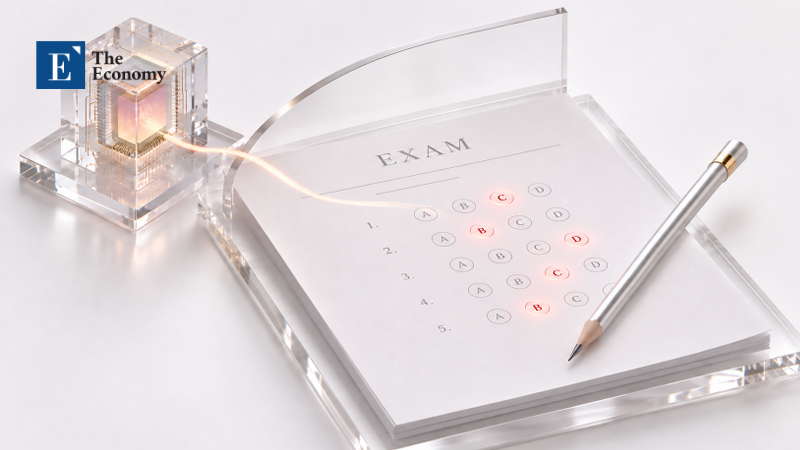
Cases of exam cheating using artificial intelligence (AI) are mounting worldwide. As generative AI, smart glasses and miniature cameras rapidly become commonplace, a growing number of candidates appear to be relying on external tools to take exams, regardless of their actual abilities. Educators say this underscores the need to redesign examination and assessment systems, moving away from multiple-choice and short-answer formats toward methods that assess problem-solving processes, logical thinking and the actual learning process.
AI Cheating Controversy at Brown University in the US
According to foreign media reports compiled on the 23rd, allegations of AI-assisted exam cheating are emerging across US universities as the technology permeates everyday life. In July, for example, Roberto Serrano, an economics professor at the prestigious Ivy League institution Brown University, discovered indications of suspected widespread AI use by students on an exam during this year's spring semester. After the midterm was held remotely in the wake of a campus shooting late last year, the average score soared to 96. According to Serrano, the average exam score in the course typically ranged from 65 to 80, and this particular midterm was harder than previous exams. Serrano then entered the exam questions into ChatGPT and found that the students' answers resembled those generated by AI.
The final exam was subsequently switched to an in-person format, and students' grades plummeted. After the change in format, 18 students withdrew from the course, while 9 remained enrolled but did not take the final. Of the 59 students who took the exam, 37 scored at least 40 points lower than on the midterm, including 17 whose scores fell by at least 60 points. Notably, 2 students who had scored 100 on the midterm received just 19 and 16.5, respectively, on the final. The overall average on the final was 48.6, nearly half the midterm average, and 19 students ultimately failed the course.
Similar Controversies Spread to the SAT and Baccalaureate
Attempts at AI-assisted cheating have also been observed in university entrance exams. The College Board, which administers the SAT in the US, identified 4 candidates in March who had taken the test using malicious software called “Auto SAT.” The program bypassed the digital SAT's screen-locking feature, sent exam questions to an AI chatbot in real time and displayed the generated answers on the candidates' computer screens. The College Board subsequently modified the testing system's design and code to block the program and filed a lawsuit against its developer. After banning smart glasses at testing centers in March, it expanded the ban in July to cover all glasses capable of accessing the internet or AI services.
France's baccalaureate, the qualification exam for university admission, has also been affected by AI cheating. According to the French Education Ministry, 1,208 cases of exam cheating were detected nationwide last year, up 273 from the previous year. Of those, 833 were referred to baccalaureate disciplinary committees, and sanctions were imposed in 634 cases. Among the cases referred to the committees, cheating involving electronic devices such as smartphones, tablets and smartwatches accounted for 55.04%, while AI-assisted cheating accounted for 8.5%. To minimize these problems, French education authorities have equipped all regional education authorities with mobile phone detectors, which are being deployed randomly at testing centers during written exams. In February, authorities also tightened procedures to allow sanctions for cheating discovered after an exam has ended. Candidates found to have cheated may have their results invalidated or be barred from taking the baccalaureate for up to 5 years.
University Entrance and Secondary School Exams in East Asia Also on Alert
Japan has also seen a case in which smart glasses were used to leak exam questions. In February 2024, a candidate taking Waseda University's entrance exam photographed questions using camera-equipped smart glasses, posted them on the social media platform X and copied onto the exam paper answers supplied by outsiders contacted in advance. One of the people who provided answers later suspected cheating and reported the incident to the university. A proctor also spotted the candidate's smart glasses during the School of Commerce entrance exam on the 21st of the same month. The university invalidated all of the candidate's entrance exam results.
Similar problems have also emerged in South Korea, including in middle and high school exams used to calculate school grades. A comprehensive survey of 5,679 middle and high schools nationwide by South Korea's Education Ministry confirmed cheating involving AI smart glasses at 1 middle school and 3 high schools this year. The incidents occurred in areas including Seoul, North Jeolla Province and Jeju. Proctors caught 3 students repeatedly touching their glasses during exams. The remaining student reportedly switched from ordinary glasses to smart glasses after the exam began and was stopped by a proctor following a tip from another student. All 4 students received scores of 0 on the exams concerned.
Table 1. Cases of Exam Cheating Using AI and Advanced Devices by Country
| Country | Date | Exam | Key Details |
|---|---|---|---|
| United States | March 2026 | Brown University midterm | Suspicions raised over widespread AI use during a remote exam |
| March 2026 | SAT | Security features bypassed to transmit exam questions to AI | |
| France | 2025 | Baccalaureate | AI-assisted cheating accounted for 8.5% of cases referred to baccalaureate disciplinary committees |
| Japan | February 2024 | Waseda University entrance exam | Smart glasses used to transmit questions to outsiders and obtain answers |
| South Korea | 2026 | Middle and high school exams used to calculate school grades | 4 cases of cheating involving AI smart glasses detected |
| From April 2026 | Certified tax accountant and certified public accountant exams | Top-scoring candidate turned himself in after using AI to solve questions photographed with a miniature camera | |
| May–November 2026 | National qualification exams | 12 cases of cheating involving smart glasses detected |
AI and Miniature Devices Infiltrate National Qualification Exams
A series of cheating cases combining AI with miniature electronic devices has also been uncovered in national qualification exams. On the 15th, the top-scoring candidate in this year's certified tax accountant exam turned himself in to police, admitting that he had cheated on both the first and second stages using a miniature camera, a smartphone and generative AI. In the first-stage exam held in April, he answered all but 1 of the 160 questions across 4 subjects correctly, scoring 97.5 in public finance and 100 each in introductory tax law, introductory accounting and commercial law. He explained that he had photographed the exam questions with a miniature camera, sent them to AI and checked the answers on his smartphone. He also claimed to have cheated in the same way on the certified public accountant exam.
A total of 12 cases of cheating involving smart glasses were detected from May through November this year in national qualification exams administered by the Human Resources Development Service of Korea. During the fire protection engineer exam held in Gwangju in May, a proctor noticed light coming from a candidate's eyeglass lenses. That same month, a camera lens mounted on a candidate's eyeglass frame was discovered during the information processing engineer exam in Seoul. Last month, a candidate was caught writing answers while wearing smart glasses during the gas engineer exam. This month, during the fire protection engineer exam in Busan, a candidate left the testing center after refusing a proctor's request to inspect the glasses.
Education Systems Centered on Multiple-Choice Tests Need Reform
Against this backdrop, calls for fundamental reform of existing examination and assessment systems are mounting among educators. Some educational institutions are currently addressing the problem by hiding text in exam questions designed to induce AI to generate incorrect answers, or by using methods to detect AI use. However, these measures depend on how particular AI models operate and have limited ability to prevent cheating using external devices such as smart glasses. This is fueling calls to move beyond assessments of memorized knowledge based primarily on simple multiple-choice and short-answer questions, toward methods such as in-person oral exams and essay-based assessments that directly evaluate △problem-solving processes △logical thinking △understanding of concepts.
Analysts say the need for such institutional reform is particularly pressing in countries such as South Korea, which rely heavily on multiple-choice exams and standardized scores. As cases of AI-assisted cheating mount, they could undermine both the fairness of existing exams and their ability to distinguish candidates' abilities, given their emphasis on finding correct answers within a fixed time. “Simply banning electronic devices from testing centers or tightening supervision will make it difficult to keep responding to new cheating methods enabled by technological advances,” an academic source said. “Without institutional reforms encompassing assessment questions and how they are designed, verification of the learning process and systems for certifying results, not only the reliability of exam scores but also public trust in the broader systems of university admissions, professional certification and public-sector recruitment that rely on those scores could collapse.”
As one of the youngest members of the team, Tyler Hansbrough is a rising star in financial journalism. His fresh perspective and analytical approach bring a modern edge to business reporting. Whether he’s covering stock market trends or dissecting corporate earnings, his sharp insights resonate with the new generation of investors.
Similar Post