“A refugee crisis involving 20 million people could emerge”: Zelensky seeks EU support as shortages of funds and weapons threaten Ukraine’s ability to sustain the war
“A refugee crisis involving 20 million people could emerge”: Zelensky seeks EU support as shortages of funds and weapons threaten Ukraine’s ability to sustain the war

Oliver Griffin is a policy and tech reporter at The Economy, focusing on the intersection of artificial intelligence, government regulation, and macroeconomic strategy. Based in Dublin, Oliver has reported extensively on European Union policy shifts and their ripple effects across global markets. Prior to joining The Economy, he covered technology policy for an international think tank, producing research cited by major institutions, including the OECD and IMF. Oliver studied political economy at Trinity College Dublin and later completed a master’s in data journalism at Columbia University. His reporting blends field interviews with rigorous statistical analysis, offering readers a nuanced understanding of how policy decisions shape industries and everyday lives. Beyond his newsroom work, Oliver contributes op-eds on ethics in AI and has been a guest commentator on BBC World and CNBC Europe.
Authored On
Modified
“Ukraine’s defeat would trigger a mass flight to Europe”: Zelensky urges additional EU support
European countries face growing burdens from hosting Ukrainian refugees as assistance is scaled back
Ukraine, weighed down by war costs, faces mounting pressure on its ability to sustain the conflict
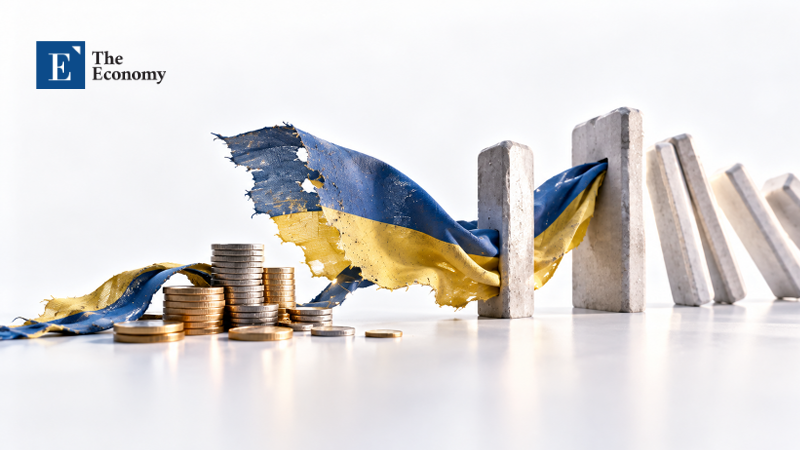
Ukrainian President Volodymyr Zelensky warned that large numbers of Ukrainians could flee to Europe if Russia wins the war. With European countries already bearing the financial and social burdens of hosting millions of Ukrainian refugees, he highlighted the possibility of further arrivals to urge expanded Western support. Ukraine currently lacks the funds and weapons needed to wage war next year, while Russia’s large-scale missile and drone strikes are weakening its ability to sustain the conflict.
Ukrainian refugees arrive in large numbers across Europe
According to Belgian business news outlet Business AM on the 19th (all dates hereafter are local time), President Zelensky said at a press conference during the European Union (EU) summit in Brussels, Belgium, on the 16th that a large-scale refugee crisis could emerge if Ukraine loses to Russia. “What would happen if we collapsed?” he asked, emphasizing, “I do not know how many refugees would head to Europe, but 20 million Ukrainians could pour into Europe.” He continued, “We are asking Europe to help defend our country because Russia would destroy us and drive our people out of their homeland,” adding, “Putin does not respect our sovereignty or territorial integrity, and does not recognize Ukraine as a state or a nation.”
Millions of refugees have already arrived in Europe since Russia’s invasion of Ukraine. According to data released on the 12th by Eurostat, the EU’s statistical office, approximately 4.43 million people who fled Ukraine held temporary protection status in the EU as of the end of August. That was an increase of 3,290 people (0.1%) from the end of the previous month. Millions remain unable to return home even now, more than four years after the war began. By country, Germany hosted 1,294,555 people, or 29.2% of all temporary protection beneficiaries in the EU, followed by Poland (939,395 people, 21.2%) and Czechia (398,360 people, 9.0%). Czechia had the highest number of temporary protection beneficiaries relative to its population, at 36.5 per 1,000 residents, followed by Slovakia (27.7) and Cyprus (27.0).
A trend toward reduced support for refugees
Meanwhile, moves to reduce the financial and social burdens of hosting Ukrainian refugees are becoming apparent in major European countries. Poland is a prominent example. In August last year, Polish President Karol Nawrocki vetoed legislation extending financial support for Ukrainian refugees and called for welfare benefits to be reduced. In particular, he argued that the monthly child allowance of PLN 800 (approximately USD 209) per child should be available only to Ukrainians working in Poland. The Polish government subsequently amended the law to make parents’ employment status a condition for receiving the child allowance. From March this year, it also began restricting access to healthcare and social welfare services and support for public accommodation for some economically inactive adults.
Germany is also becoming increasingly wary of further refugee arrivals. In June, the German government, together with Poland and other countries, called for restrictions on EU temporary protection eligibility for Ukrainian men of conscription age. It cited an increase in arrivals of Ukrainians subject to conscription in recent months. Since August, Germany has included fulfillment of, or exemption from, military service obligations among the temporary protection requirements for Ukrainians entering the EU for the first time. The Netherlands has also strengthened its system requiring working Ukrainian refugees to cover part of their accommodation and meal costs. The relevant charges were increased in October last year, and adult refugees with income must now pay up to EUR 244.22 (approximately USD 280) per person per month toward the operating costs of public accommodation.
Table 1. Reductions in support for Ukrainian refugees in major European countries
| Country | Key measures |
|---|---|
| Poland | Child allowances subject to parental employment and children’s school enrollment requirements; reduced public healthcare and accommodation support for economically inactive adults |
| Germany | Restrictions on temporary protection for new arrivals who have not fulfilled military service obligations; existing beneficiaries excluded |
| Netherlands | Operating-cost charges imposed on public accommodation residents with income; separate meal charges when meals are provided |
The burden of war costs grows by the day
President Zelensky’s warning of a mass influx of refugees can be seen as a statement made with these burdens on European countries in mind. With funding urgently needed to maintain Ukraine’s front lines, he directly addressed the repercussions of delayed Western support and urged swift decisions. In April, the EU had already given final approval to a loan package totaling EUR 90 billion (approximately USD 103 billion) to meet Ukraine’s financial and defense needs. The funds will be disbursed over the two years from 2026 to 2027. Of the total, EUR 60 billion (approximately USD 68.9 billion) is allocated to weapons procurement and expanding defense industry production capacity, while the remaining EUR 30 billion (approximately USD 34.4 billion) is earmarked for general financial support, including maintaining public services and restoring key infrastructure such as energy and transport facilities.
The problem is that Russia’s recent airstrikes have generated enormous additional expenditures, making it difficult to cover the costs of war with this loan package alone. At the EU summit on the 16th, President Zelensky said the cost of waging war next year was expected to reach EUR 155 billion (approximately USD 178 billion). He stressed, “We need at least another EUR 70 billion (approximately USD 80.4 billion) to maintain our defense, weapons and national resilience,” adding, “This is a realistic amount, and it will help us hold Russia back.”
Weapons supply disruptions intensify
In his speech that day, President Zelensky also appealed for support, saying, “Thanks to drones, we are repelling most Russian attacks on the front lines,” and, “Depending on the type of drone, we could currently double or triple production, but we do not have enough funding to do so.” Ukraine, in other words, has the production capacity but cannot expand drone output because of budget shortages. Financial constraints have also affected its ability to secure long-range strike weapons. Late last month, Ukrainian Prime Minister Serhiy Koretsky said, “We must close a funding gap of USD 27 billion (approximately USD 27.6 billion) to maintain weapons orders needed for combat operations early next year.” He noted, “Our ability to conduct active combat operations, including in the first quarter of 2027, depends on this funding, and our long-range strike capabilities and ability to carry out operations targeting Russian territory could also be affected.”
The air defense system is also in a precarious position. On the 15th, The Washington Post reported that Ukraine’s stocks of Patriot interceptor missiles, used to defend against Russian ballistic missile attacks, had fallen critically low. Successive Russian missile strikes have increased interceptor consumption, while inconsistent deliveries of U.S. aid have disrupted replenishment. Some Patriot interceptors purchased with funding from European countries have also reportedly not reached Ukraine because the U.S. government’s approval for their transfer has been delayed.
Large-scale airstrikes cause mounting casualties
Amid these problems, recent battlefield developments have also been unfavorable to Ukraine. Russia’s continuing missile and drone strikes across Ukraine are increasing civilian casualties and damage to critical infrastructure. According to Reuters, Russian forces launched a large-scale air assault beginning on the night of the 18th, firing 16 ballistic missiles at the Ukrainian capital, Kyiv, and surrounding areas, and deploying more than 200 drones nationwide. The attacks struck a broad area, from Kharkiv and Dnipro in the east to Odesa in the south and Volyn and Rivne in the west. More than 10 energy facilities were damaged, and over 500,000 households lost electricity. At least 10 civilian deaths were also reportedly confirmed.
The severity of the situation becomes even clearer when the figures are viewed over a broader period. According to a report released on the 15th by the UN Human Rights Monitoring Mission in Ukraine (HRMMU), at least 328 civilians were killed and 2,105 injured in the war between Russia and Ukraine last month. Total casualties rose 85% from the same month a year earlier, while the death toll was the highest recorded for any September since the full-scale invasion in 2022. Meanwhile, Russia plans to continue its offensive against Ukraine’s energy and transport infrastructure. On the 16th, The Associated Press reported that Russian President Vladimir Putin had visited military commanders and ordered them to continue airstrike operations against Ukraine. Russian Chief of the General Staff Valery Gerasimov also reportedly outlined the results of attacks on Ukrainian energy facilities at the meeting and said strikes on bridges, railways and data centers would continue.
Oliver Griffin is a policy and tech reporter at The Economy, focusing on the intersection of artificial intelligence, government regulation, and macroeconomic strategy. Based in Dublin, Oliver has reported extensively on European Union policy shifts and their ripple effects across global markets. Prior to joining The Economy, he covered technology policy for an international think tank, producing research cited by major institutions, including the OECD and IMF. Oliver studied political economy at Trinity College Dublin and later completed a master’s in data journalism at Columbia University. His reporting blends field interviews with rigorous statistical analysis, offering readers a nuanced understanding of how policy decisions shape industries and everyday lives. Beyond his newsroom work, Oliver contributes op-eds on ethics in AI and has been a guest commentator on BBC World and CNBC Europe.
Similar Post