“Easing combustion-engine car rules and favoring European-made vehicles”: EU moves to defend against Chinese automakers’ market gains, with repercussions for automakers across the bloc’s borders
“Easing combustion-engine car rules and favoring European-made vehicles”: EU moves to defend against Chinese automakers’ market gains, with repercussions for automakers across the bloc’s borders

Aoife Brennan is a contributing writer for The Economy, with a focus on education, youth, and societal change. Based in Limerick, she holds a degree in political communication from Queen’s University Belfast. Aoife’s work draws connections between cultural narratives and public discourse in Europe and Asia.
Authored On
Modified
France and Germany seek further easing of EU rules phasing out combustion-engine cars
Chinese electric and hybrid vehicles accelerate gains in Europe as trade barriers rise
Other non-EU automakers, including Tesla, Toyota and Nissan, face mounting pressure
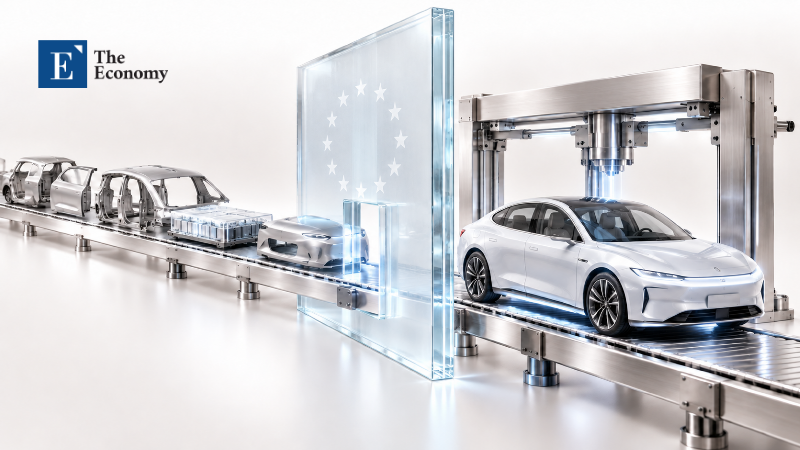
France and Germany are pursuing ways to ease the European Union’s (EU) rules for phasing out combustion-engine cars. As Chinese electric and hybrid vehicles rapidly expand their presence in Europe, the aim is to ease the transition burden on automakers within the bloc while protecting its industrial base by tightening European production and sourcing requirements. Europe is also accelerating work on additional countermeasures, including the Industrial Accelerator Act (IAA). These regulations are weighing on the European business strategies of not only Chinese manufacturers but also many other automakers based outside the EU.
France and Germany discuss easing combustion-engine car regulations
According to the Financial Times (FT) on the 13th (all dates hereafter are local time), French President Emmanuel Macron said at the Paris Motor Show on the 12th that “an agreement on EU automotive policy is imminent” and that “we are finalizing an agreement with Germany so that Europe can move forward.” In the negotiations, Germany is calling for the 2030 emissions-reduction targets for automakers to be relaxed and, in particular, is seeking to ease the EU ban on sales of new combustion-engine cars that takes effect in 2035. The central proposal is to allow combustion-engine cars to account for up to 10% of total new-car sales even after 2035. The agreement is also expected to include provisions that would not require combustion-engine vehicles to use low-carbon fuels or low-carbon materials.
Through its cooperation with Germany, France appears likely to secure support for concentrating public subsidies and procurement contracts in key technology sectors, including electric vehicles and batteries, on manufacturers within the EU. The measure is intended to strengthen Europe’s automotive supply chain and production base. An agreement between the two countries alone, however, would not change EU rules: amendments to the relevant legislation require approval from the Council, which represents EU member states, and the European Parliament. In particular, because expanding permitted sales of new combustion-engine cars would substantially weaken the EU’s existing climate-policy ambitions, considerable friction could arise during the discussions ahead.
Chinese electric vehicles expand their influence in Europe
Market observers view these European countries’ moves as a form of pushback against Chinese automakers. Over the past several years, Chinese companies have rapidly expanded their influence in Europe’s automotive market, led by electric vehicles. According to the European Automobile Manufacturers’ Association (ACEA), 20% of battery-electric vehicles sold in the EU last year were manufactured in China. Market research firm JATO Dynamics also reported that Chinese automotive brands’ European market share rose from 2.7% in the first half of 2024 to 5.1% in the first half of last year, while their sales surged 91% over the same period.
The EU has steadily erected trade barriers to curb China’s advance. Starting in 2023, it conducted an anti-subsidy investigation into Chinese-made electric vehicles for about a year. In July 2024, it imposed provisional countervailing duties on those vehicles after concluding that Chinese government subsidies had distorted competition within the bloc. This was the first large-scale trade sanction against Chinese-made electric vehicles. In October of the same year, following approval by member states, the EU finalized additional tariffs of up to 35.3%, varying by manufacturer. Specifically, countervailing duties of 17.0% were applied to BYD, 18.8% to Geely and 35.3% to SAIC, while Tesla vehicles manufactured at its Shanghai factory in China were also subject to a 7.8% tariff. These duties come on top of the existing 10% vehicle import tariff and were set to apply for five years from October 30, 2024.
Hybrid vehicle offensive also intensifies
As the EU raised its trade barriers, China pushed further into the local market by expanding sales of hybrid vehicles, which face relatively lower tariffs. According to China’s General Administration of Customs, Chinese hybrid vehicle exports to the EU’s 27 member states totaled USD 7.5 billion (approximately USD 7.72 billion) in the first half of this year, three times the USD 2.5 billion (approximately USD 2.57 billion) recorded a year earlier. That was roughly nine times the full-year 2021 export value of USD 845 million (approximately USD 869 million). The FT also reported that Chinese automakers’ share of the EU plug-in hybrid market jumped from 2% in 2024 to 25% in the first half of this year.
In response, the European Commission asked China to voluntarily reduce its hybrid vehicle exports to Europe and lower its market share, but China refused. Following further friction, the two sides recently agreed to cap imports of Chinese-made hybrid vehicles at 350,000 a year. The measure is scheduled to take effect as early as the beginning of December, with the annual allowance increasing by 6% each year. In addition, the import cap applied to China will be set no lower than the caps applied to other exporting countries.
Table 1. EU measures to counter Chinese-made vehicles
| Category | Key provisions |
|---|---|
| Battery-electric vehicles | Manufacturer-specific countervailing duties imposed on Chinese-made electric vehicles in addition to existing import tariffs |
| Hybrid vehicles | Annual cap on EU imports of Chinese-made hybrid vehicles, with the permitted volume progressively increased each year |
Tesla faces European regulations
Industry observers note that Europe’s moves to protect its domestic industries are affecting not just China but automakers based outside the bloc more broadly. A prominent example is US electric vehicle manufacturer Tesla. Tesla recently changed the name of its autonomous driving technology in Europe from “Full Self-Driving Supervised (FSD)” to “Tesla Assisted Driving.” The change followed a statement by Germany’s Federal Ministry of Transport on the 6th that the FSD name could create a misleading impression of the technology’s actual capabilities. German authorities noted that the system is not fully autonomous driving technology that handles all driving tasks, but rather a driver-assistance system that supports certain tasks, such as acceleration, braking and steering. They stressed that drivers must continuously monitor their surroundings even while the system is operating and must be able to take direct control of the vehicle immediately if necessary.
Regulatory barriers have also been evident in efforts to introduce the driver-assistance system across the EU. Tesla secured approval for its FSD system from the Netherlands Vehicle Authority (RDW) in April after approximately 18 months of safety assessments, but this does not immediately authorize commercial deployment throughout the EU. This is because new vehicle technologies that do not fully comply with existing EU safety rules must undergo a separate exemption approval process under Article 39 of the vehicle type-approval regulation (EU 2018/858). For Tesla to offer the technology throughout the EU, Dutch authorities must submit an application to the Commission for EU-wide use, followed by a vote in the relevant committee comprising member states.
Japanese automakers also on alert
Japanese automakers remain concerned about the IAA being pursued by the EU. The legislation focuses on protecting European companies’ production base and expanding demand for European-made products in response to an influx of low-priced goods from China and other countries outside the bloc. It covers major strategic industries, including automobiles, steel, cement, aluminum and batteries. In the automotive sector, proposals call for EU production and component-sourcing requirements for electric vehicles and plug-in hybrids covered by public procurement or certain subsidies and tax benefits. Under the Commission’s draft, final assembly of the relevant vehicles must, in principle, take place in the EU, and EU-sourced vehicle components, excluding batteries, must account for at least 70% of the ex-factory price. Separate EU production requirements have also been established for battery cells and key drivetrain components.
Toyota, one of Japan’s leading automakers, produced approximately 80% of the vehicles it sold in Europe last year within the European region, but that figure includes production in non-EU countries such as the United Kingdom and Türkiye. This is why Toyota Motor Europe CEO Yoshihiro Nakata called in June for key partner countries, including the United Kingdom, Japan and Türkiye, to be included in the IAA’s definition of EU-made products. Nissan faces a similar issue. According to a Guardian report in March, Nissan had reportedly warned the British government at the time that it might have to consider closing its Sunderland plant if the United Kingdom were excluded from the IAA’s definition of EU-made products. The Sunderland plant directly employs approximately 6,000 people and is the United Kingdom’s largest vehicle manufacturing facility, with capacity to produce up to 600,000 vehicles annually.
Aoife Brennan is a contributing writer for The Economy, with a focus on education, youth, and societal change. Based in Limerick, she holds a degree in political communication from Queen’s University Belfast. Aoife’s work draws connections between cultural narratives and public discourse in Europe and Asia.
Similar Post