"From Price Competition to Safety Regulations": Restructuring Pressure Mounts on China's Auto Industry as Shift to 'New Quality Productive Forces' Accelerates
"From Price Competition to Safety Regulations": Restructuring Pressure Mounts on China's Auto Industry as Shift to 'New Quality Productive Forces' Accelerates

As one of the youngest members of the team, Tyler Hansbrough is a rising star in financial journalism. His fresh perspective and analytical approach bring a modern edge to business reporting. Whether he’s covering stock market trends or dissecting corporate earnings, his sharp insights resonate with the new generation of investors.
Authored On
Modified
China sharply tightens rules on new-vehicle safety verification and quality control
Regulation-driven restructuring pressure expected to mount amid weak domestic demand and cutthroat competition
From quantitative to qualitative growth: China's 'new quality productive forces' strategy spreads across industry
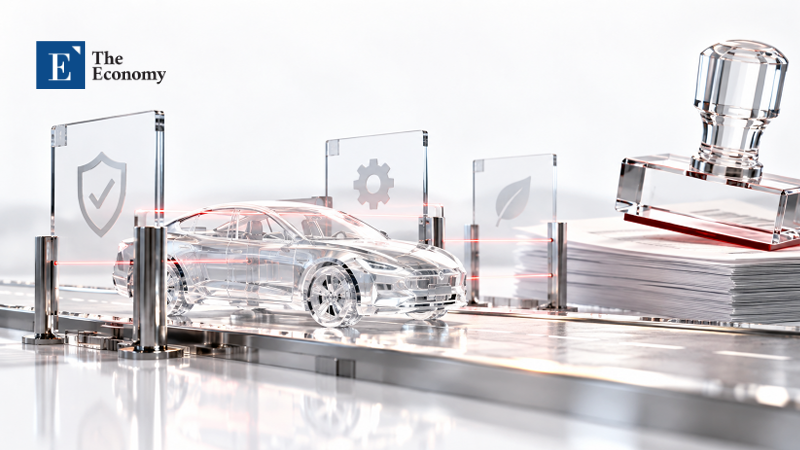
Chinese regulators are stepping up scrutiny of the quality and safety of Chinese-made electric vehicles. Repeated recalls and controversies over vehicle defects have increased the quality-control burden on manufacturers. Market observers say tighter regulations could accelerate restructuring in China's automotive industry, where slowing demand and price competition have eroded profitability. Some also see the measures as aligning with China's strategy of developing 'new quality productive forces,' which emphasizes technological innovation and quality improvements.
China Raises Regulatory Bar for Automakers
According to a report by Hong Kong's South China Morning Post (SCMP) on the 12th (all dates hereafter are local time), China's Ministry of Industry and Information Technology (MIIT) recently released a draft notice for public consultation on strengthening the management of innovative design and research-and-development testing and verification for automotive products. It was jointly prepared with the Ministry of Public Security, the Ministry of Ecology and Environment, and the State Administration for Market Regulation, among others. The proposal centers on strengthening mandatory safety verification for new vehicles and expanding review criteria for innovative designs. First, automakers must conduct at least 30,000 km of vehicle reliability testing during the type-approval process for new models. The requirement covers both new-energy vehicles, including electric vehicles, and conventional internal-combustion vehicles. Items requiring verification include overall vehicle reliability and durability, body structure, software functional stability, environmental adaptability, heating and cooling performance, and resistance to water and dust ingress and sealing performance. Manufacturers must also conduct environmental adaptability testing for at least one year.
Regulations on vehicle designs incorporating new technologies will also be tightened. Authorities plan to expand safety verification for 41 innovative design features, including yoke steering wheels, powered doors, virtual buttons, specialized seats, and in-vehicle displays. Fully flush door handles and foldable or flexible displays will be prohibited. 'Zero-gravity' seats designed to create a weightless posture, rotating seats, and similar features will require separate verification of crash safety, anti-pinch protection, and operational reliability. The new approval standards are scheduled to take effect on January 1, 2027. Manufacturers will therefore have to submit additional information on the technical characteristics of innovative designs, along with testing and verification materials, when applying for new-vehicle approval. Vehicles already approved must also have their relevant technical documentation and verification results supplemented by July 1, 2027. New models that have not undergone sufficient required testing or for which falsified verification materials have been submitted will not receive regulatory approval. Even vehicles already approved may face production suspensions and recalls if safety defects are confirmed.
Vehicle Quality Controversies Keep Recurring
The Chinese government had already announced sweeping quality and safety inspections of automakers in August. At the time, four agencies—the Ministry of Industry and Information Technology, the Ministry of Public Security, the Ministry of Ecology and Environment, and the State Administration for Market Regulation—jointly announced a 'Special Campaign to Improve Production Conformity and Quality of Road Motor Vehicle Products,' stating that they would conduct a year-long nationwide inspection drive. The inspections focus on four areas: production conformity, product reliability, durability, and testing and verification of new technologies. They are intended to check whether the specifications of mass-produced vehicles meet government approval standards and to examine everything from parts procurement and production processes to quality-control systems and the durability of key components. Other key inspection targets include testing and verification procedures for advanced driver assistance systems (ADAS) and autonomous-driving functions, as well as functional safety, cybersecurity, data security, and the retention of accident records.
The growing regulatory intervention appears to stem from recurring quality controversies in the local market. For example, according to Reuters, Tesla and eight Chinese automakers agreed in August to recall approximately 4.3 million vehicles over safety concerns that their doors might fail to open properly in emergencies. Tesla alone accounted for around 2.98 million of those vehicles, while Xiaomi, Leapmotor, and Xpeng also participated in large-scale recalls. More recently, footage of closed vehicle-performance tests released by Dongchedi, a leading automotive information platform owned by ByteDance, reignited market concerns. The footage showed the brake-pedal brackets on all three Huawei Maextro V800 electric vehicles used in an emergency braking test snapping under the load as the vehicles braked sharply from 100 km/h.
Table 1. China's Tightening Automotive Quality and Safety Regulations
| Category | Key Details |
|---|---|
| New-Vehicle Approval Standards | Mandatory driving reliability and environmental adaptability testing; stricter safety verification and documentation requirements for innovative designs |
| Mass-Production Quality Control | Comprehensive inspections covering conformity between approved specifications and actual production vehicles, parts procurement, production processes, ADAS, cybersecurity, and other areas |
| Enforcement Measures | Restrictions on approval for new vehicles with inadequate verification or falsified documentation; vehicles with safety defects subject to production suspensions and recalls |
Automakers' Profitability Plunges
Market observers say the tighter regulatory stance could significantly affect competition within the local industry. The slowdown in demand in China's automotive market has recently become protracted. According to Reuters, passenger-car sales in China totaled approximately 1.63 million units last month, down 28.1% from a year earlier. Sales of new-energy vehicles, including electric vehicles and plug-in hybrids, also fell 16.7% year on year to approximately 1.08 million units. By contrast, China's vehicle exports surged 73.2% to 923,000 units over the same period. This reflected local manufacturers pushing large volumes of production that could not be absorbed by the domestic market into overseas markets.
The problem is that cutthroat competition among manufacturers during this process has weakened overall profitability. According to Chinese financial news outlet Yicai, citing the China Passenger Car Association (CPCA), China's automotive industry generated revenue of CNY 7.0062 trillion (approximately USD 1.08e+3 billion) from January through August this year, up 2.9% from the same period a year earlier. Costs, however, rose 4% to CNY 6.237 trillion (approximately USD 963 billion), while profits plunged 16% to CNY 253.4 billion (approximately USD 39.1 billion). The profit margin declined from 4.3% in 2024 to 4.1% in 2025 and 3.6% in January–August this year. That was also well below the average profit margin of 6.6% across China's industrial subsectors over the same period.
Will Less Capable Companies Be Filtered Out?
Against this backdrop, the Chinese government's tightening of automotive safety regulations could accelerate industry restructuring. With many manufacturers already struggling to secure profitability amid chronic oversupply and price competition, stringent regulations that impose additional costs could serve as a filter. Indeed, global consulting firm AlixPartners forecast in July last year that only 15 of the 129 brands selling electric vehicles and plug-in hybrids in China would remain financially viable by 2030. That represents only about 12% of the total.
The cost burden of tighter regulations is likely to be particularly pronounced during new-vehicle development. If driving and durability tests and extreme-environment verification requirements for new-vehicle approval become more stringent, manufacturers will have to invest additional funds in testing personnel, facilities, and the operation of test vehicles. Problems discovered during verification will require design changes and retesting, potentially delaying new-model launches. These changes are expected to deal an especially severe blow to manufacturers that have reduced development costs and shortened new-vehicle development cycles by cutting testing periods. Obligations to inspect vehicles already sold for defects and conduct recalls could add further financial pressure.
'New Quality Productive Forces' Policy Gains Momentum
Some observers also see the regulatory moves as aligned with the qualitative growth strategy being pursued across Chinese industry. The Chinese government has recently focused on fostering so-called new quality productive forces—enhancing industrial competitiveness through technological innovation and productivity gains rather than relying on higher output and low-price competition. First introduced by Chinese President Xi Jinping in September 2023, the concept centers on advanced technology, high production efficiency, and quality improvements. On the 9th, the Central Committee of the Communist Party of China and the State Council also released new guidelines for developing new quality productive forces, outlining plans to curb indiscriminate investment and overproduction in high-tech industries. The aim is to prevent cutthroat competition in emerging industries, strengthen technological safety and reliability, and minimize wasted resources.
Artificial intelligence (AI) is one area where this policy direction is particularly evident. In August last year, China's State Council announced its 'AI Plus' action plan, signaling its intention to improve productivity and efficiency by integrating AI into manufacturing, science and technology, consumption, public services, and other areas. The goal is to expand AI use across six key areas by 2027 and raise the adoption rate of next-generation smart devices and AI agents to more than 70%. The financial sector is also moving to concentrate funding on advanced technology development and industrial upgrading. This year, the People's Bank of China expanded the quota for its relending program for scientific and technological innovation and technological upgrading to CNY 1.2 trillion (approximately USD 185 billion), increasing financial support for technology companies and projects to replace outdated equipment. According to materials released last month by China's State Council Information Office, bank lending associated with the program totaled CNY 1.5 trillion (approximately USD 232 billion) as of the end of April this year. In addition, the guidelines on new quality productive forces announced on the 9th included measures to support technology companies' stock listings, bond issuance, and mergers and acquisitions, and to strengthen the supply of capital needed for long-term technology development.
As one of the youngest members of the team, Tyler Hansbrough is a rising star in financial journalism. His fresh perspective and analytical approach bring a modern edge to business reporting. Whether he’s covering stock market trends or dissecting corporate earnings, his sharp insights resonate with the new generation of investors.
Similar Post