Russia Courts China for Icebreakers: Will a Market Closed to South Korea Open to China?
Russia Courts China for Icebreakers: Will a Market Closed to South Korea Open to China?

Matthew Reuter is a senior economic correspondent at The Economy, where he covers global financial markets, emerging technologies, and cross-border trade dynamics. With over a decade of experience reporting from major financial hubs—including London, New York, and Hong Kong—Matthew has developed a reputation for breaking complex economic stories into sharp, accessible narratives. Before joining The Economy, he worked at a leading European financial daily, where his investigative reporting on post-crisis banking reforms earned him recognition from the European Press Association. A graduate of the London School of Economics, Matthew holds dual degrees in economics and international relations. He is particularly interested in how data science and AI are reshaping market analysis and policymaking, often blending quantitative insights into his articles. Outside journalism, Matthew frequently moderates panels at global finance summits and guest lectures on financial journalism at top universities.
Authored On
Modified
Western sanctions disrupt technology and equipment supplies to Russian shipbuilding
Joint construction with China discussed to secure vessels for the Northern Sea Route
A new competitive factor for South Korean shipbuilders hoping to reenter the market after the war
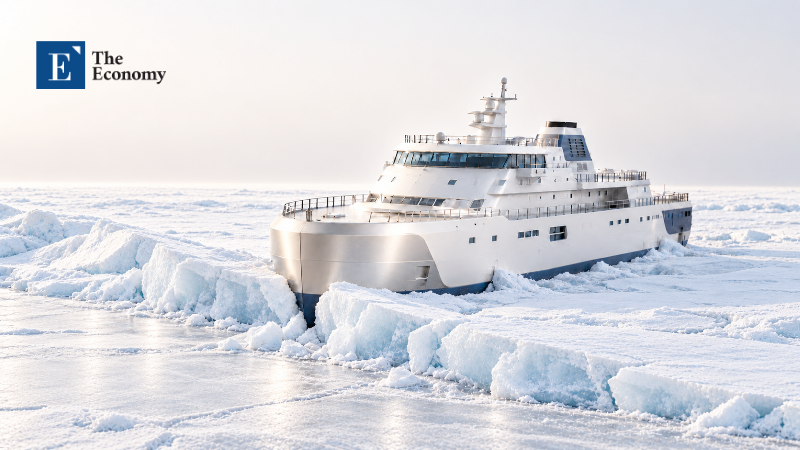
Russia is pursuing plans to jointly build vessels for the Northern Sea Route with China and introduce Chinese technology and equipment at Russian shipyards. With Western sanctions having halted cooperation with South Korean shipbuilders, Moscow is seeking to bring in China as a new shipbuilding partner. China, meanwhile, is gaining polar navigation experience and working with Russia to secure fleets for the Northern Sea Route, pointing to closer shipbuilding cooperation between the two countries.
Russia Explores Chinese Participation in Joint Construction of Arctic Ice-Class Vessels
According to the South China Morning Post (SCMP) on the 12th (all dates local), Nikolai Patrushev, an aide to the Russian president and chairman of Russia's Maritime Board, visited Shanghai Waigaoqiao Shipbuilding on the 8th to discuss cooperation between the two countries' shipbuilders with its management. The shipyard, part of the state-owned China State Shipbuilding Corporation (CSSC), is one of China's major large-vessel construction hubs. Patrushev proposed jointly building several ice-class vessels for Arctic operations with China at Russian shipyards. The proposed vessels included ships for China's Arctic maritime transport, and the possibility of China establishing its own ice-class merchant fleet was also raised. Introducing Russia's planned Trans-Arctic Transport Corridor project, he mentioned the possibility of jointly building Chinese vessels to use the route.
Cooperation in design and research was also discussed alongside joint shipbuilding. In his meeting with Waigaoqiao management, Patrushev examined the possibility of technical exchanges between Chinese shipyards' design departments and Russian shipbuilders' design bureaus. The proposal envisioned sharing the engineering capabilities of the two countries' design organizations and also included cooperation through Russian shipbuilding research institutes. In subsequent talks in Beijing with Ke Jixin, China's vice minister of industry and information technology, discussions covered Chinese companies participating as technology partners and equipment suppliers at new Russian shipbuilding facilities. The two sides reportedly also considered scientific and technological cooperation in shipbuilding, joint basic and applied marine research, and the introduction of advanced information technology into ship construction.
Russia Seeks to Secure 17 Icebreakers for the Northern Sea Route by 2030
Alongside its cooperation talks with China, Russia is accelerating the expansion of its own icebreaker fleet for the Northern Sea Route. State-owned nuclear company Rosatom has outlined plans to increase the number of icebreakers supporting navigation along the route to 17 by 2030. Construction is also underway: in August, two RITM-USD 0.15 reactors were installed aboard the nuclear-powered icebreaker Leningrad, being built at the Baltic Shipyard. The Leningrad is part of Project 22220, Russia's next-generation nuclear icebreaker construction program. Measuring 173 meters long and 34 meters wide, it is designed to navigate through ice up to 3 meters thick. Four vessels of the same class—the Arktika, Sibir, Ural and Yakutia—are already escorting cargo ships along the Northern Sea Route. They will be joined by the giant nuclear-powered icebreaker Rossiya, which is under construction with a target commissioning date of 2030. Powered by two reactors delivering a combined propulsion output of 120 megawatts (MW), the Rossiya is designed to break through ice up to 4.3 meters thick and clear a channel 50 meters wide.
The shipping lanes cleared by these icebreakers serve as export routes for Russian energy. According to an analysis released last month by the U.S.-based Center for Strategic and International Studies (CSIS), Russia's cumulative seaborne crude oil exports from the Arctic since February 2022 were estimated at USD 18.8 billion (approximately USD 19.4 billion). Ice-class tankers load cargo at Arctic crude oil terminals and take it to floating storage and offloading facilities (FSOs), where conventional tankers receive it for transport to international markets. During this period, volumes passing through two storage vessels, the Umba and Kola, accounted for approximately 53% of Russia's Arctic seaborne crude exports. Including a nearby ship-to-ship transfer anchorage in Murmansk, the three hubs handled 77% of those exports, worth USD 14.5 billion (approximately USD 15.0 billion). Nuclear-powered icebreakers open ice-blocked routes and support tanker passage in this process. CSIS researchers identified 110 instances since February 2022 in which sanctioned tankers belonging to the “shadow fleet” received escorts from Russian nuclear-powered icebreakers for at least six hours.
Table 1. Expansion of Russia's Arctic Icebreaker Fleet and Support for Crude Oil Exports
| Category | Scale and Specifications | Key Details |
|---|---|---|
| Icebreaker fleet expansion | 17 vessels by 2030 | Rosatom plans to expand the icebreaker fleet supporting navigation along the Northern Sea Route |
| Leningrad | Length: 173 m; width: 34 m Maximum icebreaking thickness: 3 m | Project 22220 nuclear-powered icebreaker Two RITM-USD 0.15 reactors installed in August |
| Same-class vessels in operation | Four vessels: Arktika, Sibir, Ural and Yakutia | Escorting cargo ships along the Northern Sea Route |
| Rossiya | Propulsion output: 120 MW Maximum icebreaking thickness: 4.3 m Cleared channel width: 50 m | Giant icebreaker equipped with two nuclear reactors Target commissioning: 2030 |
| Arctic crude oil exports | Cumulative export value: USD 18.8 billion | Total since February 2022 Ice-class tankers → storage and offloading facilities → conventional tankers → international markets |
| Major transshipment hubs | Three hubs handle 77% of exports Export value: USD 14.5 billion | Storage vessels Umba and Kola handle 53% 77% including the Murmansk ship-to-ship transfer anchorage |
| Shadow fleet escorts | 110 instances of escorts lasting at least six hours | CSIS identified instances of Russian nuclear-powered icebreakers escorting sanctioned tankers since February 2022 |
China Expands Arctic Exploration with Domestically Built Icebreakers
As it pursues cooperation with Russia on the Northern Sea Route, China is also gaining polar navigation experience using domestically built icebreakers. A leading example is the Xuelong 2, delivered by Shanghai's Jiangnan Shipyard in 2019. China's first domestically built polar icebreaker was jointly designed by the CSSC-affiliated Marine Design and Research Institute of China and Finland's Aker Arctic, and is operated by the Polar Research Institute of China. In 2023, the Xuelong 2 took part in China's 13th Arctic Ocean scientific expedition, sailing more than 15,500 nautical miles over 78 days and conducting research around the North Pole. In July 2024, it departed Qingdao, entered the Arctic Ocean via the Bering Sea and sailed to Murmansk in northwestern Russia. That same summer, the Jidi and Zhongshan Daxue Jidi also headed to the Arctic, with China deploying three vessels simultaneously for polar research. While the Xuelong 2 crossed the Arctic Ocean and called at a Russian port, the other vessels continued navigation and exploration in surrounding waters, including the Chukchi Sea.
As more vessels were subsequently deployed, survey areas and missions also diversified. In August last year, the U.S. Coast Guard identified five Chinese research vessels in Arctic waters near Alaska—the Xuelong 2, Jidi, Zhongshan Daxue Jidi, Shenhai 1 and Tansuo 3—indicating that icebreakers and deep-sea research vessels were operating together. Four vessels—the Xuelong, Xuelong 2, Jidi and Tansuo 3—also participated in the 16th Arctic Ocean expedition organized by China's Ministry of Natural Resources this year. Among them, the Xuelong and Xuelong 2 returned to Shanghai on the 30th of last month after conducting marine environmental surveys in the Chukchi Plateau, the Canada Basin and the central Arctic Ocean. The expedition also included field tests of Chinese-developed unmanned ice observation stations and ocean observation buoys.
China Expands Export Routes to Europe via the Northern Sea Route
Alongside exploration in Arctic waters, commercial shipments carrying cargo from China to Europe have also taken place. The container ship Istanbul Bridge departed China's Ningbo port on September 23 last year and arrived at Felixstowe in the United Kingdom on October 13, completing the journey via the Northern Sea Route in 20 days. Carrying approximately 25,000 tonnes of cargo, the ship primarily transported lithium-ion batteries and solar-related products. It entered the Northern Sea Route on October 1 that year and followed Russia's northern coast toward Europe. According to Captain Zhong Desheng, preparations for the voyage began three years before departure. The day after the vessel arrived in the United Kingdom, the China-Russia subcommittee on Northern Sea Route cooperation met and approved an action plan covering logistics and technical cooperation as well as infrastructure development.
Having begun commercial transport along the Northern Sea Route, China is also pursuing the development of a nuclear-powered icebreaker capable of carrying both cargo and passengers. In December last year, a ship design research institute under CSSC unveiled a concept design for a multipurpose icebreaker intended for seasonal cargo transport and polar tourism. Approximately 165 meters long and 30 meters wide, with a displacement of about 30,000 tonnes, the proposed vessel would accommodate up to 250 people and 300 standard 20-foot containers. Its cargo hold is designed to allow loading space to be adjusted for large and nonstandard cargo, while its target icebreaking capability is to pass through ice 2.5 meters thick at 3.7 kilometers per hour. The plan calls for a molten salt reactor as the power source, combined with supercritical carbon dioxide power generation technology. The concept design received approval in principle (AiP) from Italian classification society RINA. The approval process examined the hull's resistance to ice loads, icebreaking performance and the feasibility of implementing the propulsion system in polar conditions.
China Could Gain a Head Start in Russia's Icebreaking Merchant Ship Market
The icebreaking merchant ship sector in which Russia has requested Chinese cooperation is a market that South Korean shipbuilders entered early, building up a track record of deliveries. Samsung Heavy Industries won orders for three icebreaking oil tankers from Russia's state-owned shipping company Sovcomflot in 2005, while Daewoo Shipbuilding & Marine Engineering, the predecessor of Hanwha Ocean, delivered 15 icebreaking LNG carriers by 2019. Projects to supply ship blocks and equipment to Russian shipyards followed, but the war in Ukraine and sanctions against Russia put the brakes on contract execution. The Zvezda Shipyard-related orders whose cancellation Samsung Heavy Industries disclosed in June last year covered 10 icebreaking LNG carriers and seven shuttle tankers, totaling USD 3.73 billion. For South Korean shipbuilders, this is a sector in which they could pursue orders again, drawing on their construction track records and local cooperation experience, if sanctions ease after the war.
Against this backdrop, China's entry into Russian shipbuilding could complicate South Korean companies' plans to resume business. China is emerging as a strong candidate to secure new orders in the Russian market, where South Korean shipbuilders are waiting to restart operations. Energy intelligence company Kpler assessed on the 9th that Chinese shipyards would be the most likely suppliers if Russia placed overseas orders for Arc7-class icebreaking LNG carriers. Companies from the two countries have already launched joint projects to secure vessels for the Northern Sea Route. China's NewNew Shipping and Russia's Rosatom established a joint venture in China in late 2024, and announced last month that they were pursuing plans to build five 4,800-TEU Arc7 ice-class container ships. With the Russian government also asking Chinese shipbuilders to jointly construct vessels and supply technology and equipment for new shipbuilding facilities, cooperation talks are extending into production. As corporate fleet acquisition projects intersect with government-level shipbuilding cooperation, the prospect of China securing Russia's new orders first is growing.
Matthew Reuter is a senior economic correspondent at The Economy, where he covers global financial markets, emerging technologies, and cross-border trade dynamics. With over a decade of experience reporting from major financial hubs—including London, New York, and Hong Kong—Matthew has developed a reputation for breaking complex economic stories into sharp, accessible narratives. Before joining The Economy, he worked at a leading European financial daily, where his investigative reporting on post-crisis banking reforms earned him recognition from the European Press Association. A graduate of the London School of Economics, Matthew holds dual degrees in economics and international relations. He is particularly interested in how data science and AI are reshaping market analysis and policymaking, often blending quantitative insights into his articles. Outside journalism, Matthew frequently moderates panels at global finance summits and guest lectures on financial journalism at top universities.
Similar Post