China Builds Self-Reliant Nuclear Ecosystem Despite U.S. Sanctions, Sets Sights on Energy Dominance by 2030

Anne-Marie Nicholson is a fearless reporter covering international markets and global economic shifts. With a background in international relations, she provides a nuanced perspective on trade policies, foreign investments, and macroeconomic developments. Quick-witted and always on the move, she delivers hard-hitting stories that connect the dots in an ever-changing global economy.
Authored On
Modified
Energy security strategy aimed at simultaneously strengthening advanced manufacturing competitiveness
Standardization and localization of nuclear technology maximize cost competitiveness and construction efficiency
Can China reshape the global balance of power despite U.S. supply chain restrictions?
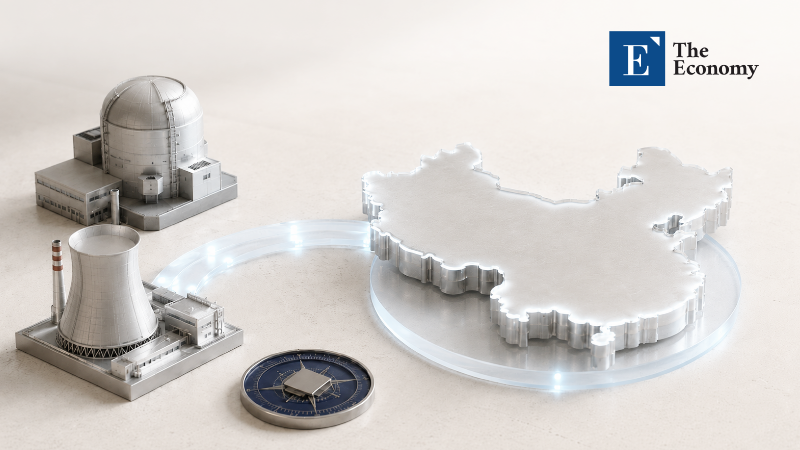
China has officially unveiled an ambitious energy transition blueprint aimed at increasing the share of non-fossil electricity generation to 50% by 2030. The plan calls for expanding renewable energy while establishing nuclear power as the country's primary baseload energy source to strengthen both energy security and advanced industrial competitiveness. As Beijing accelerates efforts to become the world's largest nuclear power producer by building an independent nuclear ecosystem despite U.S. technology restrictions, global competition for leadership in the nuclear industry is entering a new phase.
15th Five-Year Energy Security Plan Unveiled, Nuclear Power Underpins Clean Electricity Transition
According to Sina Finance and United Daily News on June 29, China's National Development and Reform Commission (NDRC) and National Energy Administration (NEA) released the 15th Five-Year Plan (2026–2030) for Building a New Energy System on June 25, outlining plans to establish a fundamentally clean, low-carbon, secure, and highly efficient energy system by 2030. Under the plan, China aims to expand its total energy production capacity to the equivalent of 5.8 billion metric tons of standard coal by 2030 while comprehensively strengthening the complementary functions, stability, and resilience of the power system. The government also intends to diversify energy import sources to enhance long-term supply security.
The plan further calls for coal and oil consumption to peak by 2030 while increasing the share of non-fossil fuels in total energy consumption to 25%. Electricity generated from non-fossil energy sources will rise from the 2025 target of 42.3% to 50% by 2030. Wind and solar power installations will also account for more than 50% of total power generation capacity by 2030, up from 47% at the end of 2025, establishing renewables as the backbone of China's electricity infrastructure.
As both the world's largest renewable energy producer and the largest carbon emitter, China has also introduced a binding target to reduce carbon emissions per unit of electricity generated by more than 10% over the next five years. To accelerate renewable deployment, Beijing will actively promote geothermal energy, hydrogen, and low-carbon fuels while doubling the use of new energy sources beyond electricity generation. Construction of integrated hydro, wind, and solar power complexes along major river basins will also be accelerated. Conventional hydropower capacity will increase to 410 gigawatts (GW) by 2030, while nuclear generation capacity will expand to 110GW.
China will also reinforce grid stability to support expanding renewable generation. The country's target for new energy storage systems (ESS), excluding pumped-storage hydropower, will increase from 180GW by 2027 to 300GW by 2030. Pumped-storage hydropower capacity will reach 160GW, while thermal power plants will increasingly serve as flexible balancing resources. Beijing also plans to expand virtual power plants (VPPs) and vehicle-to-grid (V2G) infrastructure. By 2030, virtual power plants are expected to provide more than 50GW of grid-balancing capability, while adjustable EV charging capacity will also reach 50GW.
China further plans to secure exclusive control over 110GW of nuclear generation capacity by 2030 by concentrating resources on proven Generation III pressurized water reactor technology. New nuclear construction will primarily rely on the Hualong One and CAP1000 reactor families. Repeated deployment of standardized reactor designs enables regulatory approval, equipment procurement, construction, and workforce training to be standardized while reducing maintenance costs through common components. Most newly approved Chinese nuclear projects already utilize these Generation III reactor designs. Although China continues research on next-generation fast neutron reactors and small modular reactors (SMRs), achieving the 2030 target will primarily depend on commercially proven large-scale pressurized water reactors. The strategy is widely viewed as simultaneously expanding generation capacity while maximizing supply chain efficiency.
China Expected to Surpass U.S. Nuclear Capacity by 2032
China's confidence in achieving its 2030 targets is underpinned by years of aggressive investment and construction across its nuclear sector. The International Atomic Energy Agency (IAEA) and BloombergNEF (BNEF) project that, given the scale of reactors currently under construction and the pace of new project approvals, China is highly likely to become the world's largest producer of nuclear electricity around 2030. Bloomberg further forecasts that China will surpass France in installed nuclear capacity next year to become the world's second-largest nuclear power producer before overtaking the United States in 2032. Installed nuclear generating capacity is projected to shift from last year's rankings of the United States (97GW), France (63GW), and China (56GW), to the United States (99GW), China (71GW), and France (63GW) next year, before reaching China (102GW), the United States (101GW), and France (63GW) in 2032.
The United States, once the global leader in nuclear energy, has significantly slowed nuclear expansion since the 1979 Three Mile Island accident. The country's 94 operating reactors now average 44 years in age. According to the U.S. Energy Information Administration (EIA), only three new reactors have entered commercial operation since 1996. President Donald Trump has proposed quadrupling U.S. nuclear generating capacity to 400GW by 2050, but analysts generally believe sustained expansion will be difficult given enormous costs and regulatory hurdles.
China, by contrast, continues constructing roughly 10 reactors annually, supported by state financing, an integrated domestic supply chain, and uninterrupted construction experience. China's nuclear construction costs are also less than one-fifth those of the United States and Europe. By simplifying its construction framework around a limited number of standardized reactor models, China can build advanced-generation reactors for approximately $2 to $3 per watt, far below the roughly $15 per watt typically seen in the United States. Constructing a single 1.4GW nuclear reactor costs approximately $3 billion to $4 billion in China, compared with roughly $20 billion in the United States. The Vogtle nuclear project in Georgia, which entered commercial operation in 2024, ultimately cost approximately $35 billion.
China has dramatically reduced construction costs through standardized reactor designs, localization of reactor manufacturing, mass construction, and vertically integrated supply chains. Hualong One, China's flagship reactor design, was developed domestically and is now being produced on a large scale. Extensive construction experience combined with localization of nearly all components—from critical systems to general-purpose equipment—has further strengthened China's cost competitiveness. Another major advantage is the availability of project financing through state-owned banks. China currently has 33 reactors under construction, while a separate program worth approximately $27 billion was approved in March last year to support construction of 10 additional reactors.

The Paradox of U.S. Nuclear Technology Sanctions Against China
Perhaps most striking is that China's nuclear expansion has occurred despite shrinking technology cooperation and increasingly restrictive U.S. export controls. The U.S. Department of Commerce placed China General Nuclear Power Group (CGN) on the Entity List in 2019 and suspended export licenses last year for American companies supplying parts and equipment to Chinese nuclear operators. As nuclear equipment and operational components were added to export restrictions, Washington expanded its pressure from blocking technology transfers to controlling broader supply chains.
Yet U.S. restrictions have failed to significantly derail China's nuclear expansion strategy. Since the 2000s, China has accumulated extensive experience in reactor design, construction, and operations through technology transfers involving Westinghouse's AP1000 reactors as well as French and Russian nuclear technologies. Beijing subsequently established a domestically centered construction system built around Hualong One. In effect, China transformed expertise acquired through early foreign technology transfers into indigenous reactor designs and localized equipment supply chains, steadily reducing dependence on overseas technology.
Indeed, U.S. sanctions have arguably accelerated China's pursuit of nuclear self-sufficiency. Following Washington's suspension of export licenses for nuclear equipment, Beijing gained additional policy momentum to localize critical components and develop alternative procurement networks. As U.S. restrictions expanded, China increasingly reclassified the nuclear supply chain as a strategic industrial sector. Nuclear equipment manufacturing encompasses advanced industrial capabilities ranging from high-strength specialty steel and precision casting to heavy forgings, instrumentation and control systems, nuclear-grade valves, and safety pumps. Rather than treating these industries merely as extensions of energy policy, China has integrated them into its broader advanced manufacturing strategy. As domestic nuclear equipment manufacturers accumulate production experience, spillover benefits are expected to extend into shipbuilding, aerospace, defense, and high-pressure industrial equipment manufacturing.
China is also increasing self-sufficiency across the nuclear fuel supply chain in addition to reactor construction and heavy equipment manufacturing. In 2022, China North Nuclear Fuel Co., a subsidiary of China National Nuclear Corporation (CNNC), produced a simulated AP1000 nuclear fuel assembly using exclusively Chinese-made components. The achievement followed years of gradually internalizing manufacturing processes and key component production after signing an AP1000 nuclear fuel manufacturing technology transfer agreement in 2011. Even within a nuclear ecosystem originally based on U.S. technology, China has effectively established an independent domestic nuclear fuel supply chain.
Strengthening cooperation with Russia has also helped offset gaps created by U.S. restrictions. Russia's state nuclear corporation Rosatom has participated in construction of the Tianwan Nuclear Power Plant and China's experimental fast reactor program, while Russian-designed VVER-1200 reactors will be installed at Units 3 and 4 of the Xudapu Nuclear Power Plant. Russia's role in nuclear fuel supply is also expanding. Earlier this year, TVEL, Rosatom's nuclear fuel subsidiary, delivered the initial fuel load for the VVER-1200 reactor at Tianwan Unit 7, followed by the first delivery of initial fuel for Xudapu Unit 3. TVEL is also reportedly planning additional deliveries of initial fuel for other VVER-1200 reactors at both Tianwan and Xudapu later this year.
Anne-Marie Nicholson is a fearless reporter covering international markets and global economic shifts. With a background in international relations, she provides a nuanced perspective on trade policies, foreign investments, and macroeconomic developments. Quick-witted and always on the move, she delivers hard-hitting stories that connect the dots in an ever-changing global economy.
- Previous “Blocking Chinese Steel Origin Laundering” Korea Unveils Molten Steel Origin Verification, but Overlapping Southeast Asian Production Networks Pose Challenge
- Next "Germany Joins Opposition" EU Methane Rules Hit a Snag as Restrictions Threaten Domestic Gas Development, Undermining Bloc's Standing as a Climate Leader
Similar Post