"Strengthening Pricing Leverage" Apple Explores Sourcing Chinese Memory Chips, Unlikely to Shift in the Near Term but Industry Dynamics Could Still Change

As one of the youngest members of the team, Tyler Hansbrough is a rising star in financial journalism. His fresh perspective and analytical approach bring a modern edge to business reporting. Whether he’s covering stock market trends or dissecting corporate earnings, his sharp insights resonate with the new generation of investors.
Authored On
Modified
Apple Lobbies to Secure Approval for Adopting China's CXMT Memory Chips
Apple's Traditional Cost-Reduction Strategy Loses Effectiveness Amid the Memory Supercycle
China's Semiconductor Industry Closes the Gap with Technology, Production Capacity, and Government Support

Apple is reportedly giving serious consideration to purchasing Chinese-made memory chips. With the AI-driven memory supercycle continuing to create a supplier-dominated market, the company is seeking to strengthen its negotiating leverage by raising the prospect of working with China's ChangXin Memory Technologies (CXMT). Market observers believe the likelihood of Apple adopting CXMT chips in the near term remains low, but they do not rule out the possibility that the competitive landscape could shift if China's semiconductor industry continues its rapid pace of development.
Possibility of Apple Purchasing CXMT Chips
The Financial Times (FT) reported on June 26 (local time) that Apple has been lobbying officials within the Donald Trump administration, including the U.S. Department of Commerce, to approve purchases of Chinese-made memory chips. The Chinese company attracting Apple's interest is reportedly CXMT, which has been included on the U.S. government's Chinese Military Companies (1260H) blacklist. Although the 1260H list is not legally binding, U.S. companies that conduct business with firms on the list may face reputational risks. Apple's lobbying effort is therefore aimed at securing official approval from the U.S. government and legitimizing such imports.
The prolonged global memory shortage is widely viewed as the primary reason Apple has turned its attention to Chinese memory products. While Apple is regarded as one of the world's most sophisticated supply chain operators, it has not been immune to the recent surge in memory prices and tightening supply. On June 25, the company raised MacBook prices by $100 to $300 and iPad prices by $100 to $200, explaining that component costs had risen sharply because demand for memory and storage devices had surged abnormally as AI data center expansion accelerated. Apple CEO Tim Cook had previously described soaring component prices, including memory, as "a once-in-a-century flood," warning that price increases would be unavoidable.
FT nevertheless noted that the success of Apple's plan remains uncertain. Even if the administration were to accept Apple's lobbying efforts, the proposal could still encounter significant resistance in Congress. John Moolenaar (R-Mich.), chairman of the House Select Committee on China, criticized the move, saying, "Apple partnering with a Chinese military company would be a grave mistake," adding that it could help the Chinese Communist Party gain control over critical supply chains. Secretary of State Marco Rubio also voiced strong opposition in 2022 while serving as a U.S. senator, when Apple was considering adopting memory chips from China's YMTC, calling the move "playing with fire."
AI Boom Weakens Apple's Cost Advantage
Some market participants believe Apple's consideration of CXMT chips is primarily intended to strengthen its negotiating position with the three dominant memory suppliers—Samsung Electronics, SK hynix, and Micron. With AI-driven memory demand showing little sign of slowing, Apple is believed to be deliberately introducing the possibility of a Chinese alternative to pressure its existing suppliers. At present, bargaining power in the memory market has shifted decisively toward suppliers. Samsung Electronics and SK hynix are prioritizing production capacity for high-margin AI server products, leaving supplies of commodity DRAM for PCs and smartphones increasingly constrained.
This environment inevitably undermines Apple's traditional cost competitiveness. Apple has historically maintained profitability by leveraging its enormous purchasing power to negotiate lower component prices. The company has established itself as a critical revenue source for suppliers by generating industry-leading sales volumes across product lines including the iPhone, MacBook, and iPad. Apple has long used this position to exert significant pricing pressure on suppliers of memory and other key components, enabling it either to absorb higher manufacturing costs internally or preserve its industry-leading profit margins.
Some analysts, however, warn that the CXMT option could ultimately backfire on Apple. Damaging relationships with the three leading memory suppliers at the current stage of the market would represent a significant strategic risk. Industry sources indicate that the combined output of the three major memory manufacturers currently satisfies only about 60% to 70% of market demand, while supply has become even more imbalanced as major technology companies such as Nvidia secure long-term supply agreements (LTAs). Under such circumstances, if Apple were to move forward with a strategy of incorporating Chinese memory chips, the three dominant suppliers would likely respond strategically. With a long queue of global customers ready to replace Apple, they could readily adjust supply priorities for products such as high-bandwidth memory (HBM) and enterprise solid-state drives (eSSDs).
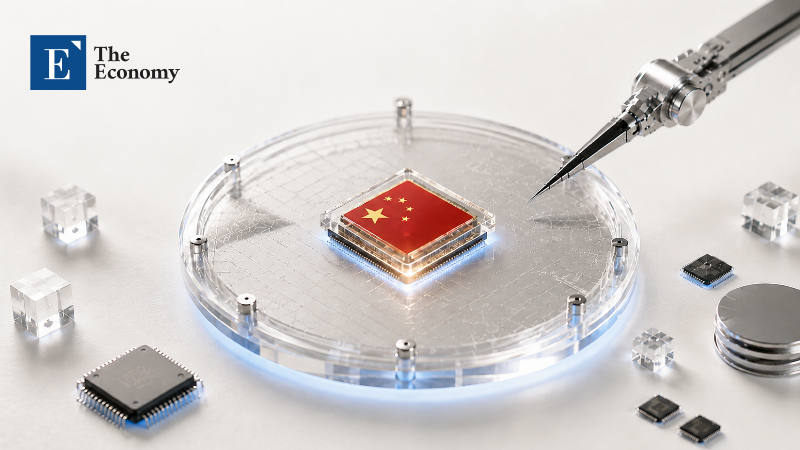
China's Semiconductor Industry Accelerates Rapidly
Nevertheless, the possibility that China's semiconductor industry could reshape the competitive landscape cannot be dismissed. CXMT was once viewed as a latecomer focused primarily on DDR4 products, but it has recently narrowed the technology gap rapidly through next-generation commodity DRAM offerings such as DDR5 and LPDDR5X. According to the company's published specifications, its DDR5 products support transfer speeds of up to 8,000 megabits per second (Mbps), while its LPDDR5X mobile products achieve speeds of up to 10,667 Mbps. These figures suggest that Chinese DRAM manufacturers are no longer confined to low-end, low-cost products and are increasingly emerging as viable alternatives in the PC, smartphone, and mainstream server memory markets.
The pace of production expansion is also becoming difficult to ignore. Market research firm Omdia projects that CXMT's DRAM production capacity will increase by 68% this year compared with last year, while some research institutions estimate monthly wafer input could expand to as many as 280,000 to 300,000 wafers. That would represent nearly half the production capacity of Samsung Electronics or SK hynix. Another research firm, TrendForce, has also estimated that CXMT raised its DDR5 manufacturing yield to approximately 80% last year, indicating that the company has already established a stable production foundation for the latest generation of mainstream memory products.
Adding further momentum is the Chinese government's extensive support. CXMT is one of the principal beneficiaries of Beijing's national semiconductor self-sufficiency strategy, receiving sustained financial assistance and policy backing despite successive rounds of U.S. sanctions. As Western nations, led by the United States, continue tightening semiconductor export restrictions, fostering the growth of leading domestic DRAM producers such as CXMT has become a national strategic priority. As a result, resources devoted to CXMT's development of advanced memory technologies are expected to continue increasing, allowing the company to gradually expand its presence, beginning with the mainstream DDR5 market for servers and PCs.
As one of the youngest members of the team, Tyler Hansbrough is a rising star in financial journalism. His fresh perspective and analytical approach bring a modern edge to business reporting. Whether he’s covering stock market trends or dissecting corporate earnings, his sharp insights resonate with the new generation of investors.
- Previous "Germany Joins Opposition" EU Methane Rules Hit a Snag as Restrictions Threaten Domestic Gas Development, Undermining Bloc's Standing as a Climate Leader
- Next “Even End-of-Life Batteries Under State Oversight” China Tightens Enforcement to Bring the Entire Battery Lifecycle Under Government Control and Cement Dominance in Recycling
Similar Post