Two Decades of State Support Cement China’s EV Supremacy, Battery Makers Capture Majority Share

Anne-Marie Nicholson is a fearless reporter covering international markets and global economic shifts. With a background in international relations, she provides a nuanced perspective on trade policies, foreign investments, and macroeconomic developments. Quick-witted and always on the move, she delivers hard-hitting stories that connect the dots in an ever-changing global economy.
Authored On
Modified
Six Chinese groups among top 10, with 62.3% global market share
Two decades of policy support and early control of critical-mineral and battery supply chains
Mass-production cost advantages accelerate sales offensive across Europe and emerging markets
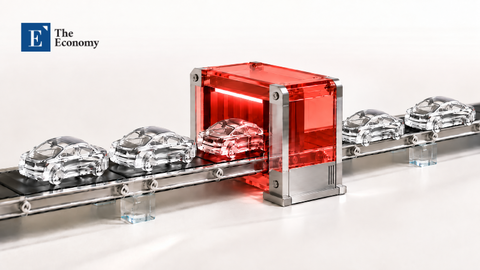
Chinese electric vehicle manufacturers are rapidly expanding their presence across Europe and emerging markets, reshaping the global automotive industry. Prolonged government support and control over critical-mineral and battery supply chains have bolstered their price competitiveness and supply capabilities. As the Chinese government moves to directly regulate price wars and capacity expansion, an oligopolistic structure dominated by market leaders is spreading across both the finished-vehicle and battery markets.
Six Chinese Groups in Top 10, Led by No. 1 BYD and No. 2 Geely
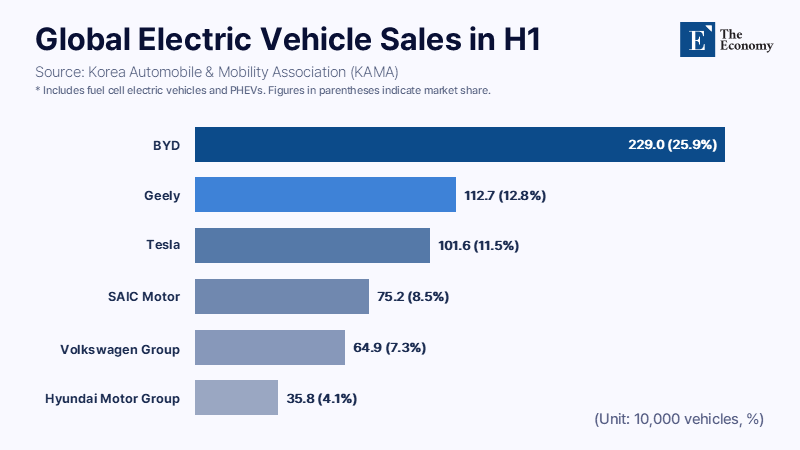
According to the Korea Automobile & Mobility Association’s (KAMA) “Global Electrified Vehicle Sales in the First Half of 2026,” released on the 16th, six of the world’s 10 largest electrified-vehicle groups by sales in the first half were Chinese. They were BYD, Geely, SAIC Motor, Chery, Leapmotor and Changan. Their combined sales rose 11.6% year over year to 5,504,386 vehicles. Their global market share increased from 57.2% to 62.3% over the same period. Electrified vehicles include battery electric vehicles, plug-in hybrid electric vehicles (PHEVs) and hydrogen fuel-cell electric vehicles.
The growth of Chinese manufacturers was particularly pronounced in Europe. Chinese brands sold 532,000 vehicles in Europe, up 90.6% from the same period last year. Their market share also climbed from 15.6% to 22.3%. Although the European Union (EU) imposed additional tariffs on Chinese electric vehicles to offset the effects of government subsidies, the gains appear to have been driven by Chinese manufacturers’ price competitiveness, multi-brand strategies, expanded exports and localization, and robust sales of PHEVs.
Chinese electric vehicle brands also accounted for more than half of the market in emerging economies. The electrified-vehicle market across emerging economies—including India, the Association of Southeast Asian Nations (ASEAN), Latin America, the Middle East and Africa—expanded 85.3% year over year to 1.08 million vehicles. Chinese manufacturers sold 599,000 vehicles in these markets, accounting for 55.4% of total sales. Their sales across emerging economies surged 103.8% from the same period last year.
Their market-entry strategies were equally diverse. Geely segmented demand by vehicle class through brands including Zeekr, Volvo and Polestar, while SAIC increased exports by foregrounding its PHEV models. Chery expanded supply by bringing overseas production bases online. BYD is building its first European passenger-car plant in Hungary and has established a regional headquarters that integrates production, research and development (R&D), and sales functions locally. Leapmotor has secured approximately 850 sales and service locations across Europe through its joint venture with Stellantis and is also pursuing local production in Spain. Changan has designated its Rayong plant in Thailand as a Southeast Asian production and export hub, expanding its distribution network to 18 countries, including Indonesia, Singapore and Australia. The strategy is designed to capture overseas demand by diversifying brands, vehicle models and production locations.
All-Out Export Offensive After Dominating Domestic Market
Experts broadly agree that Chinese manufacturers have already seized control of the global market for affordable electric vehicles. Chinese companies’ domestic market share surpassed that of global manufacturers in 2023 and reached 69.5% last year. Their export performance has also continued to strengthen. China exported more than 5.7 million vehicles last year, overtaking Japan to become the world’s largest automobile exporter.
Chinese manufacturers began exporting electric vehicles overseas in 2021, and roughly five years later, Europe is confronting the threat posed by Chinese-made EVs with growing alarm. Some forecasts suggest that Chinese vehicles could account for 30% of the European market by around 2030. Volkswagen, BMW and Mercedes-Benz of Germany—the birthplace of the modern automobile—are struggling in China, once their largest market, and have begun closing domestic plants and implementing restructuring measures. Volkswagen has recently even faced speculation over the possibility of bankruptcy.
State-Built Electric Vehicle Supremacy
The rise of Chinese manufacturers originated with Beijing’s two-decade drive to establish China as an electric vehicle powerhouse. According to the International Energy Agency (IEA), China designated electric vehicles as a strategic industry in its national industrial plan in 2001 and launched the “Ten Cities, Thousand Vehicles” program in 2009, using government funds to purchase buses, taxis and official vehicles and thereby create an initial market. Purchase subsidies, exemptions from vehicle purchase taxes, low-interest financing, investment in charging infrastructure, and land and electricity support from local governments followed. The US-based Center for Strategic and International Studies (CSIS) estimates that the Chinese government provided at least $230.8 billion in support to the electric vehicle industry between 2009 and 2023. Of that total, $45.2 billion was disbursed in 2023 alone.
The policy mobilization extended seamlessly from central government ministries to local governments and state-owned financial institutions. According to research published in July by the international academic journal Scientific Reports, China’s central, provincial and municipal governments issued approximately 7,300 electric vehicle-related policy documents from the early 2000s through 2023. The central government pressured automakers to produce electric vehicles through production and sales targets and the dual-credit regulation, while local governments simultaneously stimulated supply and demand through preferential license-plate policies, purchase subsidies and industrial-park development. Vehicle purchase-tax reductions have been extended three times since their introduction in 2014, with additional tax relief for 2024–2027 alone estimated at $72.3 billion. From this year through 2027, China is also maintaining tax benefits of up to $2,100 per passenger vehicle by cutting the purchase tax on new-energy vehicles by half.
Control of Critical Minerals and Regulation of Price War
China’s early control of critical-mineral and battery supply chains has also powered the industry’s rapid growth. China accounts for more than 70% of global battery production, while Chinese companies have secured control over major mines in the Democratic Republic of the Congo, the world’s largest producer of cobalt. Their influence over raw-material supplies and prices has consequently expanded. An integrated production system extending from critical materials such as rare earths to batteries, dedicated vehicle platforms and finished vehicles has strengthened both cost competitiveness and supply stability.
Having built the industry through massive government support, Beijing has begun directly managing overheated price competition and excess capacity. In February, China’s State Administration for Market Regulation implemented the 28-article “Compliance Guidelines for Pricing Practices in the Automotive Industry,” bringing below-cost sales intended to force competitors from the market, deceptive discounts and pressure on sales platforms to participate in discount campaigns under regulatory scrutiny. Authorities required vehicle prices to reflect production costs and market supply and demand and instructed sellers to inform consumers of the transaction risks associated with vehicles offered at conspicuously low prices. As deteriorating profitability began undermining R&D investment and suppliers’ cash flow, the government’s “anti-involution” campaign to curb destructive competition was also formalized as a permanent regulatory framework for the automotive industry.
Direct restrictions on capacity expansion have been imposed in the battery sector. The Chinese government launched a comprehensive survey of production capacity and utilization rates at electric vehicle and energy storage system (ESS) battery factories nationwide and temporarily suspended approvals for new projects that had not yet entered the construction phase. Between January and July this year, 100 new battery projects were contracted, with disclosed investment alone reaching $64.7 billion. Their combined planned annual production capacity totaled 2,608.5 gigawatt-hours (GWh), equivalent to 1.5 times China’s total battery output last year. Following a year-end capacity-utilization assessment, the government plans to restrict new investment by less-efficient manufacturers and directly manage the pace of capacity expansion by market leaders including Contemporary Amperex Technology (CATL) and BYD.
Chinese Dominance Extends to Battery Market
Such capacity controls are likely to increase concentration across China’s automotive industry. Manufacturers with low utilization rates could be barred from making new investments, while expansion permits and overseas growth capabilities become concentrated among major companies with advanced technology and extensive sales networks. Swiss investment bank UBS expects Chinese automakers’ share of the global automobile market to rise from 22% in the first half of this year to 37% by 2030. It also forecasts that Chinese brands’ share of Europe’s overall new-car market will increase from 8% to 20%, while its optimistic scenario projects shares of 45% globally and 30% in Europe. In addition, a survey of 12,000 European consumers found that 36% of respondents would consider purchasing a Chinese electric vehicle, with preference for Chinese brands exceeding the combined figure for Japanese and South Korean brands.
The overseas expansion of Chinese automakers is also reshaping battery procurement in favor of Chinese suppliers. According to market research firm SNE Research, Chinese companies’ share of the global electric vehicle battery market outside China rose from 44.0% to 55.7% year over year between January and July, surpassing the 50% threshold. Over the same period, the combined battery usage of LG Energy Solution, SK On and Samsung SDI fell 8.9%, while their collective market share declined from 37.6% to 27.2%. CATL expanded its customer base to include Tesla, BMW, Mercedes-Benz, Toyota and Kia, while BYD increased its battery usage outside China by 69.1%, supported by growth in its own electric vehicle exports. The cost advantage generated by economies of scale increasingly favors China’s market leaders as price competition intensifies. The IEA found that Chinese battery cells are more than 30% cheaper on average than European cells and more than 20% cheaper than US cells. Approximately half of the cell-manufacturing cost gap between the EU and China was attributed to production efficiency and automation, while 30% stemmed from lower-cost procurement of critical minerals and components.
Anne-Marie Nicholson is a fearless reporter covering international markets and global economic shifts. With a background in international relations, she provides a nuanced perspective on trade policies, foreign investments, and macroeconomic developments. Quick-witted and always on the move, she delivers hard-hitting stories that connect the dots in an ever-changing global economy.
Similar Post