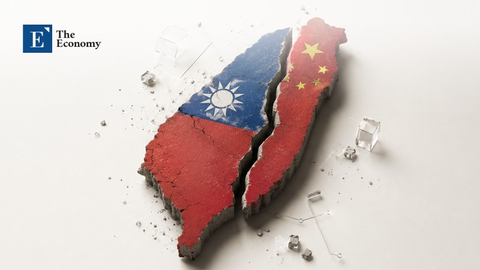
“Ready to Invade Taiwan?” China Overhauls National Defense Mobilization Law After 16 Years, Clarifying Military and Local Authority to Accelerate Wartime Transition

Anne-Marie Nicholson is a fearless reporter covering international markets and global economic shifts. With a background in international relations, she provides a nuanced perspective on trade policies, foreign investments, and macroeconomic developments. Quick-witted and always on the move, she delivers hard-hitting stories that connect the dots in an ever-changing global economy.
Authored On
Modified
Comprehensive Overhaul of China’s National Mobilization System in Preparation for a Protracted Taiwan Conflict
Stronger Operational Endurance Through Expanded Civilian Shipping, Amphibious Equipment and Unmanned Systems
Rising Prospect of Military Action in the 2030s as Key Capabilities Approach Completion

China has revised its National Defense Mobilization Law for the first time in 16 years, establishing a legal framework to place civilian personnel, industry, data and infrastructure immediately at the state’s disposal in wartime. Beijing is rebuilding the rear-area mobilization system needed to support amphibious operations and a protracted conflict in a Taiwan contingency, while accelerating the expansion of civilian shipping, new amphibious equipment, unmanned systems and long-range strike capabilities. Although 2027, the target year for the modernization of China’s armed forces, has long been cited as a potential date for a war over Taiwan, military experts believe the risk could become greater in the 2030s, when deficiencies in transportation, logistics and joint operations are expected to have been substantially addressed. Taiwan and Japan are also raising their level of preparedness through expanded exercises, civilian evacuation plans and missile deployments, increasing the costs that China’s leadership would have to bear before deciding to take military action.
Codifying the Conversion of Peacetime Resources for Wartime Use, Comprehensive Overhaul of China’s Mobilization System
According to China’s state-run Global Times on September 15, the National Defense Mobilization Law, revised last month for the first time in 16 years, is scheduled to take effect on October 1. For the first time, the revised law defines national defense mobilization as the rapid transition between peacetime and wartime and the conversion of economic and social capacity into defense capabilities when national sovereignty, unity, territorial integrity, security or development interests are threatened. It also codifies the authority of the State Council and Central Military Commission to take immediately necessary measures when the country’s sovereignty, unity, territorial integrity, security or development interests face a direct threat. The measure is interpreted as an attempt to limit arbitrary enforcement during a crisis and bring control over national resources under established legal procedures.
The central change is the explicit expansion of mobilization to encompass data and advanced industries. The revised law calls for the establishment of a data-support system for national defense mobilization and the development of mobilization capacity in advanced technologies and emerging domains. Enterprises responsible for the research, production and maintenance of military materiel will be required to stockpile equipment, materials, technologies, data and software, organize specialized technical personnel and conduct regular training. The delivery of strategic materials, security assessments of defense-industry supply chains and the continuous updating of reserve-force information have also been incorporated into the formal system. Organizations operating transportation, postal, telecommunications, cybersecurity, medical, food, energy, civilian nuclear, media and urban infrastructure services will be required to establish and train specialized support units in peacetime. Chinese authorities said the measures are intended to provide an accurate inventory of personnel and industrial capacity available for wartime deployment and enable ministries, local governments and the military to activate their responses simultaneously as soon as a crisis erupts.
China began reforming its national defense mobilization system in 2019 and has established national defense mobilization offices across provinces, cities and counties since 2022. Analysts say the latest legal revision primarily incorporates into law the organizational restructuring and redistribution of responsibilities between the military and local governments undertaken over several years following military reforms. The revised legislation also states that “national defense mobilization shall uphold the leadership of the Communist Party of China, be guided by Xi Jinping Thought on Strengthening the Military, and implement the holistic approach to national security and the military strategy for the new era.”
Integrated Military-Civilian Transport Network for a Taiwan Contingency
Military experts say the revision is not directed at a conflict in any specific region, but will in practice provide the institutional foundation for mobilizing civilian resources should hostilities erupt in the Taiwan Strait. The reason the overhaul is associated with a Taiwan contingency lies in the Chinese military’s capacity to sustain operations. If the United States and Japan intervene in a Taiwan Strait conflict, the fighting is unlikely to end quickly, and civilian support—from transporting amphibious forces and equipment to supplying communications, medical services, food and energy—will determine China’s ability to wage war. The revised law therefore expressly designates transportation, postal, telecommunications, cybersecurity, energy, medical and media organizations for national defense duties, while enabling authorities to control finance, information networks, the movement of materials and transportation assets. China has already used civilian vessels in exercises around Taiwan and in gray-zone coercion. With legal and administrative systems now being reinforced as well, the foundations for integrated military-civilian operations have become more robust.
The Chinese government is also rapidly strengthening the capacity to transport troops and equipment, long regarded as the greatest weakness in a potential amphibious assault on Taiwan. In its China Military Power Report published last year, the U.S. Department of Defense noted that the People’s Liberation Army had yet to secure sufficient conventional maritime and airlift capacity for a large-scale amphibious operation. China’s military is in fact deploying civilian roll-on/roll-off vessels in exercises to compensate for transport shortfalls while simultaneously accelerating the expansion of its military amphibious forces. This is also why Taiwan’s Ministry of National Defense identified upgrades to the Z-20 multirole helicopter, unmanned transport helicopters, the Type 076 amphibious assault ship and specialized amphibious barges capable of self-propelled navigation and deploying floating bridges as major programs in its report this year. The operational concept calls for aircraft and helicopters to insert advance forces and bypass coastal defenses at the outset of an operation, followed by amphibious barges and civilian transport vessels carrying subsequent troop contingents and supplies. The specialized barges would be tasked with unloading troops and equipment directly onto the coast even if Taiwan’s ports had been destroyed.
Preparation for a Protracted Conflict in the Taiwan Strait
China’s operational concept has also shifted toward integrating blockades, precision strikes, cyberwarfare and unmanned systems. Taiwan’s Ministry of National Defense recently noted that Chinese military exercises around the island have concentrated on “joint blockade and control” operations involving military aircraft, naval vessels and coast guard ships to sever external maritime routes, with the objective of neutralizing Taiwan’s command-and-control networks and air-defense capabilities during the opening phase of a conflict. In particular, the Chinese military is understood to have closely studied the utility of low-cost drone swarms in the war in Ukraine, as well as the rapid depletion of munitions, the strain on air-defense networks, industrial mobilization capacity and vulnerabilities in alliance cohesion exposed by the Iran war. The U.S. Department of Defense has likewise assessed that China is expanding experimentation and training with related capabilities as it develops an “intelligentized warfare” doctrine combining artificial intelligence (AI), big data and advanced computing with reconnaissance, target identification, command decision-making and cyberwarfare.
The Chinese military is simultaneously strengthening its long-range strike and nuclear deterrent capabilities to raise the cost of U.S. intervention. A recent People’s Liberation Army documentary aired by the state-run China Central Television (CCTV) showed an H-6N strategic bomber, nicknamed the “Thunder God,” flying with a Jinglei-1 (JL-1) air-launched ballistic missile. The U.S. Department of Defense classifies the H-6N as a nuclear-capable bomber and said China deployed the aircraft for the first time in a joint patrol with Russia’s Tu-95 strategic bombers in 2024. Hypersonic missiles, long-range anti-ship strike capabilities and airborne nuclear forces differ in nature from assets that would directly support an amphibious assault on Taiwan, but are considered strategically valuable for delaying third-country intervention by threatening Guam, U.S. bases in Japan and carrier strike groups.
Table 1. Potential Timeline for a Chinese Invasion of Taiwan and Outlook for Force Modernization
| Category | Key Details | Assessment |
|---|---|---|
| 2027 | Centenary of the founding of the People’s Liberation Army and the benchmark year set by President Xi Jinping for military modernization | Potential acquisition of the core capabilities required to attack Taiwan and deter U.S. forces in the region |
| Current Force Posture | Insufficient capacity to transport large numbers of troops and heavy equipment across the Taiwan Strait and sustain supply lines over an extended period | Limited ability to conduct a stable amphibious campaign while also contending with intervention by the United States and Japan |
| 2030–2035 | Expected completion of major force-development programs, including upgrades to the Z-20 helicopter, unmanned transport helicopters, the Type 076 amphibious assault ship and specialized amphibious barges | Enhanced operational capacity linking coastal entry with the deployment of follow-on troops and heavy equipment and long-term resupply |
| Support-System Upgrades | Expansion of low-Earth-orbit communications satellite networks, the fourth-generation BeiDou satellite navigation system, space, cyber and electronic-warfare capabilities, and field medical evacuation capacity | Stronger capacity to deploy amphibious forces inland and sustain prolonged operations even when communications and navigation networks are disrupted |
China’s 2027 Military Modernization Target, Experts Focus on the 2030s
The potential timing of a Chinese invasion of Taiwan has long been discussed in connection with the progress of these force-modernization efforts. U.S. security authorities have so far focused on 2027. The year marks the centenary of the founding of the People’s Liberation Army and serves as the benchmark set by President Xi Jinping for military modernization. Security authorities in the United States and other Western countries have characterized this objective as a stage at which China would secure the ability to achieve a “strategically decisive victory” in a war over Taiwan, impose “strategic counterbalance” against the United States in strategic domains including nuclear forces, and exercise “strategic deterrence and control” over neighboring countries. Western governments have focused on the possibility that the Chinese military could acquire around that time the core capabilities needed to attack Taiwan and constrain U.S. forces in the region.
The prevailing assessment, however, is that China’s current force posture remains insufficient to conduct a large-scale amphibious campaign reliably. It would have to transport large numbers of troops and heavy equipment across the Taiwan Strait, sustain supply lines over an extended period and contend with intervention by the United States and Japan. Yasuhiro Sugiura, head of the Asia and Africa Division at Japan’s National Institute for Defense Studies, predicted that the likelihood of a Chinese invasion of Taiwan could increase substantially in the 2030s, when the Chinese military is expected to close its current capability gaps. He assessed that China’s military is studying the Russia-Ukraine war and U.S. military operations in Venezuela and Iran to identify and address deficiencies in its force structure. “At the current pace, many of the elements the People’s Liberation Army now lacks will have been filled by the 2030s,” he said.
Taiwanese military experts have also assessed that major force-development programs—including upgrades to the Z-20 helicopter, unmanned transport helicopters, the Type 076 amphibious assault ship and specialized amphibious barges—could be completed in stages between 2030 and 2035. By then, the conditions for linking the coastal insertion of advance forces with the deployment of follow-on troops and heavy equipment and long-term resupply in a single operation are expected to improve substantially. According to Taiwan’s Central News Agency (CNA), the Chinese military is also developing a low-Earth-orbit communications satellite network and a fourth-generation BeiDou satellite navigation system in preparation for disruptions to communications and navigation networks following an amphibious landing. Analysts say that strengthening space, cyber and electronic-warfare support systems together with field medical evacuation capacity would significantly improve China’s ability to deploy amphibious forces inland and sustain them over a prolonged period.
Taiwan Strengthens Defensive Posture as China Prepares for Total War
The revision of the National Defense Mobilization Law is therefore interpreted as an effort to close the remaining gaps in the Chinese military’s rear-area support system. Incorporating civilian vessels, communications networks, and energy and medical facilities into a wartime operating framework during peacetime could substantially offset the limitations of the military’s own transportation and logistics capabilities. The benchmarks for assessing China’s readiness have consequently broadened beyond the number of amphibious ships and combat aircraft to include the speed at which civilian transport networks can be converted for wartime use, the capacity for long-term resupply and the ability to block reinforcements from the United States and Japan. Military experts broadly agree that if any one of these pillars falters, China would struggle to hold occupied territory and sustain operations following an amphibious landing.
As China consolidates a warfighting system encompassing both the military and civilian sectors, Taiwan and Japan are also accelerating efforts to strengthen their defensive posture. Taiwan’s armed forces conducted an “Immediate Combat Readiness Exercise” in June to test wartime transition, command and control, and logistics operations. During the Han Kuang exercises in August, the navy and coast guard conducted their first joint large-scale blockade exercise, escorting merchant vessels and clearing naval mines. The Japanese government has also prepared a plan to evacuate 120,000 residents and tourists from the Sakishima Islands within six days and intends to deploy a surface-to-air missile unit on Yonaguni Island, close to Taiwan. These responses by neighboring countries are expected to increase the casualties and logistical burden China’s military would face, potentially influencing Beijing’s decision on whether to initiate hostilities.
Anne-Marie Nicholson is a fearless reporter covering international markets and global economic shifts. With a background in international relations, she provides a nuanced perspective on trade policies, foreign investments, and macroeconomic developments. Quick-witted and always on the move, she delivers hard-hitting stories that connect the dots in an ever-changing global economy.
Similar Post