SoftBank Default Risk Hits Four-Year High, Raising Alarm Over Debt-Funded AI Investment

Anne-Marie Nicholson is a fearless reporter covering international markets and global economic shifts. With a background in international relations, she provides a nuanced perspective on trade policies, foreign investments, and macroeconomic developments. Quick-witted and always on the move, she delivers hard-hitting stories that connect the dots in an ever-changing global economy.
Authored On
Modified
SoftBank’s financing costs surge as it funds OpenAI investment
Higher yields demanded in bond markets leave little room for further equity investment
Industry’s financial burden grows as debt increasingly underpins AI investment
Pressure is mounting on the funding sources that have sustained the race to invest in artificial intelligence (AI). Japan’s SoftBank Group, a major OpenAI shareholder, has increased its borrowing to meet its investment commitments, and its financing costs have already surged. In the bond market, the cost of protection against a SoftBank default has soared, while corporate bond investors are demanding higher yields. OpenAI also lowered its valuation to raise funds to use before going public, but failed to secure the full amount sought. For an AI industry that has relied on borrowing to keep investing in infrastructure, delays in follow-on funding could force a slowdown in service expansion.
SoftBank’s Quarterly Financing Costs Rise to 2.6 Times Year-Earlier Level
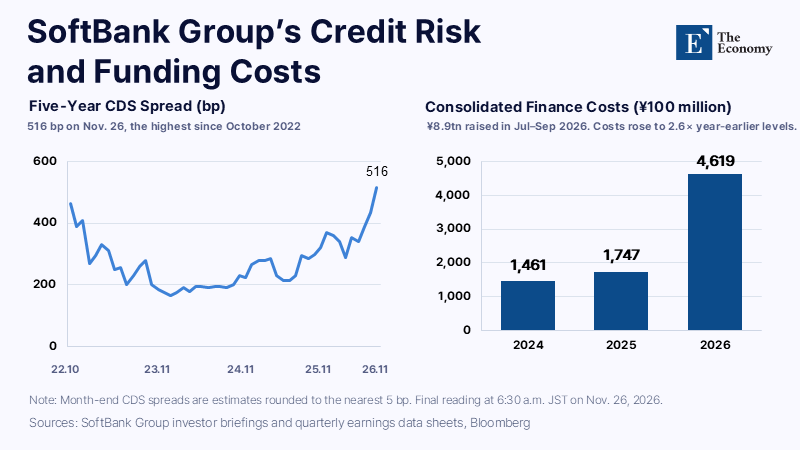
According to Bloomberg on the 26th (all dates hereafter are local time), the premium on SoftBank Group’s five-year credit default swaps (CDS) rose to 516 basis points (5.16 percentage points) as of 6:30 a.m. Tokyo time that day. It was the first time since October 2022 that the cost investors pay to protect against the risk of SoftBank failing to repay its debt had exceeded 500 basis points. In the corporate bond market, investors buying SoftBank bonds have also demanded higher spreads. The USD-denominated bonds SoftBank issued in September carried an annual coupon of 9.75%, the highest ever for the company’s USD-denominated debt. The spread between these bonds, which already carried a high interest rate at issuance, and U.S. Treasuries widened by about 40% in two months to 644 basis points.
Higher market yields have increased SoftBank’s burden when raising fresh funds. In the three months from July through September this year alone, SoftBank raised JPY 9 trillion. It raised USD 6.9 billion in Japan and USD 11.1 billion overseas through corporate bond issuance. Beyond corporate bonds, its borrowing secured against shares in British chip designer Arm also increased by USD 5 billion. During July–September, when it issued corporate bonds and increased secured borrowing, SoftBank recorded financing costs of JPY 461.9 billion in its quarterly results, 2.6 times the level a year earlier.
Alongside the scale of its borrowing, the value of SoftBank’s holdings, including Arm, is a factor in its credit rating. S&P Global Ratings recently estimated SoftBank’s loan-to-value (LTV) ratio at more than 30%. S&P’s threshold for considering a downgrade is 35%. For example, if the value of its assets falls by 10% when its LTV ratio is 30%, the ratio rises to 33.3% even if borrowing remains unchanged. Arm’s share price also played a role when S&P raised its outlook on SoftBank’s credit rating from “negative” to “stable” in July. At the time, S&P said a sharp rise in Arm’s share price since the end of March had increased the value of SoftBank’s listed equity holdings and brought its LTV ratio below expectations.
JPY 332.5 Billion in Interest Over Seven Years on a Single JPY 1 Trillion Bond Issue
Even after its credit rating outlook improved in July, however, SoftBank faced higher interest rates on new borrowing in Japan. A prime example is the JPY 1 trillion in seven-year corporate bonds issued to Japanese retail investors in September. SoftBank initially indicated an annual interest rate of 4.3–4.9%, then set the annual coupon at 4.75% on September 4. That was 2.45 percentage points above the average annual coupon of 2.3% on JPY-denominated corporate bonds sold by Japanese companies to retail investors that year up to that point. SoftBank will pay JPY 47.5 billion in annual interest on this bond issue alone. If the entire issue remains outstanding until maturity, interest payments over seven years will total JPY 332.5 billion. It must also repay the JPY 1 trillion principal in a lump sum in September 2033.
Higher interest rates create a substantial burden when issuing new corporate bonds to repay maturing debt. On September 17, the day it issued the new bonds, SoftBank repaid JPY 400 billion in JPY-denominated bonds sold to Japanese retail investors seven years earlier. The old bonds carried an annual coupon of 1.38%, with annual interest payments of JPY 5.52 billion. Applying the new bonds’ annual rate of 4.75% to the same JPY 400 billion principal would raise annual interest to JPY 19 billion. That amounts to an additional JPY 13.48 billion a year to borrow the same amount through JPY-denominated bonds with the same maturity. Other low-interest bonds also matured that month. Six days earlier, on September 11, SoftBank repaid JPY 97.9 billion in JPY-denominated bonds issued in 2019 at an annual rate of 1.38%.
Table 1. SoftBank’s Funding for Its OpenAI Investment and OpenAI’s Pre-IPO Fundraising
| Category | Item | Key Details |
|---|---|---|
| SoftBank | Additional Investment Commitment | Committed in February to invest an additional USD 30 billion, payable in installments |
| Investment Funding | Borrowed USD 10 billion in August against OpenAI shares held by the Vision Fund Issued foreign-currency bonds overseas in September to fund the final installment | |
| Payment Completed | Paid USD 10 billion in October from the proceeds of foreign-currency bond issuance Cumulative investment of USD 64.6 billion, including earlier investments | |
| OpenAI | Existing Investment Commitments | Secured USD 122 billion in investment commitments in March |
| Additional Funding Needs | Operating and capital expenditures are projected to exceed operating cash inflows by USD 278 billion over 2026–2030 | |
| Pre-IPO Fundraising | CEO Altman ruled out an IPO that year in September, citing AI safety concerns Sounded out existing shareholders, including SoftBank and MGX, about additional investment | |
| Revised Fundraising Terms | Sought a valuation of USD 1.4 trillion, up from USD 852 billion in March Lowered valuation to USD 1.25 trillion in late October and cut fundraising target from USD 30 billion to USD 20 billion | |
| Initial Fundraising Results | Secured USD 11 billion by November 6, leaving a USD 9 billion shortfall against the revised target |
OpenAI Seeks More Funding Despite USD 122 Billion in Investment Commitments
SoftBank’s increased borrowing to meet its promised investment in OpenAI has been a major driver of its growing funding burden. The additional USD 30 billion SoftBank agreed to invest in OpenAI in February was to be paid in several installments. In August, while making those installment payments, SoftBank borrowed USD 10 billion against OpenAI shares held by its Vision Fund. In September, it issued foreign-currency bonds overseas to fund the final installment. The following month, it sent USD 10 billion of the bond proceeds to OpenAI, completing the investment pledged in February. Including earlier investments, SoftBank has invested a total of USD 64.6 billion in OpenAI.
Although SoftBank paid its entire pledged investment by October, OpenAI continued raising funds afterward. It had secured USD 122 billion in investment commitments in March, but expected spending on the computing infrastructure needed to train next-generation models and operate ChatGPT to outpace revenue growth. In investment materials obtained by the Financial Times (FT), OpenAI projected that its spending on business operations and capital investment over the five years from this year through 2030 would exceed cash generated from operations by USD 278 billion. Yet it had no immediate plans to raise funds through a public share offering. In September, CEO Sam Altman ruled out an initial public offering (IPO) before year-end, citing AI safety concerns. OpenAI therefore approached existing shareholders, including SoftBank and United Arab Emirates (UAE) investment firm MGX, to gauge their interest in additional investment before its listing.
OpenAI’s pitch to investors rested on its revenue growth since July. It planned to secure a valuation of USD 1.4 trillion, up from USD 852 billion in March, and raise USD 30 billion on that basis. But as technology stocks fell in October and concerns grew over AI companies’ capital spending burdens, some investors reduced their planned commitments. OpenAI also lowered its proposed valuation to USD 1.25 trillion at the end of that month and cut its fundraising target to USD 20 billion. After those adjustments, it had initially secured USD 11 billion by the 6th of this month. That was slightly more than one-third of its original target, and it still needed another USD 9 billion to meet even the reduced goal.
Anthropic Shares Fall Below IPO Price, Complicating OpenAI Investment Talks
For OpenAI, which still needs to raise USD 9 billion, rival Anthropic’s stock market performance is another concern. Shares in Anthropic, which operates the AI service Claude, rose as high as USD 115 intraday on their first trading day last week, but fell 6.5% on the 24th, dropping below the IPO price of USD 83. The following day, they slid as low as USD 73.85 intraday before closing at USD 82.19. With even investors who had been waiting for a listing now able to buy a competitor’s shares below its IPO price, OpenAI must first convince them of the rationale for valuing its unlisted shares at USD 1.25 trillion.
If delays in additional investment prevent OpenAI from expanding its servers as planned, ChatGPT users could also feel the effects. Because ChatGPT generates an answer on its servers each time a user submits a question, it needs more computing infrastructure as more people connect simultaneously. Anthropic already set a precedent in March by lowering usage limits for both free and paid Claude subscribers during peak hours. It kept total weekly allowances unchanged but made the usage allotted in five-hour blocks run out sooner between 5 a.m. and 11 a.m. U.S. Pacific time. Experts say that if OpenAI’s server expansion also fails to keep pace with demand, one option would be to reduce the number of questions each user can submit during peak hours.
Follow-On Funding Burden Threatens AI Service Expansion
Ultimately, OpenAI urgently needs investors capable of making large commitments, like SoftBank, if it is to maintain its current service scale while accepting new users. But Middle Eastern sovereign wealth funds, which have poured large sums into overseas technology companies, now face the pressing task of offsetting losses to their own economies from the Iran war. In March, an official in the Gulf region told Reuters that some countries had begun reviewing their sovereign wealth fund investment strategies in response to the war’s economic impact. In these circumstances, other investors OpenAI could turn to are semiconductor and cloud companies whose revenues grow as more data centers are built. Indeed, in February, Nvidia agreed to invest USD 30 billion in OpenAI, matching Chairman Son’s commitment, while Amazon agreed to invest USD 50 billion.
If similar deals materialize again, Samsung Electronics, SK Hynix and Taiwan’s TSMC are also mentioned as potential candidates OpenAI could approach for funding. Last October, Samsung Electronics and SK Hynix signed letters of intent to supply memory chips for Stargate, OpenAI’s data center construction project, while TSMC is cited as the contract manufacturer for AI chips designed jointly by OpenAI and Broadcom. All three companies depend on continued server orders from OpenAI to generate revenue from memory supplies or chip production. For suppliers, however, the profits from selling chips are separate from the risks of buying a stake in a customer. If OpenAI asks these companies to invest, negotiations are expected to focus not only on the share price but also on the volume of semiconductor purchases OpenAI would guarantee and the duration of the contracts.
Anne-Marie Nicholson is a fearless reporter covering international markets and global economic shifts. With a background in international relations, she provides a nuanced perspective on trade policies, foreign investments, and macroeconomic developments. Quick-witted and always on the move, she delivers hard-hitting stories that connect the dots in an ever-changing global economy.
Similar Post